With the presidential inauguration scheduled for Friday of this week, there has been much speculation about what the new first family in the White House will be like.
First known photo of White House 1846Melania Trump
Melania Trump will step into the role of first lady, although she has said that she will not move into the White House until at least the end of her young son’s school term. She will remain living at Trump Tower in New York City.
People have become so accustomed to having a First Lady in the White House that speculation immediately started about who would fill that role until Mrs. Trump moves to Washington. Ivanka Trump is the name that comes to mind as the most likely White House hostess during the times when Melania Trump is not in residence. It wouldn’t be the first time someone other than the president’s wife filled that job—daughters, nieces and daughters-in-law have served in previous administrations.
The role of First Lady has not always been as important as it is now. In the early days of the Republic, serving as hostess as the President’s dinners was not a time-consuming task. It wasn’t until the middle of the 19th century that people even adopted the title First Lady or paid much attention to the woman besides the president. Harriet Lane changed all that.
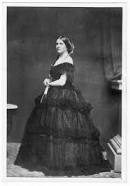
When James Buchanan, our only bachelor president, was inaugurated in 1857, his orphaned niece Harriet Lane became his official hostess. At 26, she was one of the youngest first ladies and her youth and good looks attracted attention. When she altered her Inaugural Ball gown by lowering the neckline two-and-a-half inches, she became a
Harriet Lane
fashion leader. Her clothes and her congeniality made her the Jackie Kennedy of the 19th century and the first really modern First Ladies. Like Mrs. Kennedy, she wanted to make the White House a cultural center. She invited artists and musicians to entertain there and also advocated for the rights of Native Americans on reservations.
During the bitterly divided years preceding the Civil War, entertaining in the White House required a genius for arranging dinners so that sworn enemies would not have to sit together or encounter each other in small groups. Harriet Lane must have had that genius because she kept the White House running smoothly up until the time that her uncle left office. By that time seven states had seceded from the Union and the election of Abraham Lincoln precipitated the Civil War. After leaving the White House, Harriet Lane went on to marry, to have two children who died young, and then to establish a home for invalid children at Johns Hopkins University and to become an art collector and benefactor to the Smithsonian Institution.
From the stately Martha Washington, who was often called “Lady Washington”, to the youthful Harriet Lane who brought glamour to the position, the activist Eleanor Roosevelt who acted as her husband’s eyes and ears around the country, the quiet Bess Truman who disliked White House duties, America has had a wide variety of first ladies. Whether wives, nieces, or daughters they have shaped a role which has become more important over the years. Many people will be watching as a new family will be moving into the White House and shaping the activities of this presidency.
During the past week, newspapers and other news sources have carried stories about two world leaders who share a characteristic rare among the powerful players on the
international scene—they are both women and both are Asian. Women have not had an easy time reaching the heights of power in Asian countries, but they have moved faster
than American women. The stories about President Tsai Ing-wen of Taiwan (above) and President Park Geun-hye of South Korea (below) have made me think about the fact that the United States is lagging behind many other countries in having a power structure that includes both men and women. What is it that makes us so backward?
Thinking about this inspired me to go back to a book I read a few years ago— Jung Chung’s biography Empress Dowager Cixi: The Concubine Who Launched Modern China (Knopf 2013). I wrote a blog post about it at the time, but recent events both here and
around the world makes the book even more relevant today.
Cixi was born in 1835, during a period when China was isolated from most other countries. A few Europeans and Americans had visited China, but there was little trade between China and the West and even less understanding. Chinese leaders considered the Westerners to be barbarians and most Westerners scorned the Chinese as ignorant and backward. Cixi was destined to revolutionize the relations between China and the rest of the world.
Girls and women at that time were not expected to play any role in public life. They existed to provide sons and heirs to their husbands. Cixi went to the royal court as one of many
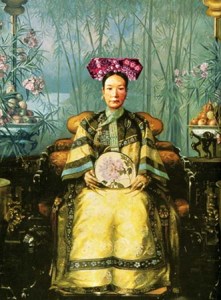
Dowager Empress Cixi
concubines for the emperor, but she had the great good luck to bear a healthy son. This changed her life. The emperor was sickly and because Cixi could read and write, she could help him handle his government duties. Doing this taught her a lot about government and how it worked. When the emperor died young, Cixi’s five-year-old son became emperor.
Cixi was intelligent and politically astute. Her husband had appointed eight regents to govern the country while his son was a child, but Cixi knew she could do the job better. She allied herself with her husband’s childless wife and the two of them became guardians of Cixi’s son, the child emperor, and effectively ruled the country. Because women could not be acknowledged as rulers, Cixi sat behind the royal throne, concealed by a screen, to listen to official reports and make decisions about what should be done.
During the late 1800s, Europe and America because more aware of the valuable resources China had to offer to the world. Europeans and Americans, as well as the Japanese, competed to get access to natural resources and to the China trade. The struggle led to the Opium Wars and to many other battles. Cixi and some of her supporters recognized that in order to keep the country independent they had to accept some Western ways. Education was reformed so that young students learned more than just the classics of Chinese literature; representatives were sent to Europe and America and foreign diplomats were finally welcomed into the Chinese court.
Cixi was by no means a perfect person; she could be cruel and impose harsh punishments and death upon her enemies, but she set the course of China toward modernization. By the time she died in 1908, China was ready to enter the twentieth century and take its place on the world stage. Now, more than a hundred years later, reading about the Dowager Empress Cixi gives us an idea of what a strong and powerful woman she was. Her determination and strength can help us to understand where China is today—a world leader. And reading about how the Dowager Empress was maligned and underestimated by many of the leaders in her own country and internationally may make us ponder whether Americans are also underestimating the women leaders in our country. I strongly recommend reading Jung Chung’s book Empress Dowager Cixi: The Concubine Who Launched Modern China (Knopf 2013).
These Strangers, in a foreign World,
Protection asked of me—
Befriend them, lest Yourself in Heaven
Be found a Refugee—. Emily Dickinson
Two or three years ago the German Chancellor Angela Merkel was one of the most popular European leaders of the 21st century. She appeared unbeatable as her party swept to an overwhelming victory in 2013. Her success seemed an anomaly in the male-dominated German politics of recent years. Journalists wondered how a plain-spoken middle aged woman whose nickname was “Mutti” (Mommy) could wield such power amid the turbulent struggles of the European Union in difficult economic times.
Merkel grew up in East Germany when it was a Communist country. Although a bright student, she was not a natural leader. In university she studied science and became a physicist and did not engage in public life. It wasn’t until the fall of the Soviet Union and the reunification of Germany that she was drawn to political life, and few people would have predicted that she would become a leader. But, improbable or not, this quiet woman made her way past the bombastic male leaders of the party and eventually emerged as the leader.
But then came the refugee crisis. When thousands of Syrian refugees tried to make their way to safety in Europe, Merkel announced that Germany would accept them. She called on other European countries to do the same. Some were welcomed, and many Germans appeared at first to be willing to make sacrifices to find housing and food for refugees. Then the inevitable bitter violence broke out. Demonstrators were soon calling for an end to refugees and a retreat to a “Germany for the Germans” mentality. Merkel’s CDU party suffered severe electoral losses. Undoubtedly the influx of refugees caused some voters to turn to severe anti-immigrant policies.
But the verdict is still out on what Angela Merkel will do—whether she will stand for Chancellor again or not. She seems to be sticking to her guns and insisting that the decision to accept refugees is the only morally defensible policy. Many idealists and religious people would agree with her. The refugees are still fleeing unbearable conditions in many countries. Despite a backlash; despite the fears; it was a proud day for Angela Merkel when she decided that Germany would be a moral leader in that path. Let’s hope that by working with other countries, and international organizations, she will be able to make it work. The quiet woman from Germany has been a strong leader—a strong “Mutti” insisting that the world should honor its deepest ideals. Good luck to her!
Much of my attention this week has been focused on the Olympics in Rio. They are quite a relief from the two political conventions we just watched because in the Olympics, people keep moving instead of talking and we can see for ourselves who is winning. There is no need for lengthy commentary about who said what and who scored points against an opponent. There is something very satisfying about a clear cut win like Katie Ledecky’s brilliant 800-meter swim that smashed the world record and won her another gold medal.
Women weren’t always so prominent in the Olympic Games. In the ancient games, of course, only men were allowed to compete and when the games were reinstated in 1896, the organizers thought it would be foolish to allow women to compete. Four years later, however, a few women managed to participate in the 1900 games in Paris—22 women out of a field of 997 athletes.
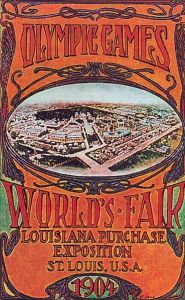
The first time the Olympic Games were held in the United States—in St. Louis in 1904—the only sport open for women was archery. Those games were among the most informal and disorganized of games because very few athletes were willing to make the long trek to St. Louis to participate. Almost everyone who took part was an American and a true amateur; many signed up at the last minute without training or knowledge about how to compete.
As the twentieth century went on, more and more women took up athletics and lobbied for a chance to compete in the Games. Some of the obstacles for women athletes were bizarre. In 1912 when the Games were held in Stockholm, women were allowed to participate in swimming, but America did not send any of its female swimmers. The reason? American organizers would not
UK Women swimmers 1912 olympics
allow women to compete in any sport in which they could not wear long skirts. Although, as you can see from this picture, the swimsuits of 1912 were very modest by today’s standards. The UK women’s team won the medals that year.
What women athletes wear has always been an issue at the Olympics. This year, for the first time, all of the countries that have Olympic Committees have sent both men and women to the Games. For the first time, women from Saudi Arabia have been allowed to participate. This means that some of the Muslim women have competed while wearing outfits that look quite different from many of their European and American counterparts.
It is a pleasure to see the freedom women have finally found, being able to wear gear that makes them comfortable while competing on even terms with all participants. Three cheers for freedom of choice!
Now that both the Republican and the Democratic Conventions are over, we can all relax and go back to wondering what we should watch this evening. But we are not going back to the same political world that existed a month ago. The Democratic party’s nomination of
Hillary Clinton 2016
Hillary Clinton for President was an historic moment that will change the dynamics of conventions for years to come. But of course the conduct of conventions has changed dramatically over the years.
Two of the most watched speeches of the conventions were those given by Michele Obama, our popular First Lady, and by Melania Trump, who aspires to be a first lady. Our Founding Fathers would be aghast if they knew that candidates wives were actually appearing in public and speaking on behalf of their parties and their husbands.
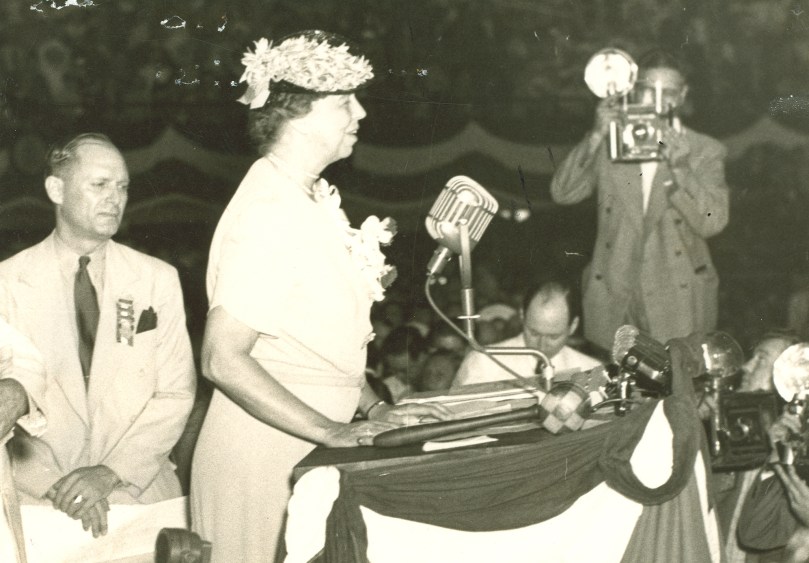
Like so many other revolutions in American politics, Eleanor Roosevelt was a pioneer in opening the way for wives to speak at nominating conventions. She surprised everyone by appearing on the podium at the 1940 Democratic Convention in Chicago to urge delegates to nominate her husband, Franklin. As the New York Times reported:
“Eight years after her husband shattered the tradition of the non-appearance of Presidential candidates before the conventions which nominated them, Mrs. Franklin D. Roosevelt, in the same hall and on the same platform, established another tonight, the first wife of a President or nominee ever to address a major political party conclave.”
Eleanor Roosevelt at the 1940 Democratic Convention in Chicago
The Times went on to report that the First Lady spoke with unusual gravity, both at the press conference when she arrived in Chicago on a chartered plane, and in the convention hall. Franklin Roosevelt had announced earlier that he did not want to run again, and Eleanor Roosevelt said she was not surprised at this because “I cannot imagine in the present state of the world, why anyone would want to carry such a burden…” Her reaction when told that her own name had been placed in nomination for the Vice Presidency was to laugh and say. “I could imagine nothing more foolish or less wanted.” Her speech, when it came, was forceful and the delegates went on to nominate Franklin Roosevelt by acclamation for an historic third term as President.
Eleanor Roosevelt, like both Michele Obama and Melania Trump this year, could not escape press comments on her clothes. “Her traveling suit was a tailored ensemble of navy cloth coat with long lapels of Eleanor blue, with a soft crepe dress beneath in the same shade. Her hat was a small one of navy straw in a modified beret type…” At least the newspaper did not report on her hair style or the height of the heels of her shoes.
We’ve come a long way since 1940 in the matter of spouses at conventions. This year Bill Clinton spoke as the spouse of a candidate—a first for a man at a convention. I do not
Bill Clinton 2016
recall any report on his clothes or any comments about who designed his suit. Perhaps the next milestone we should aim for is equal treatment for spouses of all genders at conventions to come. Now that the glass ceiling has been shattered, surely we can break the tradition of judging women by their clothes and men by their words. Let’s see what the 2020 conventions will bring.
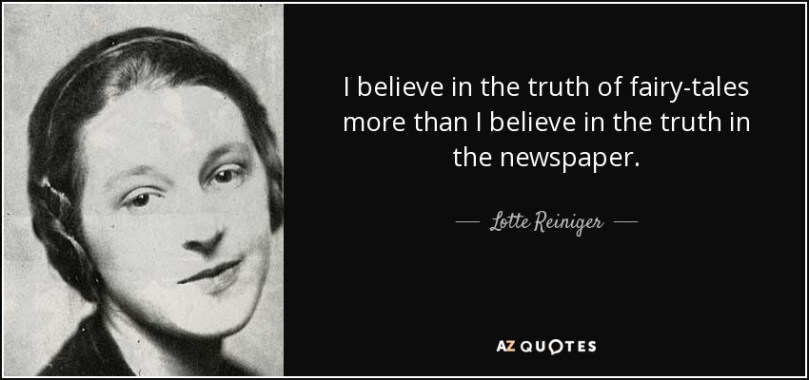
When I clicked on the Google search site a few days ago, I was surprised to find that Google was honoring the 117th birthday of Lotte Reiniger. Who was she? One of the early animation artists who made films out of fairy tales. Her pioneering work in the 1920s was an important part of the movement that led to the torrent of animated fairy tale films from the Disney studios and others.
Now that we are drowning in highly colored, loud, fast-paced versions of fairy tales on screens everywhere, it’s worthwhile to look back and think about how children encounter fairy tales. For most American children—at least the ones who are lucky enough to have a parent or caregiver who reads to them—their first experience of a fairy tale is an unamplified voice telling the tale while showing still pictures in a book. Often the story is read over and over again.
Fairy tales are usually told in a bare, straightforward style. “There was once a poor widow who lived in a lonely cottage. In front of the cottage was a garden wherein stood two rose trees, one of which bore white and the other red roses.” That’s the beginning of Snow White and Rose Red and the story continues in the same bare, clean style.
Lotte Reiniger’s adaptations of fairy tales started with a silhouette animated Cinderella in 1922. You can see the short film on YouTube https://www.youtube.com/watch?v=Kku75vGDD_0 and watch how Reiniger brings the viewer into the story—showing how
Scene from Reinigers “Cinderella”
the black paper is cut into figures who act out the story. The process is almost like that of a child who wants to draw pictures to illustrate the story she has just heard.
Of course Lotte Reiniger was not a child; she was a skillful artist who conceived the idea of telling a story through the traditional art of the silhouette. But unlike the silhouettes that were popular during the 18th and 19th century as portraits or as illustrations in books, Lotte Reiniger wanted to make her silhouettes move and so she invented a new form of animation.
Lotte Reiniger was born in Berlin in 1899. As a child she was attracted to art and to the movies, the new art form that was developing in Europe during the early years of the 20th century. As a young woman she worked in the movie industry and specialized in making silhouette title cards for the silent movies of the era. Then she moved on to making her own movies.
After marrying Carl Koch, a fellow artists who became her collaborator, she produced several more films in Germany. The couple left Germany when the Nazi party was rising to power, but were unable to get permanent visas to live in any other country, so for several years they lived in France, Italy and other European countries. But always they continued to work on their films. After the war, they moved to England where Lotte Reiniger made a number of silhouette films based on Grimm’s fairy tales and shown on the BBC.
Lotte Reiniger had a long and fruitful career. Her work influenced early animation films and deserves to be recognized as an important precursor to the work of later animation studios. But more than that, her films are still beautiful works of art that can be appreciated by children and adults today. Quite a few of them are available on YouTube.
Wouldn’t it be nice if today’s children could see some different ways in which fairy tales can be changed from words into pictures? Cinderella need not be the blonde glamour girl shown in American pop culture. The story doesn’t need to be puffed out with extra characters or elaborate songs. The magic is in the simple story itself. Fortunately, there are many talented artists who have given us different versions of the images our imaginations paint when we listen to the story. Thanks to Google for reminding us of the work and vision of Lotte Reiniger.
On April 26, 2016, in Dublin, Sabina Higgins, wife of Michel Higgins, the President of Ireland, laid a wreath at the grave of Countess Constance Markievicz, who is buried at Glasnevin Cemetery along with many other veterans of the 1916 Easter rebellion. This tribute was one of the first steps in the national celebration Ireland is holding to commemorate the Easter uprising that happened 100 years ago.
Markievicz is not an Irish name and you may find it hard to understand how a woman born into a wealthy Protestant family, raised in luxury, and married to a Polish Count is now lying in a grave close to the burial sites of many of the revolutionaries who fought for Ireland’s freedom from Britain. Constance Markievicz’s transformation from a famous beauty to a hard-fighting, hard-working social activist is one of the romantic stories that has become part of the legend of Irish history.
Like many of the other fighters in the Irish rebellion, Constance first became involved with the cause of Irish independence through the arts. She joined Sinn Fein and became enthusiastically anti-British, refusing to stand up in public places when the National Anthem was played, for example. And she embarrassed some of her family members by declining to drink the king’s toast at the end of formal dinners. To further Irish culture she supported the famous Abbey Theater and worked with Maud Gonne to see that the works of Irish playwrights were presented there. Her husband Casimir Markievicz was a portrait painter and interested in writing for the theater, but after a few years of working together, the couple gradually grew apart. In 1914, after fourteen years of marriage, Casimir returned to Poland and never again lived in Ireland although he and Constance continued to be friends.
When World War I broke out, some nationalists in Ireland saw the Germans as natural allies to help the fight for Irish freedom. Constance was among many others who tried to buy arms and supplies from Germany to help the Irish cause. Unlike many of the other women working for Irish freedom, Constance knew how to shoot and was comfortable using a gun. She started a national scout organization to teach teenaged boys and girls how to shoot. When the Easter uprising started, she was ready to join the military and served as second in command to Michael Mallin, a captain of the Irish Citizen Army.
The Easter rising was a brief war, but the consequences for Ireland and for the men and women who fought in the rebellion were dramatic. When, after a week of fighting, the rebels surrendered, the British decided that all of the leaders should be made examples to demonstrate the fate awaiting rebels. Almost all of the men were summarily executed, but Constance Markievicz’s sentence was changed to life imprisonment on the grounds that she was a woman.
Constance was sent to prison, first in Ireland and later in England. There she scrubbed floors and sewed prisoners’ nightclothes. One of her few solaces was embroidery. She used to draw colored threads from the rags she used for cleaning and kept white pieces of material from the nightclothes to embroider on. Oddly enough, this echoed the activity of Mary Queen of Scots centuries before who passed her time in prison by embroidering elaborate scenes. Perhaps both of these women understood the idea of art therapy many years before psychologists recognized its value.
When Constance Markievicz was released from prison in 1917, she continued her work for Ireland. The Easter uprising marked the beginning of Ireland’s successful journey to independence and Constance was an honored leader. She was the first woman ever elected to the British House of Commons, although in a protest against accepting the British parliamentary rule, she did not take her seat. Later, when Ireland had its own Parliament, she became the second female government minister in Europe.
Although she died at the early age of 59, she continued her active life until the end. By the time she died she had given away all of her early wealth and died, as wished, among the poor of Dublin, in a public ward of the hospital. Her life story is well told in Anne Marreco’s biography The Rebel Countess: The Life and Times of Constance Markievicz. It is a life well worth remembering.
When I was ten years old, I decided I wanted to grow up and be the first woman president of the United States. My teachers encouraged girls with all the stories about how women, having finally achieved the vote, and having served in so
Hillary Clinton
many capacities in World War II, were destined to be leaders just as men were. And we had great role models in Rosalind Russell and Katherine Hepburn who portrayed strong, capable women in the movies. Somehow my life didn’t turn out that way and neither did the life of any other woman of my generation. Now, more than half a century later, we are still waiting to see the first female president.
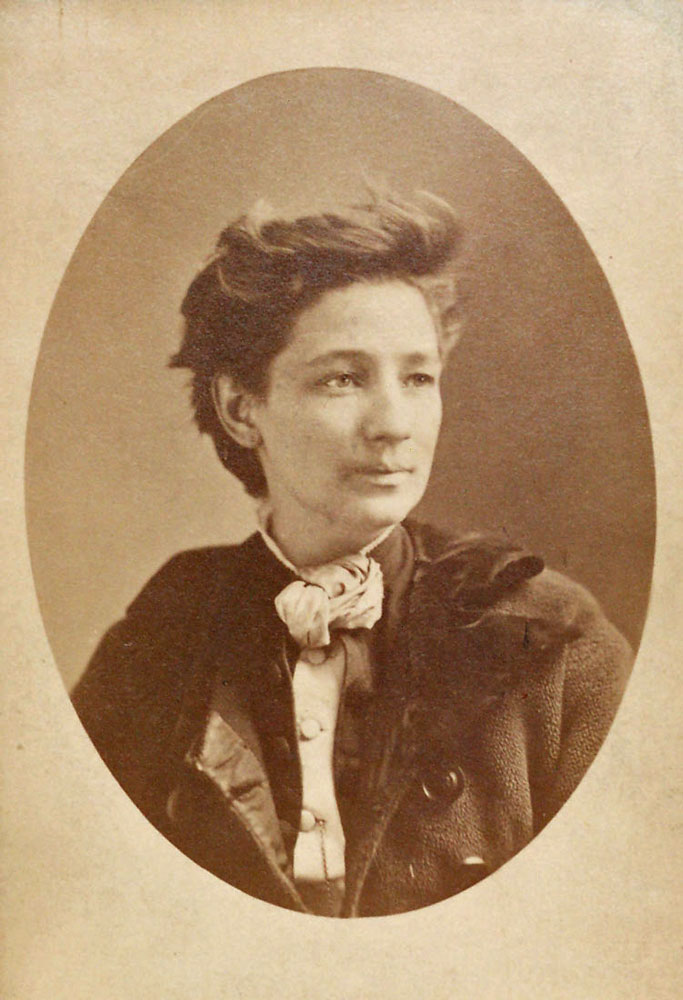
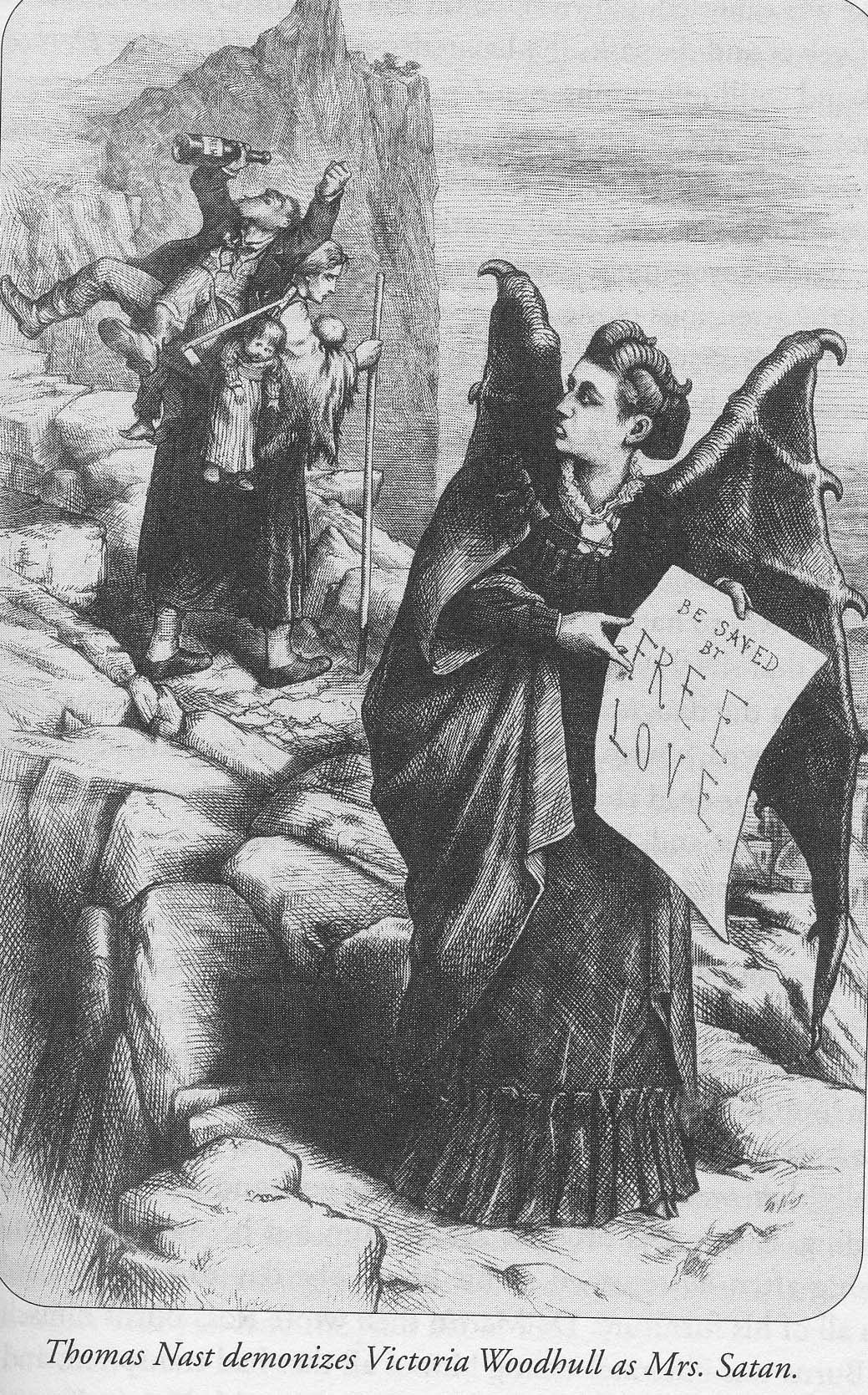
I remembered those optimistic feelings when I read Gail Collins’s thought-provoking column in today’s New York Times about “Hillary in History”. Collins goes through the list of women who have come close to the presidency or attempted to reach it, starting with Victoria Woodhull in 1872. who I have written about in this blog. There have been other contenders over the years, including Shirley Chisholm and
Victoria Woodhull
Margaret Chase Smith, but none was ever taken as seriously as Hillary Clinton. Millions of women will be cheered by her victory if she wins—cheered perhaps even if they don’t agree with all of her positions and policies. It’s wonderful to think that at last a woman is being taken very seriously as a potential threat to the old-boy network that has run the country, and the world, for so long.
An yet, nothing is perfect. When President Obama was elected in 2008, the media and many of us ordinary citizens engaged in an orgy of celebration. With an African American in the White House, we must surely have seen the end of racism in the country. It hasn’t quite worked out that way, has it? We still have to struggle with the everyday racism that affects so many Americans despite the great achievements of individuals members of minority groups.
No doubt it will be the same with women. If Hillary takes over the White House, we can expect she will have the successes and failures that all presidents have encountered. There will not be a sudden rise of women to executive positions in the top corporations; Silicon Valley firms will still hire more men than women; and media commentators will still believe it’s appropriate to critique a woman’s fashion choices instead of her policy statements when she gives a speech.
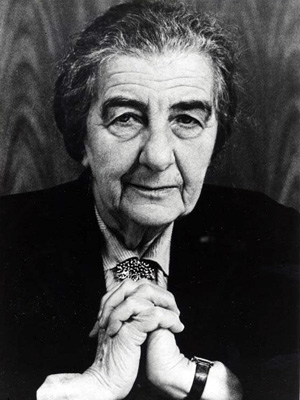
Golda Meir
Golda Meir was one of the most powerful leaders of Israel and Margaret Thatcher one of the notable British leaders of recent years, but as we look at the pictures of powerful leaders in Israel and England today, the women are notably absent (except for Scotland, of course, which carries on its independent ways). The election of Hillary Clinton will not change the entire fabric of women’s position in society, but if it happens, it will be an important step toward the eventual goal of having every individual given a fair and equal place in the world.
Next Monday, September 7, will be celebrated as Labor Day in the United States (Labour Day in Canada) and thousands of people will hold picnics or parades and watch fireworks to celebrate the day. This day marks the end of summer and more people will worry about beating the traffic on their way to an event than about the state of labor in the country. That’s too bad because there has been a lot of news recently that affects labor—the minimum wage has been raised in several California cities and in Seattle to $15 per hour; on the downside are the revelations recently published in the New York Times about how difficult it is to work at Amazon.com. Several commentators have used this article as the basis for condemning the tech industry in general for expecting longer hours and worse treatment than employees should accept. It seems clear that the situation for working people is a confused and contentious one. That’s nothing new.
The Labor Day holiday began during the 1880s, sponsored by labor unions as a way of forwarding their campaign to established the eight-hour day. There is still argument about whether it was Matthew Maguire or Peter McGuire who first proposed a day to honor labor. Both men were active union men and they were probably thinking of labor as representing primarily working men, but actually women have often been the people who benefitted most from the labor laws sponsored by unions. The eight-hour day was a step forward for women who worked in factories and mills. Over the years the 58-hour week has become the 40-hour week making it possible for women to work and yet have enough time to take care of their families.
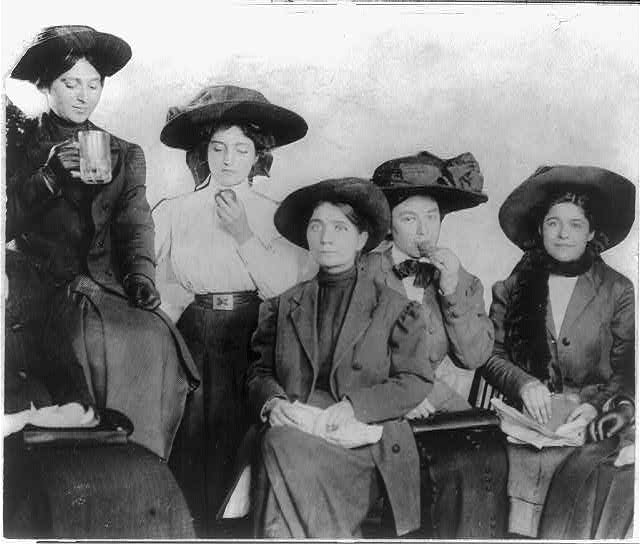
During the early part of the 20th century, unions grew stronger helped by the strikes sponsored by women who worked in the garment trades. The establishment of the ILGWU (International Ladies Garment Workers Union) helped to make
Garment workers in NY on strike
women workers an integral part of the labor movement. Most of the workers in the garment industry in New York at that time were immigrant girls and women who were willing to strike to support their demands. Although the struggle to win recognition of the ILGWU was long and difficult, it convinced many women of the importance of the union movement. Woody Guthrie celebrated the women union supporters in his song “There Once Was a Union Maid”
Oh, you can’t scare me, I’m sticking to the union,
I’m sticking to the union, I’m sticking to the union.
Oh, you can’t scare me, I’m sticking to the union,
I’m sticking to the union ’til the day I die.
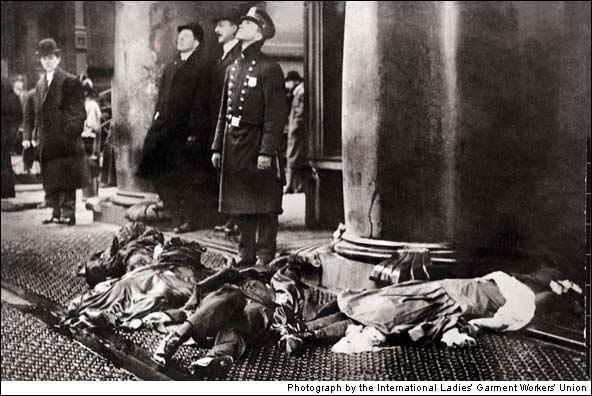
There aren’t many women working in garment factories in New York any more, or even in the United States. Instead, most of the women’s clothing used in America come from countries like China, Pakistan, and Bangladesh, where the union movement has never been powerful. We were reminded of that two years ago
Triangle Factory Fire 1911 (ILGWU photo)
in April of 2013 when the Rana Plaza building in Bangladesh collapsed killing more than 1,000 people, most of them young women workers. Just like the women killed in the terrible Triangle Shirtwaist Company fire in New York a hundred years earlier, these women were struggling to make a living while getting low wages and often being ordered to work in unsafe conditions.
The world stood by in horror as the month-long search for survivors continued. The newly-elected Pope Francis expressed the feelings of many when he pointed out that no one should have been working under the conditions at Rana Plaza. As reported by the Huffington Post, the Pope said:
A headline that really struck me on the day of the tragedy in Bangladesh was ‘Living on 38 euros a month’. That is what the people who died were being paid. This is called slave labour. Today in the world this slavery is being committed against something beautiful that God has given us – the capacity to create, to work, to have dignity. How many brothers and sisters find themselves in this situation! Not paying fairly, not giving a job because you are only looking at balance sheets, only looking at how to make a profit. That goes against God



 overwhelming victory in 2013. Her success seemed an anomaly in the male-dominated German politics of recent years. Journalists wondered how a plain-spoken middle aged woman whose nickname was “Mutti” (Mommy) could wield such power amid the turbulent struggles of the European Union in difficult economic times.
 appeared at first to be willing to make sacrifices to find housing and food for refugees. Then the inevitable bitter violence broke out. Demonstrators were soon calling for an end to refugees and a retreat to a “Germany for the Germans” mentality. Merkel’s CDU party suffered severe electoral losses. Undoubtedly the influx of refugees caused some voters to turn to severe anti-immigrant policies.
 keep moving instead of talking and we can see for ourselves who is winning. There is no need for lengthy commentary about who said what and who scored points against an opponent. There is something very satisfying about a clear cut win like Katie Ledecky’s brilliant 800-meter swim that smashed the world record and won her another gold medal.
 the only sport open for women was archery. Those games were among the most informal and disorganized of games because very few athletes were willing to make the long trek to St. Louis to participate. Almost everyone who took part was an American and a true amateur; many signed up at the last minute without training or knowledge about how to compete.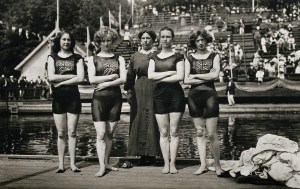



 fairy tales. For most American children—at least the ones who are lucky enough to have a parent or caregiver who reads to them—their first experience of a fairy tale is an unamplified voice telling the tale while showing still pictures in a book. Often the story is read over and over again.
 Glasnevin Cemetery along with many other veterans of the 1916 Easter rebellion. This tribute was one of the first steps in the national celebration Ireland is holding to commemorate the Easter uprising that happened 100 years ago.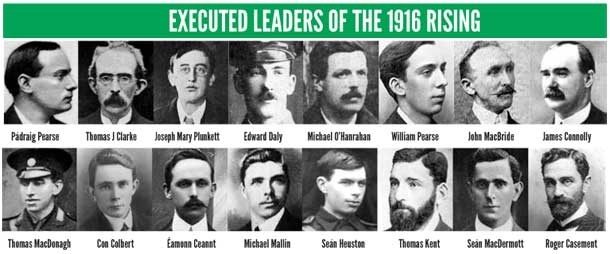



 Teacups and Tyrants-Adele Fasick looks at people, books, and history