Who told us about climate change?

Just a few miles from where I live in San Francisco, the effects of climate change are obvious to everyone. This winter’s record El Nino has brought rain storms that have eroded beach communities along the Pacific. This photo from the San Francisco Chronicle Pacifica_2016shows how some of the homes in the city of Pacifica are teetering on the edge of a cliff over the ocean. Scientists are predicting that climate change will bring stronger and harsher El Nino storms in years to come because of the warming oceans caused in large part by human activity. Anyone who reads newspapers or watches news on TV know that this is true, yet somehow many of the Republican candidates who want to lead the country cannot seem to accept the facts.

Climate change is an undeniable fact, yet we still get candidates saying things like this: “If you look to the satellite data in the last 18 years there has been zero recorded warming. Now the global warming alarmists, that’s a problem for their theories. Their computer models show massive warming the satellite says it ain’t happening. We’ve discovered that NOAA, the federal government agencies are cooking the books,” Ted Cruz is quoted as saying that in 2015. Why do some politicians find it so difficult to accept scientific facts?

It’s not as though the idea of climate change hasn’t been discussed for years. The medieval idea that the world is unchanging and that human beings have no influence on it was challenged more than 200 years ago by Alexander von Humboldt, one of the
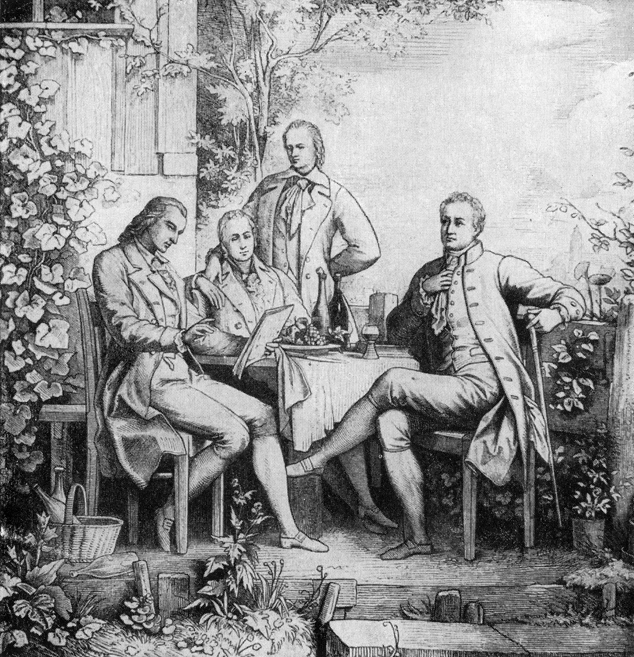
Humboldt and Goethe
Alexander von Humboldt with Goethe and other friends.

greatest scientists the world has ever known, although much of his work has been forgotten.

Born in 1769, Humboldt traveled to South America in 1800 to explore nature and culture in the Spanish colonies there. When he saw the changes that Europeans has brought to the country by cutting down forests and cultivating lands, he developed his theories of how men affect climate. “When forests are destroyed, as they are everywhere in America by the European planters, …the springs are dried up or become less abundant.”  He noted how this allowed the soil to be washed away during heavy rains, causing erosion and a loss of fertile soil

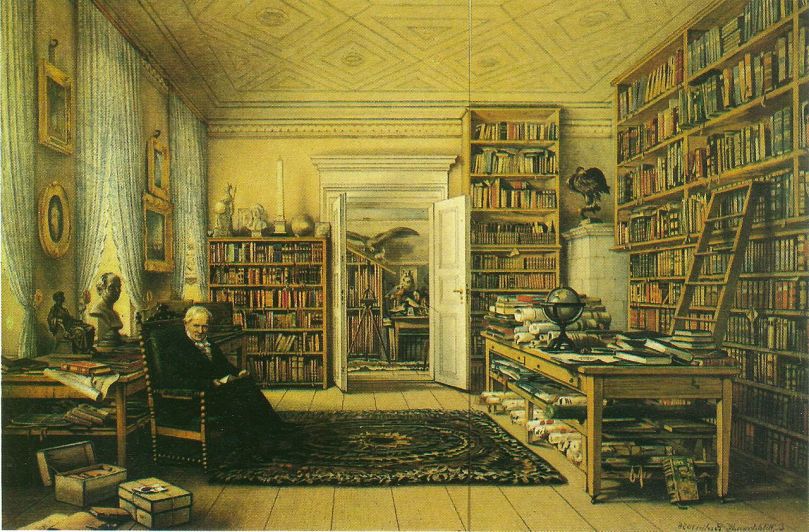
Knowledge is a slow-growing plant, but Humboldt was one of those people who planted ideas that have blossomed during the centuries since he started his explorations. One of the other ideas that he developed in South America was a hatred of slavery, because he saw the cruelty of the European practice of enslaving native peoples. Slowly many of his Humboldt in his libraryideas have been accepted by mainstream thinkers. Slavery has disappeared in much of the modern world.  Let’s hope that more of the climate change deniers will continue to think about the questions and ideas that he raised.
We are lucky this year to have a new biography of Alexander von Humboldt available. Andrea Wulf, has explored Humboldt’s life and ideas in The Invention of Nature: Alexander von Humboldt’s New World. I highly recommend it to anyone interested in seeing how scientific ideas have developed over the years and learning more about the people who have given us our modern view of the world.  
 

What will you have for lunch?

In the New York Times recently, Bettina Elias Siegel reports on the state of school lunches in France as shown in Michael Moore’s new documentary film Where to Invade Next. To many of us who have watched children’s reactions to food over the years, it is surprising to learn that in a village in Normandy, French school children Juliet Corsonare served “scallops, lamb skewers and a cheese course” for lunch. That sounds like a gourmet’s dream, but of course if this meal were served in an American school there would have to be many other options—what about the vegetarian children? or the ones who are allergic to fish? Or cheese? Most American children have learned to be picky and opinionated about food before they even start school. Siegel (and the film) contrast the French school with a typical American high school where the students choose pizza, French fries, and other unhealthy meals for lunch, washed down with sugary soft drinks.

Siegel makes many good points in her article pointing out that Americans are unwilling to support the infrastructure that would allow children to be given healthy, locally-sourced food for their school lunches. Americans have opted out of paying any but the lowest taxes possible to support children’s needs, in the expectation that competition among corporations will somehow provide the best options for school meals. Are we really surprised that this hasn’t worked? Instead of an array of healthy foods, most school districts yield to the economic necessity of presenting children with the cheap, highly-processed foods they have learned to enjoy. Perhaps the time has come when we should teach our children to prepare their own school lunches. They might surprise us.

Over the years, a number of reformers have tried to help Americans learn how to cook healthier, inexpensive food to feed their families. Back in 1883, when America was suffering through one of its worst depressions and many people were unemployed, a woman named Juliet Corson decided she could help people cope with poor wages by teaching them to cook. Born in 1841, Juliet leaned to cope with poverty when her stepmother kicked her out of the house and told her to earn her own living. Juliet became a librarian at the Working Woman’s Library and found out how difficult it was to feed a family on small wages. She started giving cooking lessons to women and then to children in New York City and soon began writing books about cooking and household management.

Her most successful book was called, believe it or not—Fifteen-Cent Dinners for Workingmen’s Families—and she gave away an edition of 50,000 copies; it was even reprinted in a daily newspaper. The menus suggested were wholesome with easily available ingredients. The book suggested meals such as rice and milk for breakfast and corned beef and cabbage for dinner. It included tips for choosing meat and vegetables at the market. Many Juliet_15 cent dinnersreaders were delighted with the worked and thanked Corson profusely, but, as always, not everyone was pleased. Some union leaders objected to its distribution on the grounds that if the bosses thought workers could feed their families so cheaply, there was no need to raise wages. It seems as though you can’t win when you give advice about what people should eat.

Juliet Corson had a successful career as a writer and lecturer and she started the New York Cooking School, one of the first successful cooking schools in the country. Although she charged her middle-class students for their lessons, she always provided free lessons to those who could not afford to pay. She was a pioneer introducing the teaching of cooking into the public schools in America and Canada. Nonetheless, she died in poverty at the age of 57 in 1897, and the teaching of choosing food and cooking has almost disappeared from American schools. Perhaps it is time to revive the idea.


Five things to hope for in 2016

New-year

The year ahead does not look as though it is going to be a wonderful one, but every day we are moving toward spring. The days are getting longer (at least in the Northern Hemisphere) and we may find 2016 will turn out better than we had hoped. Here are five things, big and small, I like to think will happen:

  1. El Nino rains will end the drought in California so that people will be able to irrigate their crops, even the smallest rural community will have water to drink, and our reservoirs will be full again.
  2. Whatever is ailing the honeybees that fertilize our crops will recede and the bees will return to do their vital task for all the almonds and fruits and garden plants.
  3. The campaign for the 2016 election will become more sensible. Candidates will talk to voters as if they are intelligent human beings. And if we all work on it—we may get the largest turnout in years for a presidential election.
  4. The San Francisco Giants will wake up, look around them and realize this is an even-numbered year, so they will go ahead and win the World Series.
  5. Despite our changing climate, the planet Earth will hold up for at least another year so that many of us will be able to welcome in 2017 in twelve months time.

“We’ll always have Paris.”

One of the most famous movie lines of the 20th century was Humphrey Bogart’s farewell to Ingrid Bergman in Casablanca “We’ll always have Paris.”

Paris
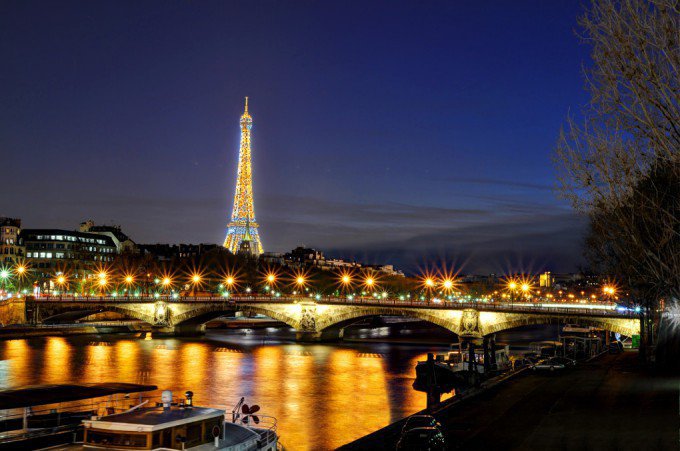
Paris at night

This week millions of people around the world were jolted into thinking about Paris because of the terrorist attacks that were carried out there. Parisians and tourists sitting in a restaurant or listening to a concert were killed or wounded and thousands others terrified by the sights and sounds of that night.

Although the Paris attacks dominated the news in Europe and America, there were other terrorist attacks this month—in Beirut and Mali as well as other countries. So much death and pain spread across so many nations leaves us with very little to feel thankful about as the holiday dedicated to giving thanks draws closer. For many people this will be a drab and fearful Thanksgiving Day.

But it is good to remember that we will always have Paris—the city has endured centuries of troubles and will not surrender to fear and despair. And we will always have Mali—a country that has been a crossroads of

Mali_2003_0002
Timeless, eternal Mali

Africa for many centuries, as well as Beirut, which has been a city since the 15th century BC and is mentioned in in ancient Egyptian scrolls. No uprising of terrorist activity, not outbursts of anger by young men with grievances will keep people from enduring and surviving into the future. So I guess that’s what we have to be thankful for this year—for the endurance of the human spirit. We will always have Paris, and Beirut and Bamako and we will always have people striving to make their way in our harsh but beautiful world.

Perhaps after all a good way to end this would be to consider the familiar Victorian poem by William Ernest Henley, “Invictus”. Although often ridiculed as an overly heroic statement by a minor poet, it may have something to say to us today.

Out of the night that covers me,

Black as the pit from pole to pole,

I thank whatever gods may be

For my unconquerable soul.


In the fell clutch of circumstance

I have not winced nor cried aloud.

Under the bludgeonings of chance

My head is bloody, but unbowed.


Beyond this place of wrath and tears

Looms but the Horror of the shade,

And yet the menace of the years

Finds and shall find me unafraid.


It matters not how strait the gate,

How charged with punishments the scroll,

I am the master of my fate,

I am the captain of my soul.


Who owns art?

Who Owns Art? Blog

One piece of good news in San Francisco this week was the announcement of the reopening of the San Francisco Museum

Atrium of S.F. Museum of Modern Art

of Modern Art scheduled for May 14, 2016. According to an article in the San Francisco Chronicle, the new museum, which has been under renovation for three years, will be the country’s largest museum of modern art.

While art lovers are waiting expectantly to see the new building and new collections, they may ponder whether any of the art displayed will cause a controversy like those that have caused problems for so many museum. For the most part, modern art pieces have not been around long enough to inspire questions about who made them. And in future there may be even fewer fears about forgeries and mis-attributions if a new scientific technique for giving art pieces permanent DNA markers comes into common use. Martin Tenniswood, a lead scientist on the project, spoke on NPR (National Public Radio) about the technique which will be able to put a tag on individual art works that clearly identify it. Just as the DNA of a person cannot be faked, so too this marker should end the fears of collectors and museums that they might purchase a forgery.

Historically, of  course, it is not only forgeries that have caused trouble. There is also the ongoing arguments about whether Western museums have the right to collect and display the art of indigenous people, and whether the urge to protect art in

Elgin Marbles in the British Museum

war-torn countries is justified. One of the first acts that started these arguments was the removal of the Elgin marbles from Greece to England. Next year will mark the 200th anniversary of the sale of the Elgin marbles to the British government. They are one of the major attractions of the British Museum and are seen every year by more than five million people.

If you want to read a fascinating account of the background of how the Elgin marbles were purchased by Lord Elgin, using the money of his extremely wealthy Scottish wife, and shipped to England at least in part because Lady Elgin was able to use her charms to persuade the Sultan of Turkey as well as the British Navy to help her, I strongly recommend the book Mistress of the Elgin Marbles by Susan Nagel. A series of events, helped along by a clash of personalities, led Lord Elgin to appreciate the value of the marbles, but eventually also to the breakup of his marriage. Would Britain ever have owned the marbles if Lady Elgin hadn’t rebelled after bearing five children and declaring that she refused to suffer through another childbirth? Would Lord Elgin have agreed with his wife’s wishes if he hadn’t been driven by the desire to have enough sons to ensure his name was carried on? Today as we look at the marbles, unchanging and austere in their dedicated gallery, we can think about the human passions that led to their being available for our viewing. But the arguments about whether or not they should be returned to Greece continue to rumble on.

Perhaps we will never settle the question of who has the right to own and display art. Is it better to have art preserved, even

Destruction of ancient Art

far from the place of its origin, or to let it remain unmoved no matter how challenging the circumstances of its homeland? Does art belong to all people in the world who take care to preserve and maintain it, or should it remain with the group who created it no matter whether it is destroyed or not? That is a very difficult question to answer. Who has the right to judge?

Shady Ladies through the Years

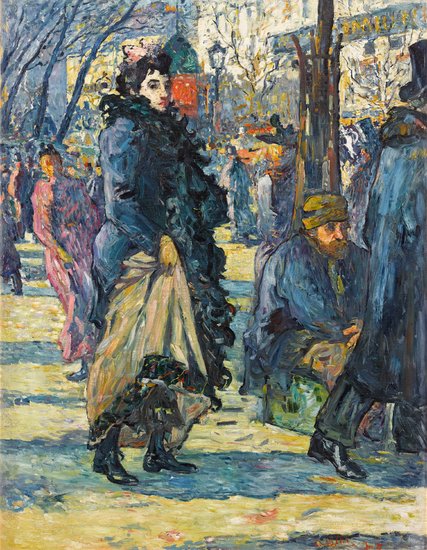
In Paris this autumn, one of the major art exhibits is “Splendor and Misery: Images of Prostitution 1850-1910,” at the Musee d’Orsay. At this exhibit people lucky enough to get to Paris can see how artists viewed some of the women who worked in the sex trade during the 19th century. There is no lack of pictures because almost all of the great artists of the period

“Sur le Boulevard” Louis Valtat

painted prostitutes. A New York Times article quotes Richard Thomson, a curator of the exhibition:

 “Why was prostitution such a big theme for artists? There was the sexual aspect, of course. But there was another reason. The city was slippery. Everything was speeding up, becoming more commercial, more ambiguous, more of a spectacle.

The same questions were coming up in American cities during the 1800s. Although many Americans thought of their new country as pure and free of the moral decay of Europe, prostitution has been a part of the country since its beginnings. During the gold rush days in California, fancy ladies were just as prominent as the hopeful miners.  Witness this popular 19th century San Francisco song:

The miners came in forty-nine,

The whores in fifty-one;

And when they got together

They produced the native son

Even though prostitution has been around throughout recorded history, societies still have a difficult time coming to grips with it. Why do women become prostitutes? Is it because they are poor and can’t find any other job? Or because they are
too lazy to take an honest job? Or are they victims of cruel abusers or criminals who force them into prostitution? No one knows all the answers, but one fact is clear—neither America nor any other country has ever completely eliminated prostitution. During the 1840s, when society was changing quickly and thousands of young people moved from farms to cities, many women found prostitution their only way to forge a life for themselves.

That’s why when I started writing my second Charlotte Edgerton mystery, I decided to focus on life in “Sin Death Visits a Bawdy House (Small) (1)City”, otherwise known as New York. When Charlotte moves there to take up a teaching job in a school for the children of freed slaves, she discovers that life in the city is filled with excitement and dangers she had never faced in rural Massachusetts. And as she gets to know some of the young women who live in the brothels that line the streets near Broadway, she gains a new respect for their struggles and their strengths. She and her fiancé, Daniel,  pursue the evildoer who stalks these ladies of the night and come to understand some of the complexities of crime and survival in a fast-changing society.

Fashion that lives through the years

Necklace by Elsa Schiaparelli

Many years ago I heard Nigel Nicolson , the well-known publisher, writer, and friend of many members of the Bloomsbury group, give a talk about his books and some of the famous people he had known. When it came to Virginia Woolf and her sister Vanessa Bell, Nicolson said, (this is not an exact quote) “They always dressed the same way, in long graceful dresses, and every twenty years or so fashion came around to put them in style”. I was struck by how much confidence they must have had to ignore the whims of fashion and dress to suit themselves. This summer, however, I’ve seen two art exhibits that have convinced me their feat would be quite possible.

When I was in London at the beginning of July, I went to the Tate Modern to see and exhibit of the art of Sonia Delaunay.

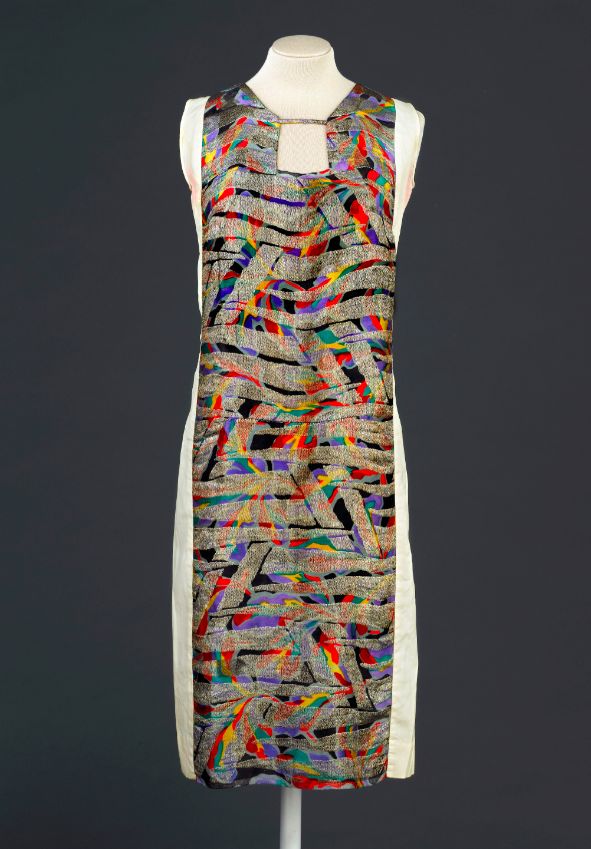
Dress by Sonia Delaunay

Although I had admired many of her paintings, I had never seen a large exhibition of her work and had no idea that she designed fabrics, dresses, and even magazine covers as well as being a painter. As I looked at some of the clothes she designed, I thought how attractive they would look at a party or public event these days—even perhaps on the red carpet at the Oscars. A woman wearing a dress like the one at the right, would stand out, but would look very fashionable.

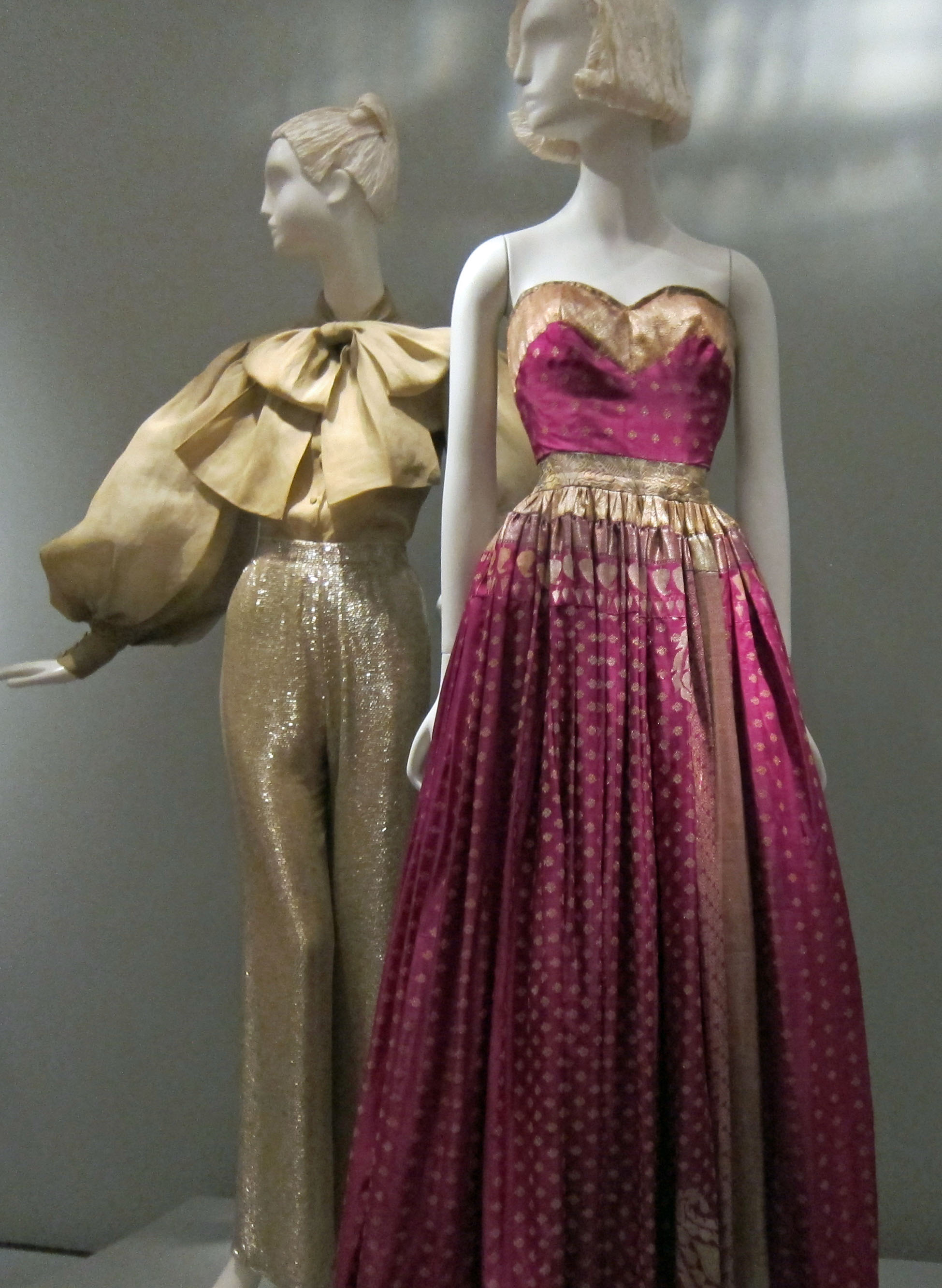
Now that I am back in San Francisco, I went to an exhibit of “High Fashion” at the Palace of the Legion of Honor to see the work of some twentieth century designers from the collection at the Brooklyn Museum. The exhibit was crowded when I was there, and it is easy to see why. The dresses on display—most of them designed for lavish parties and social events—are amazing. We saw dresses by Christian Dior, Jeanne Lanvin, Elsa Schiaparelli, Mainbocher and many others. It was striking how many of the fashions are almost timeless. They still look as beautiful and wearable today as they did during the last century. (The shoes worn by the mannequins, however, do not look wearable at all.)

Dresses by Mainbocher

I’ve never been particularly interested in fashion and have spent most of my life wearing the informal clothes that are the usual choice of academics and librarians, but after seeing these two exhibits, I can understand better why there are so many fashionistas in the world. High fashion offers some delightful examples of how clothing can also be high art and add pleasure to the world. I still have some reservations about the excesses, however. Elsa Schiaparelli’s insect necklace (above) probably goes a step too far for most of us to accept as wearable.

The Price We Pay for Art

Today I went to the DeYoung Museum here in San Francisco to see an exhibit of paintings by J.M.W. Turner. It seemed a good way to take my mind off the painful thoughts about the terrorism in South Carolina this week. Some subjects are too painful to think about for very long, so I needed a break and joined the people eager to see the new exhibit of paintings.

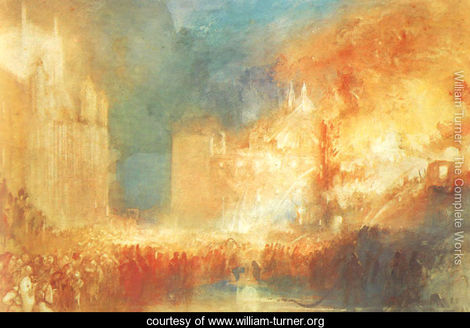
Turner’s colorful paintings fill the galleries with light and the visitors crowded around each painting seemed absorbed in soaking up the color and vibrant emotion of the works. Turner was a British landscape painter, probably the best painter

Burning of the Houses of Parliament

England ever produced. Born in 1775, he began exhibiting his paintings early and continuing to develop and expand his talents throughout his life. His landscapes changed from being fairly straightforward presentations of natural scenes in the tradition of 18th century painters, to being explosions of color with vague outlines of buildings, people, and ships.

I walked through the galleries, stopping at each painting to admire the hazy forms and explosive colors. But as I looked at each painting, the scenes from a movie I saw a few months ago kept coming back to me—the critically acclaimed film Mr. Turner shows the artist working on some of these same paintings. As portrayed by actor Timothy Spall, Turner was a man dedicated to art but cruelly negligent about people. Despite his success as a painter, he refused to support his common law wife or his two daughters, and he sexually abused his housekeeper and treated her with contempt. He appeared to believe that his artistic talents justified his callous disregard for other people. Perhaps they did, but as I looked at his paintings, I wished that I had never seen the movie and learned the sordid details of his life. It’s too bad that that a movie once seen cannot be un-seen so that the images continue to influence any future view of the subject.

What is the value of an artist’s life compared with the value of the people (usually women and children) who suffer because of his vanity? (Of course, the genders may be reversed, but historically most artists have been men and most victims of artists have been women.) Do we really believe that all people are created equal, when people of genius are often treated

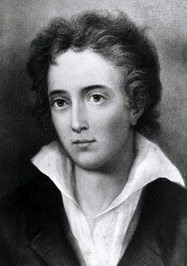
Percy Bysshe Shelley

as though they are exempt from the normal moral norms of other people?

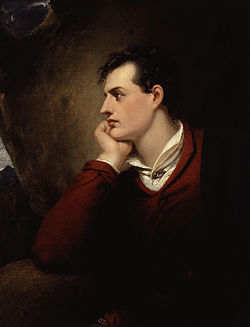
What is the value of art compared with human suffering? Do artists like Richard Wagner with his vicious anti-Semitism deserve to be honored and supported? Both Shelley and Byron, two of England’s greatest poets mistreated the women

Lord Byron
Lord Byron

who loved them and neglected their children. They left a legacy of beautiful poetry, but it does make me wonder whether spending a lifetime creating great art has any effect at all on the artist’s moral sense and human empathy.

What is the value of looking at great paintings, listening to fine music, and reading lovely poetry? They are produced by imperfect human beings, sometimes people we would despise if we knew them personally, but the art itself can be far better than the individual who created it. We have to accept creations made by flawed people, because we need poetry, music, and art to make our lives complete. And as Jean Cocteau once wrote:  The poet is a liar who always speaks the truth. The artists and poets of the world create beauty despite their weaknesses, so I guess we should be grateful for what we learn from them and not ask for perfection in their lives.

Wrath of God or Natural Disaster–Earthquakes Past and Present

Those of us who live in California are always conscious of the threat of earthquakes. It is not that we walk around in fear, but the idea that one could occur is always lurking in the back of our minds. And now comes the massive 7.8 earthquake in Nepal! The pictures of crumpled buildings and of people camping out on the street are a vivid reminder of what can

Rescue during the Lisbon earthquake 1755

happen. All the threats of crime and terrorism pale beside the scope of what natural forces can bring about. But through the centuries people have  had a hard time accepting the ideas that our lives, hopes and dreams can be overturned merely by natural forces that are not directed at us. As I read the news reports I started wondering when people began to acknowledge how little control we humans have over nature and began reading about earthquakes.

The Lisbon quake, more than 250 years ago was a kind of turning point in how Europeans and Americans viewed the causes of natural disasters. When the earth shook and Lisbon, the magnificent capital city of Portugal, started falling in ruins, the attention of the world was captured. The Lisbon quake was probably the first worldwide—or at least European-wide global calamity. Earlier disasters, from the volcano at Pompeii to the Great London fire, had been of interest mostly within the country or region where they occurred. But by 1755, Europeans had become internationalized. They traded with other countries, exchanged ambassadors, and understood that disasters could spread damage from one country to another. What people could not understand, or didn’t want to understand, was that they had no control over these destructive forces.

The first reaction among many people was to blame Lisbon itself for the tragedy. If only people had led virtuous lives, God would not have punished them by sending an earthquake. John Wesley, the English Methodist preacher wrote:

Woe! To the Men on Earth who dwell,

Nor dread th’Almighty Frown,

When God doth all his Wrath reveal,

And showers his Judgments down!

A century or two earlier the religious reaction might have been accepted and prayer and fasting become the only solution to the damage, but by the 18th century, philosophers had begun to ask other questions. Perhaps God wasn’t regulating everything that happened on earth. Perhaps there were forces that could not be controlled by prayer and repentance. Thoughtful men and women became divided on the causes and appropriate responses to unforeseen events. For the first time a number of governments throughout Europe began sending aid and supplies to Lisbon rather than just advice about purifying the city. George II of England encouraged the House of Commons to send 100,000 pounds to “send such speedy and effectual relief, as may be suitable to so affecting and pressing an exigency.” It was the beginning of international disaster aid which has since become such an important part of the world scene.

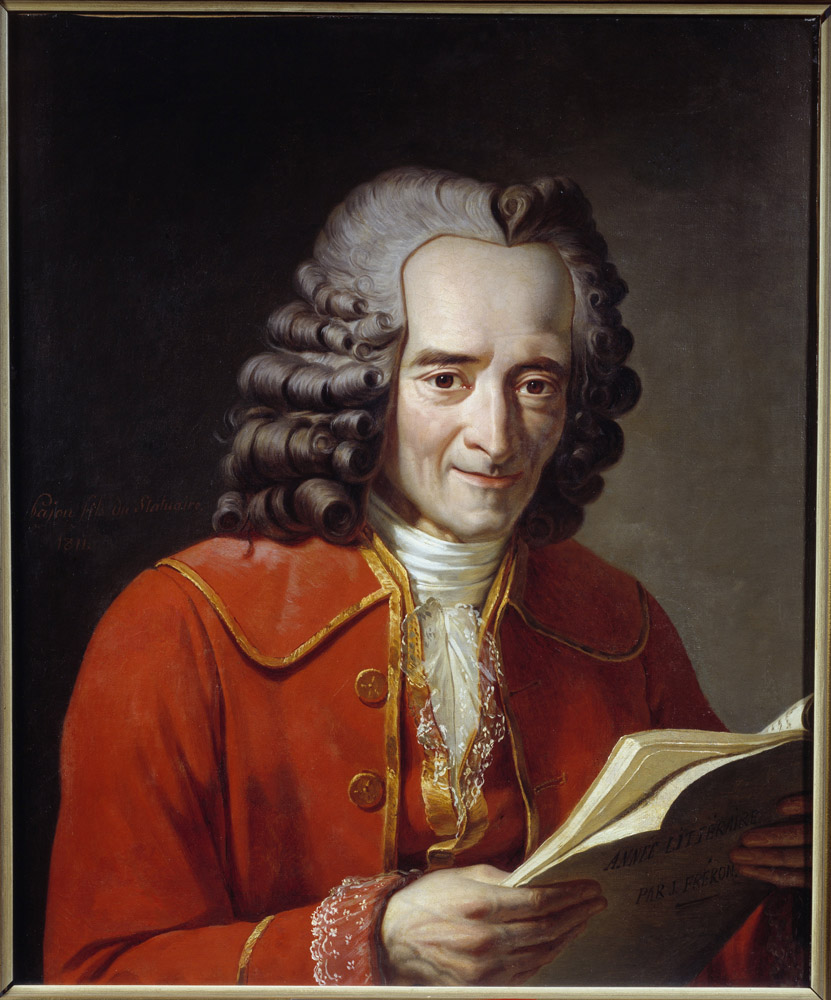
Voltaire
Voltaire

Portugal was lucky to find a leader, the Marquis de Pombal, who brought order to the city and supervised its reconstruction. One of his most surprising innovations was to send out a questionnaire asking people to tell the government exactly what they had seen and experienced during the quake. So, in a way, he was the founder of survey research as well as seismology

Culturally, however, it was perhaps Voltaire who stamped the earthquake most firmly on the consciousness of the world. He turned from the optimism of his early days when he accepted Alexander Pope’s belief that “Whatever is, is right” and became a skeptic. His story Candide has delighted readers from that day to this and in recent years as a drama it has been produced in theaters throughout the world.

There is so much to be said about the Lisbon earthquake and the lessons the world learned from it. One book that recounts the story vividly is Nicolas Shrady’s The Last Day: Wrath, Ruin, and Reason in the Great Lisbon Earthquake of 1755. It is available in many libraries as well as on amazon.com and it will give you a lot to think about.

Candide (cover art by Rockwell Kent)

Now that the earthquake has hit Nepal, we can at least be thankful that international response and help came immediately. Volunteers from many countries have converged on Katmandu and the surrounding area to help victims. The damage to individuals and families can never be undone, but at least the world has learned to care and not to judge.

Women on the Money

The campaign to put a new face on the twenty dollar bill—replacing Andrew Jackson with a woman is growing fast. Gail Collins wrote a column about it in the N.Y. Times  not long ago and she gives us the link to the official campaign site www.womenon20s.org The argument is that dead white men have monopolized U.S. currency ever since the country

Is this the face for the new $20 bill?

began issuing money and it’s time for a change. We see the familiar faces of George Washington, Abraham Lincoln, Ulysses S. Grant, and Andrew Jackson on the bills we use every day. Not a woman in sight!

In this, as in so many other ways, the United States is more conservative than many other countries. Britain, of course, has Elizabeth II on the currency as do many of the countries from the Commonwealth. But they don’t stop with the monarch. Australia has put Nelly Melba, the opera singer, on its currency, Canada honors the first woman judge, Emily Murphy, and of course Argentina has Eva Peron. Denmark has placed the author, Karen Blixen on its currency. Surely it is time that America follows their lead and portrays a woman.

The Women on 20s campaign has a list of candidates to replace Andrew Jackson and they are good ones. There are lots of familiar faces—Eleanor Roosevelt, Susan B. Anthony, Rosa Parks and others. One of my favorites would be Frances Perkins, the first Secretary of Labor under President Franklin Roosevelt. I’ve written about her on this blog before. She was the person most responsible for setting up the Social Security program that has changed the lives of so many older Americans.

Shirley ChisholmAnother favorite of mine is Shirley Chisholm, the first African American woman elected to Congress and in 1972 became the first African American woman to become a candidate for a major party nomination for President. Throughout her Congressional career, Chisholm worked to improve the lives of people living in the inner city and struggling with poverty and poor job prospects. She pushed through a bill guaranteeing a minimum wage for household workers and supported increases in education and health care.

Both Frances Perkins and Shirley Chisholm worked through the political system, just as the men who are now on our currency have done. Perhaps we should change the scope of the search and look at candidates from entirely different fields. If I had a completely free choice, I think I’d pick a poet—someone who was a little less serious about being in the company of the sober, serious men who inhabit the other currency. How about Emily Dickinson with her confession—

Emily Dickinson
Emily Dickinson

I’m nobody! Who are you?
Are you nobody, too?
Then there’s a pair of us -don’t tell!
They’d banish us, you know.

If a poet can be nobody, then surely the twenty-dollar bill can be even less important. That’s something that might make us feel better as we see them flying out of our wallets every day. But of course perhaps all of our currency is flying away. As the Apple Watch comes on the scene, none of us may need currency any more. Emily and Andrew as well as George, Abraham, and Ulysses and the bills they represent may be merely historical footnotes as our technological world moves on.