Thinking about Working Women on Labor Day

Next Monday, September 7,  will be celebrated as Labor Day in the United States (Labour Day in Canada) and thousands of people will hold picnics or parades and watch fireworks to celebrate the day. This day marks the end of summer and more people will worry about beating the traffic on their way to an event than about the state of labor in the country. That’s too bad because Labor Daythere has been a lot of news recently that affects labor—the minimum wage has been raised in several California cities and in Seattle to $15 per hour; on the downside are the revelations recently published in the New York Times about how difficult it is to work at Amazon.com. Several commentators have used this article as the basis for condemning the tech industry in general for expecting longer hours and worse treatment than employees should accept. It seems clear that the situation for working people is a confused and contentious one. That’s nothing new.

The Labor Day holiday began during the 1880s, sponsored by labor unions as a way of forwarding their campaign to established the eight-hour day. There is still argument about whether it was Matthew Maguire or Peter McGuire who first proposed a day to honor labor. Both men were active union men and they were probably thinking of labor as representing primarily working men, but actually women have often been the people who benefitted most from the labor laws sponsored by unions. The eight-hour day was a step forward for women who worked in factories and mills. Over the years the 58-hour week has become the 40-hour week making it possible for women to work and yet have enough time to take care of their families.

During the early part of the 20th century, unions grew stronger helped by the strikes sponsored by women who worked in the garment trades. The establishment of the ILGWU (International Ladies Garment Workers Union) helped to make
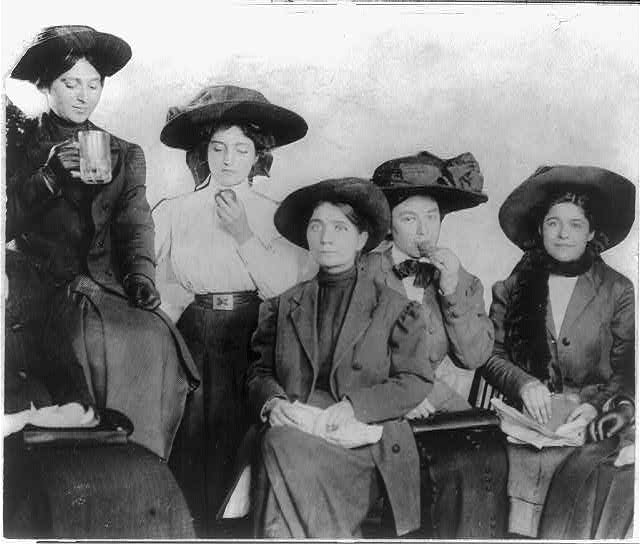
Garment workers in NY on strike

women workers an integral part of the labor movement. Most of the workers in the garment industry in New York at that time were immigrant girls and women who were willing to strike to support their demands. Although the struggle to win recognition of the ILGWU was long and difficult, it convinced many women of the importance of the union movement. Woody Guthrie celebrated the women union supporters in his song “There Once Was a Union Maid”

Oh, you can’t scare me, I’m sticking to the union,
I’m sticking to the union, I’m sticking to the union.
Oh, you can’t scare me, I’m sticking to the union,
I’m sticking to the union ’til the day I die.

There aren’t many women working in garment factories in New York any more, or even in the United States. Instead, most of the women’s clothing used in America come from countries like China, Pakistan, and Bangladesh, where the union movement has never been powerful. We were reminded of that two years ago
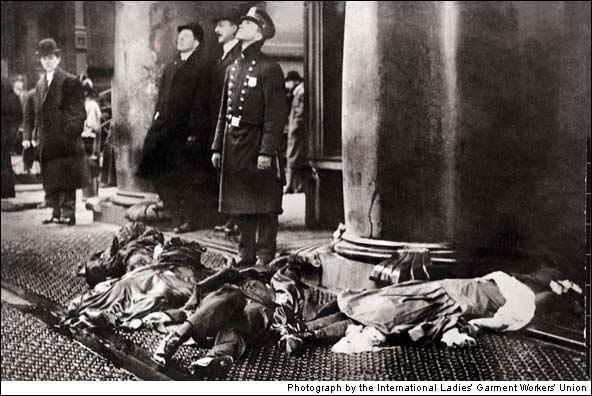
Picture of bodies from the Triangle factory fire.
Triangle Factory Fire 1911 (ILGWU photo)

in April of 2013 when the Rana Plaza building in Bangladesh collapsed killing more than 1,000 people, most of them young women workers. Just like the women killed in the terrible Triangle Shirtwaist Company fire in New York a hundred years earlier, these women were struggling to make a living while getting low wages and often being ordered to work in unsafe conditions.

The world stood by in horror as the month-long search for survivors continued. The newly-elected Pope Francis expressed the feelings of many when he pointed out that no one should have been working under the conditions at Rana Plaza. As reported by the Huffington Post, the Pope said:

A headline that really struck me on the day of the tragedy in Bangladesh was ‘Living on 38 euros a month’. That is what the people who died were being paid. This is called slave labour. Today in the world this slavery is being committed against something beautiful that God has given us – the capacity to create, to work, to have dignity. How many brothers and sisters find themselves in this situation! Not paying fairly, not giving a job because you are only looking at balance sheets, only looking at how to make a profit. That goes against God![
 Now, within the last few days there has been more information about Rana Plaza. A documentary film was made about the disaster focusing on the life of one young woman who survived. Unfortunately, a judge in Bangladesh has ruled that the film cannot be shown for at least six months because it shows the garment industry in Bangladesh in a bad light. The women who work in the garment industry in Bangladesh and other developing countries need the support of the labor movement in America and Europe to ensure that their safety is recognized as being more important than the profits to be gained by corporations exploiting them.

Let’s make this Labor Day one to remember the workers throughout the world who still need the solidary and strength of the labor movement to give them the respect they need to make a decent living for themselves and their families.

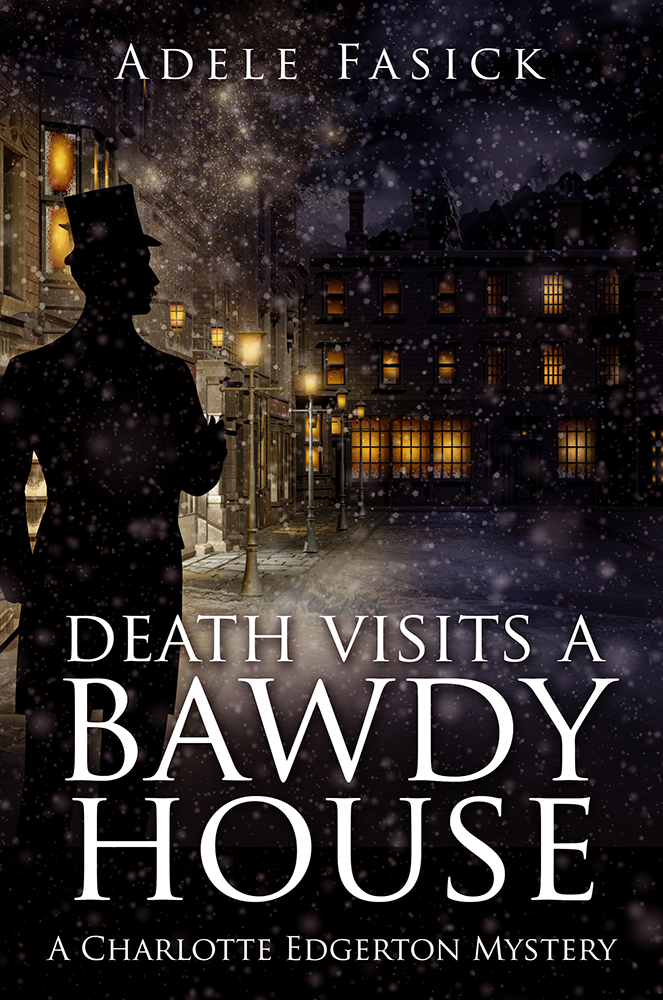
Death Visits a Bawdy House—a new Charlotte Edgerton Mystery

When Charlotte Edgerton moves to New York City from staid Boston in 1843, she finds the crowds on Broadway and the attractions of P.T. Barnum’s new American Museum thrilling. She is young, idealistic, and in love. The future looks bright for Death Visits a Bawdy House (Small)herself and her devoted Daniel. But when first one and then another of the glamorous “sporting girls” who work in the city’s famous brothels is murdered, Charlotte becomes aware of the darkness that lurks behind the bright glow of the city.

In a city where abolitionists are not popular and suspicion of free blacks runs high, the arrest of a black man for the crimes stirs high emotions. Charlotte and Daniel discover even police can be prejudiced, politicians are not always honest, and kindness can lead to danger. When a ruthless murderer tricks her into becoming a prisoner, Charlotte must rely on her wits to save herself and a helpless child.

I am happy to announce that my second Charlotte Edgerton Mystery book has been published and is now available in print and Kindle format at Amazon.com. Death Visits a Bawdy House paints a picture of New York City as it was in the years before the Civil War. Young men and women from the country were flooding into the city looking for jobs and trying to build new lives, but often what they found was poverty and corruption.

While I was researching background for this novel, I learned a great deal about life in New York during the tumultuous 1840s. New York was becoming the commercial center of America, but the commerce depended on a supply of cheap labor. Women especially were expected to work long hours as milliners or dressmakers at wages so low they often could not pay for a room in a respectable boarding house. If they took a job as a servant in one of the wealthy houses, they often had to fend off the advances of their employers or other men in the family. No wonder that many young girls envied the prostitutes who strolled up Broadway flaunting their beautiful clothes. Were those women better or worse off than the married women who struggled to take care of their husbands and children in the over-crowded slums of the city? That’s not always an easy question to answer.

I have been surprised to see in the past week or so that the question of whether prostitutes should be treated as criminals, victims, or independent sex workers has come up again in the news. At its world conference this month, Amnesty International, a global human rights organization, passed a resolution proclaiming that Sex Workers Rights Are Human Rights. After two years of studying the issue, Amnesty International has decided to call on governments to decriminalize consensual sex between adults. That’s a radical position and there has been lively discussion and much opposition to this decision. Nothing about the issue is clear cut. I certainly find it difficult to decide what we should do about sex workers. How can we protect women against sex trafficking, but still allow them to choose to be sex workers if they wish? It is fascinating to me that the question that was a lively discussion back in the 1840s is still being debated now.

But we don’t have to spend all of our time debating great issues. Take some time off and read the story about Charlotte and Daniel and their life in New York City—Death Visits a Bawdy House.

Scandalous Candidates are Nothing New–Have You Heard of Victoria Woodhull?

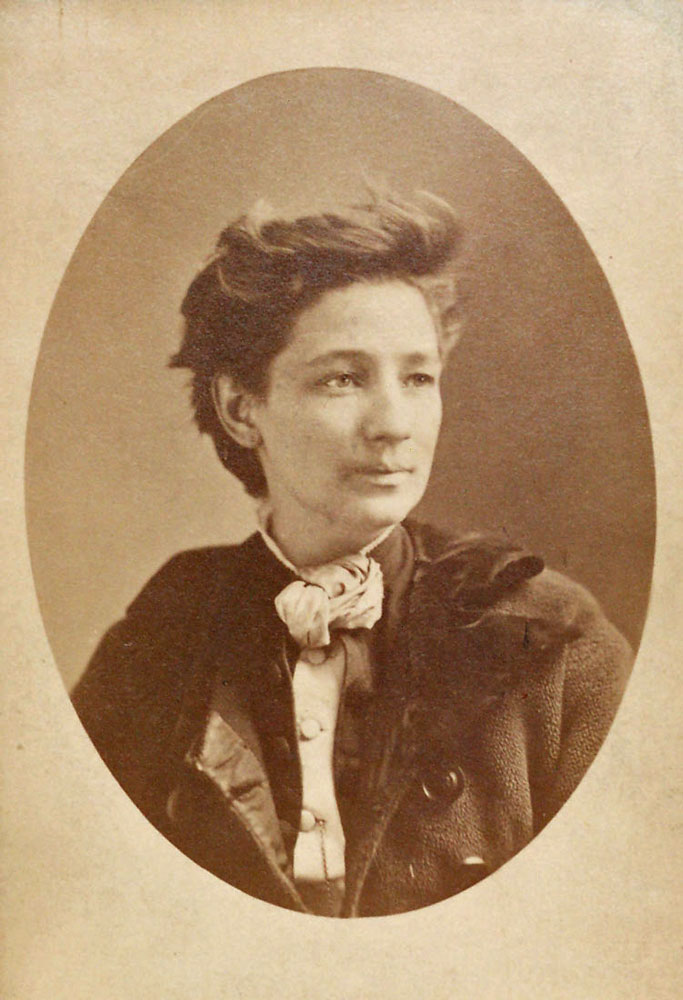
Although it will be more than a year before we face another presidential election, the media is already filled with stories of men and women who have declared themselves candidates. You may think we have quite a few colorful and unusual candidates in this cycle, but have you ever heard about the candidate from the past who spent Election Day in jail and who wasn’t allowed to vote?Victoria Woodhull

The year was 1872, and the candidate was Victoria Woodhull, the first woman who declared she wanted to be president of

Portrait of Victoria Wookhull
Victoria Woodhull

the United States. Her presidential campaign raised questions from the time it started. Whether it was legal or not is still an undecided question. Victoria and other members of her Equal Rights party claimed that women were defined as citizens in the U.S. Constitution and they had the right to vote and run for office. She based her claim on the Fourteenth Amendment’s provision that “All persons born or naturalized in the United States, and subject to the jurisdiction thereof, are citizens of the United States and of the State wherein they reside.” Women are persons and are therefore entitled to vote. The argument persuaded some people, especially women who had never been allowed to vote whether they were citizens or not.

And who was Victoria Woodhull? Born in Ohio in 1838, she had grown up in an unstable and impoverished family. She declared she had been “a child without a childhood” because her father had put his daughters to work as soon as he realized they could tell fortunes and claim healing powers. Victoria escaped from him by running away at 15 to get married, but the husband she chose was as shiftless as her father. He quickly became an alcoholic and a philanderer. Fed up with his neglect and dependence, Victoria divorced him and decided to make life on her own terms with her two children.

Some women in those circumstances might have struggled to maintain respectability by turning to teaching, but respectability was not high on the list of Victoria’s priorities. She had discovered spirituality and believed in her power to foresee events to come. Her sister Tennessee was also a clairvoyant and both sisters were quite willing to use their talents as well as their sexual appeal to earn money. Both were at various times accused of being prostitutes, but they were clever enough to use their sexual availability to their advantage. During the late 19th century when a married woman could lose her husband, children, and livelihood by a single slip into adultery, while married men were free to consort with prostitutes and enjoy their sexual adventures without losing anything. Tennessee and Victoria claimed the same privilege.

Following Victoria Woodhull’s trail offers some tantalizing clues about what 19th century America was like. Who knew that these women in their long skirts and corsets were asking the same questions we are asking today? Certainly I had never known how much Victoria’s spiritualist beliefs influenced the women’s rights movement. She was not the only member of the group who believed that spirits speaking to them from beyond the grave gave them ideas for their campaign. Spiritualism, which had started about 1848, the same year of the first Women’s Rights Convention, attracted many American radicals. Campaigners for both abolition of slavery and for women’s rights tended to gravitate toward the group because it welcomed new ideas and encouraged individualistic thinking. Victoria Woodhull first gained fame, and made a living, by going into trances and predicting what would happen in the future. She believed firmly that spirits spoke directly to her and guided her in her life. Perhaps it was only natural that people who lived unconventional lives were attracted to the idea that they could find truth on their own with the help of spirits rather than through conventional religion with its unbending rules.

Whether or not Victoria found the truth in spiritualism, she certainly found worldly success. At least she, her second husband, Captain Blood, and her sister Tennessee Claflin became rich through their association with Cornelius Vanderbilt. Cornelius-VanderbiltVictoria and her sister met Vanderbilt, whose wife had recently died, when they moved to New York. Victoria and Tennie (as she was called) charmed the elderly Vanderbilt, who had been famous for being attracted to beautiful women. When Victoria began to offer him advice about investments, he decided to set up the two sisters as brokers. Their unconventional business attracted many customers and they made a great deal of money for themselves. Perhaps it was Victoria’s business success that gave her the courage to enter political life.

Victoria Woodhull’s declaration that she would be a candidate for President of the United States was a bold move that electrified voters in 1870.  In May 1872, the name of Victoria’s People’s Party was changed to the Equal Rights Party. The party officially nominated Victoria for president and she chose Frederick Douglass, the well-known ex-slave and public speaker, as her vice-presidential running mate. (He later said that he had never heard anything about it.) Both Elizabeth Cady Stanton and Isabella Beecher Hooker, strong supporters of women’s right to vote, supported Victoria’s candidacy, but neither of them believed she had a chance to be president. Because Victoria’s spirit counselors had told her she was destined for high office, she herself firmly believed she would win. This was the first presidential election in which women’s suffrage was an issue, because it was the first one held after the formation of the National Woman Suffrage Association and the American Woman Suffrage Association in 1869.

While the three different suffrage groups were arguing among themselves, the traditional political parties also struggled over their candidates. Ulysses S. Grant, a Republican, was seeking a second term, but the so-called Liberal Republicans split from the main party and nominated Horace Greeley, founder of the New York Tribune. Greeley also got the Democratic nomination. After the turmoil of nominations the campaign itself was one of the most bitterly-fought campaigns in American history.

Victoria’s unquestioning faith in her spirits led her astray when it came to politics. In the end it wasn’t the search for voting rights that brought her down, it was the familiar question about sexual purity and scandal. Victoria and her sisters had lurid pasts compared to those of the other women leading the suffrage movement, but these respectable women also had many secrets to hide. The intrigues and infidelities of leading male citizens touched the lives of their wives as well as their mistresses. Henry Ward Beecher, a distinguished minister and civic leader, was especially vulnerable. His sister Isabella Beecher Hooker was one of Victoria’s strongest supporters, but when rumors about her brother started circulating, she was torn. Unfortunately, Victoria, because of her friendships with brothel managers and prostitutes, knew many of the most scandalous stories in New York.

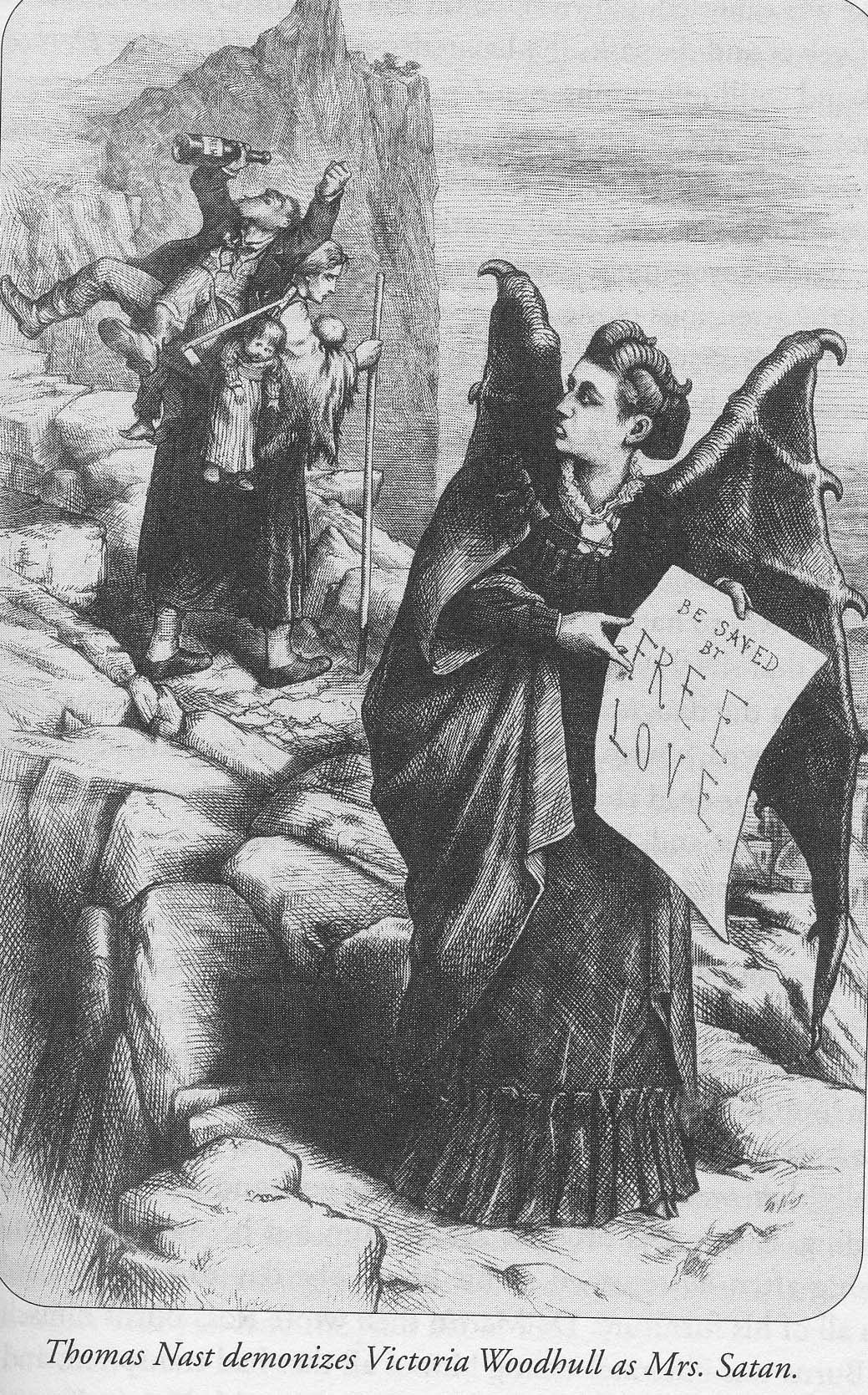
Victoria Woodhull believed in sexual freedom, as many of the suffragettes did, but she practiced it more than many othersCartoon showing Victoria Woodhull as Mrs. Satan. This made her vulnerable to political opponents who spread stories about her and pilloried her in the press. Thomas Nast in his cartoons made her a special target as “Mrs. Satan”. After that cartoon appeared Victoria’s political life was dead. Her speaking engagements were cancelled and her supporters fled to other candidates. Embittered by the desertions, Victoria finally printed an article revealing the affairs of Henry Ward Beecher and other leading citizens. This is what led to her arrest and was the reason she spent Election Day in jail rather than at the polls. Some of the women’s suffrage leaders did attempt to vote; Susan B. Anthony cast a ballot, but her vote was not counted and she was given a $100 fine for the attempt. The election which seemed to promise vindication for women’s rights proved to be a miserable failure for them.

Today, as we look back from the enormous new freedoms in sex and marriage that have been gained over the last hundred years and more, it’s hard to know what to think of Victoria Woodhull. She pioneered many of the ideas we now accept as desirable. Who would go back to the bad old days when women weren’t allowed to vote or manage their own money or divorce their husbands and keep custody of the children? At the same time, we have to admit that Victoria would have been a terrible president. Going into trances and listening to the voices of spirits got her a long way, but they probably wouldn’t have provided a clue about how to reconcile the North and South after the long destruction of the Civil War. We can admire her spirit in making public some of the sins of hypocrites who were running the country, but we have to admit that her unsavory activities (and her disreputable family) set back the suffrage by decades. Women didn’t finally get the vote in the United States until the passage of the 19th amendment 1920.

Death Visits a Bawdy House (Small)My next book, the second in the Charlotte Edgerton Mystery series, Death Visits a Bawdy House, which will be published later this month, dips into some of the same issues that plagued Victoria Woodhull. Charlotte discovers that New York City in 1843 was called Sin City because of the visibility of sexually free women on city streets. Victoria Woodhull would have felt right at home.

Fashion that lives through the years

Necklace by Elsa Schiaparelli

Many years ago I heard Nigel Nicolson , the well-known publisher, writer, and friend of many members of the Bloomsbury group, give a talk about his books and some of the famous people he had known. When it came to Virginia Woolf and her sister Vanessa Bell, Nicolson said, (this is not an exact quote) “They always dressed the same way, in long graceful dresses, and every twenty years or so fashion came around to put them in style”. I was struck by how much confidence they must have had to ignore the whims of fashion and dress to suit themselves. This summer, however, I’ve seen two art exhibits that have convinced me their feat would be quite possible.

When I was in London at the beginning of July, I went to the Tate Modern to see and exhibit of the art of Sonia Delaunay.

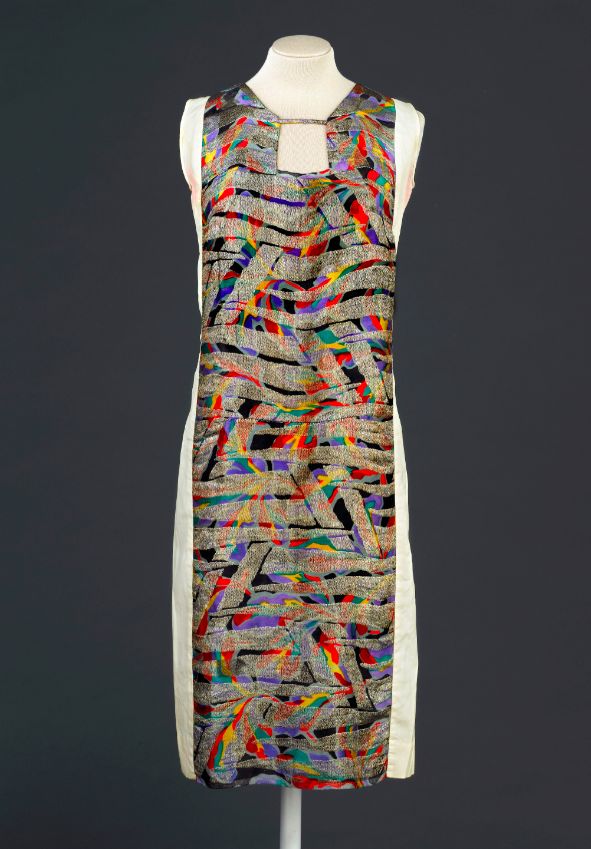
Dress by Sonia Delaunay

Although I had admired many of her paintings, I had never seen a large exhibition of her work and had no idea that she designed fabrics, dresses, and even magazine covers as well as being a painter. As I looked at some of the clothes she designed, I thought how attractive they would look at a party or public event these days—even perhaps on the red carpet at the Oscars. A woman wearing a dress like the one at the right, would stand out, but would look very fashionable.

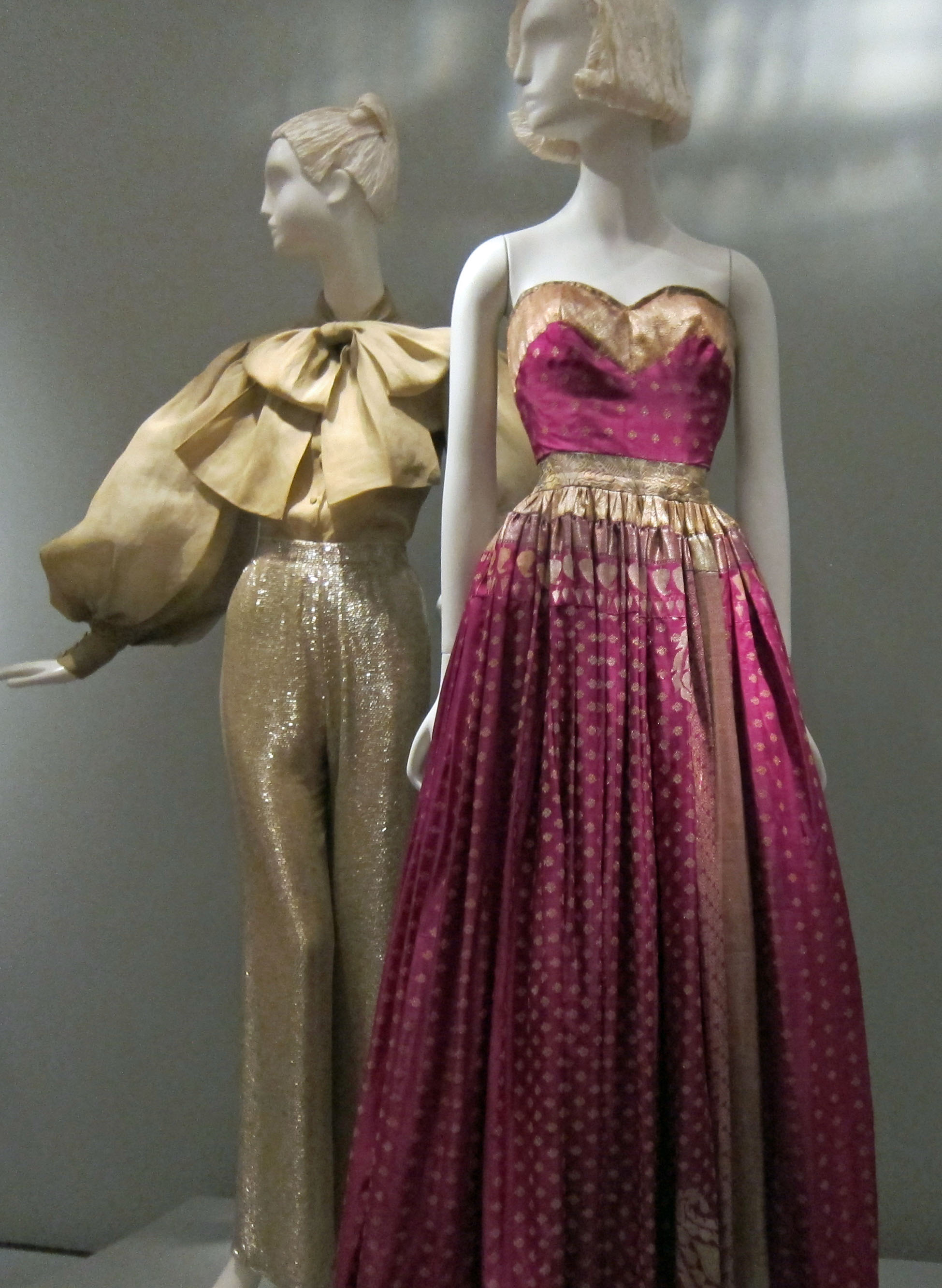
Now that I am back in San Francisco, I went to an exhibit of “High Fashion” at the Palace of the Legion of Honor to see the work of some twentieth century designers from the collection at the Brooklyn Museum. The exhibit was crowded when I was there, and it is easy to see why. The dresses on display—most of them designed for lavish parties and social events—are amazing. We saw dresses by Christian Dior, Jeanne Lanvin, Elsa Schiaparelli, Mainbocher and many others. It was striking how many of the fashions are almost timeless. They still look as beautiful and wearable today as they did during the last century. (The shoes worn by the mannequins, however, do not look wearable at all.)

Dresses by Mainbocher

I’ve never been particularly interested in fashion and have spent most of my life wearing the informal clothes that are the usual choice of academics and librarians, but after seeing these two exhibits, I can understand better why there are so many fashionistas in the world. High fashion offers some delightful examples of how clothing can also be high art and add pleasure to the world. I still have some reservations about the excesses, however. Elsa Schiaparelli’s insect necklace (above) probably goes a step too far for most of us to accept as wearable.

Independence Day–Don’t Forget the Women

Everywhere throughout America today people are celebrating the Fourth of July-the anniversary of the signing of the Declaration of Independence. We may not spend much time thinking about the reason for the holiday, but there are many reminders on TV, social media and newspapers. And when we think about it, what usually comes to mind is a picture of

Signing the Declaration of Independence

enlightened gentlemen in elegant clothes sitting decorously at a table and writing a document that would stand for centuries as the cornerstone of a stable democracy. The pictures don’t show the quarrels and struggle that went on when people decided to pursue independence and later to write a constitution that would make the new country possible. And the pictures show only half of the story—there are no pictures and seldom any mention of the women who inspired those men and sometimes goaded them into action.

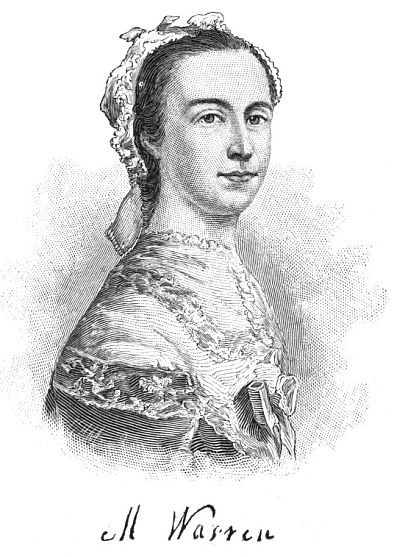
Pictures can’t show the whole story. You have to read the words behind the pictures to get a closer look at our revolutionary leaders. Last year I read a biography of Mercy Otis Warren, who, like her good friend Abigail Adams, influenced many of the men who fought in the Revolution and went on to start a country. Mercy and John Warren’s home became a meeting place for leaders who organized the Boston Tea Party and fought for the rights of the colonies to organize their own governments. Even though women were not encouraged to participate in public life, Mercy Warren began writing pamphlets and satirical verses and dramas that supported the Revolutionary cause.

Mercy Warren
Mercy Warren

At leisure then may G[eor]ge his reign review,
And bid to empire and to crown adieu.

For lordly mandates and despotic kings
Are obsolete like other quondam things.  (1775)

The years following the Revolution brought little peace to Mercy Warren and her husband as they disagreed with many of the decisions of the Federalists who controlled the government. James Warren, who had been a leading figure in the war for independence, was shut out of government service and his sons struggled to find posts.

When a new constitution was drafted and presented to the states, Mercy Warren opposed its ratification. She wrote a pamphlet “Observations on the New Constitution…” in which she urged the states to reject the draft. One of her major objections was the lack of a bill of rights “There is no provision by a bill of rights to guard against the dangerous encroachments of power” she wrote. She was also concerned about the six-year terms given to senators. “A Senate chosen for six years will, in most instances, be an appointment for life…” (Well, she was right about that, wasn’t she? Many Senate terms have lasted for a generation or more.) She worried that there were no defined limits to judiciary powers and that the executive and legislative branches were dangerously blended together. The Constitution certainly did not seem a sacred document to her.

As we all know, the Constitution was ratified and has become the basis of American law. Some of Mercy Warren’s concerns were addressed very early. The passage of the Bill of Rights can be attributed in part to her demands. Other aspects of government continue to be addressed such as the power struggle between the Legislative and Executive branches. But the Constitution survives and so does the country.

Reading about the early struggles for democracy in America can give us some hope that our leaders in Washington will eventually find a way to work together and solve some of the problems confronting our world today. The past may look peaceful as we gaze back at the solemn pictures of Founding Fathers, but revolution is never easy, and it never solves all of a society’s problems. America was designed by a quarreling group of imperfect men and women. And every Fourth of July has been celebrated amidst continuing arguments and struggles to make the country more democratic for all its citizens. Don’t let those elegant suits and quill pens fool you—life in a democracy is never peaceful and free of strife.

If you want to read more about Mercy Otis Warren, there is information about her in Cokie Roberts’s book Founding Mothers. For a complete biography, I highly recommend Muse of the Revolution: the Secret Pen of Mercy Otis Warren by Nancy Rubin Stuart.

The Price We Pay for Art

Today I went to the DeYoung Museum here in San Francisco to see an exhibit of paintings by J.M.W. Turner. It seemed a good way to take my mind off the painful thoughts about the terrorism in South Carolina this week. Some subjects are too painful to think about for very long, so I needed a break and joined the people eager to see the new exhibit of paintings.

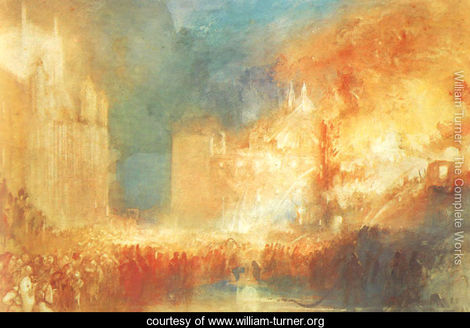
Turner’s colorful paintings fill the galleries with light and the visitors crowded around each painting seemed absorbed in soaking up the color and vibrant emotion of the works. Turner was a British landscape painter, probably the best painter

Burning of the Houses of Parliament

England ever produced. Born in 1775, he began exhibiting his paintings early and continuing to develop and expand his talents throughout his life. His landscapes changed from being fairly straightforward presentations of natural scenes in the tradition of 18th century painters, to being explosions of color with vague outlines of buildings, people, and ships.

I walked through the galleries, stopping at each painting to admire the hazy forms and explosive colors. But as I looked at each painting, the scenes from a movie I saw a few months ago kept coming back to me—the critically acclaimed film Mr. Turner shows the artist working on some of these same paintings. As portrayed by actor Timothy Spall, Turner was a man dedicated to art but cruelly negligent about people. Despite his success as a painter, he refused to support his common law wife or his two daughters, and he sexually abused his housekeeper and treated her with contempt. He appeared to believe that his artistic talents justified his callous disregard for other people. Perhaps they did, but as I looked at his paintings, I wished that I had never seen the movie and learned the sordid details of his life. It’s too bad that that a movie once seen cannot be un-seen so that the images continue to influence any future view of the subject.

What is the value of an artist’s life compared with the value of the people (usually women and children) who suffer because of his vanity? (Of course, the genders may be reversed, but historically most artists have been men and most victims of artists have been women.) Do we really believe that all people are created equal, when people of genius are often treated

Percy Bysshe Shelley

as though they are exempt from the normal moral norms of other people?

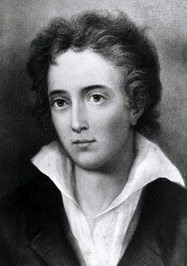
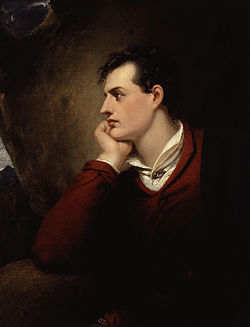
What is the value of art compared with human suffering? Do artists like Richard Wagner with his vicious anti-Semitism deserve to be honored and supported? Both Shelley and Byron, two of England’s greatest poets mistreated the women

Lord Byron
Lord Byron

who loved them and neglected their children. They left a legacy of beautiful poetry, but it does make me wonder whether spending a lifetime creating great art has any effect at all on the artist’s moral sense and human empathy.

What is the value of looking at great paintings, listening to fine music, and reading lovely poetry? They are produced by imperfect human beings, sometimes people we would despise if we knew them personally, but the art itself can be far better than the individual who created it. We have to accept creations made by flawed people, because we need poetry, music, and art to make our lives complete. And as Jean Cocteau once wrote:  The poet is a liar who always speaks the truth. The artists and poets of the world create beauty despite their weaknesses, so I guess we should be grateful for what we learn from them and not ask for perfection in their lives.

June and the Reluctant Brides

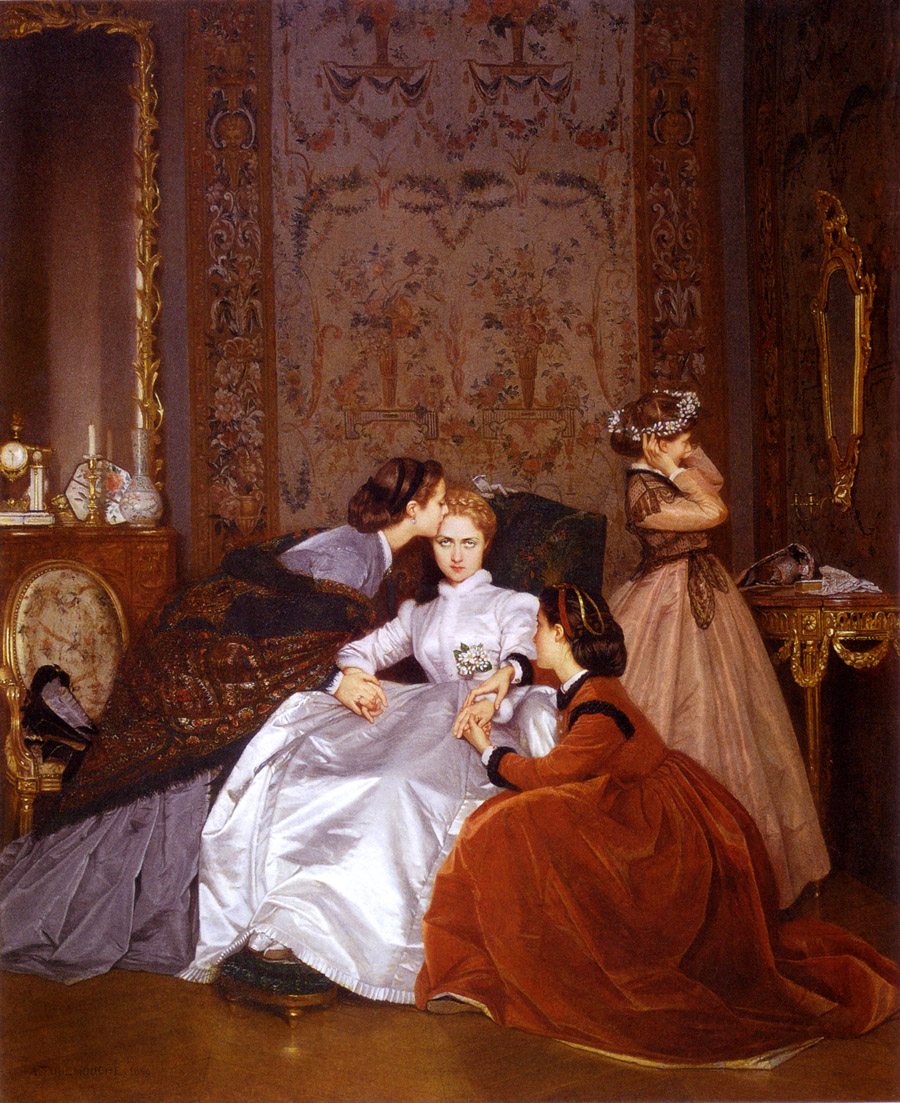
June has arrived and with it the promise of more weddings as today’s couples decide to commit themselves to the semi-permanence of marriage. Not as many Americans are getting married as they did fifty years ago. In 1950, only 22% of

The Reluctant Bride by August Toulmouche
The Reluctant Bride
by Auguste Toulmouche

Americans had never been married now the percentage has just past the halfway mark—50.3%. The reason for this change has often been discussed by social scientists and the media. Women now are better educated than ever before and more of them can earn a living without a husband, but this doesn’t seem to be the reason for the decline. College educated people are more likely than high school graduates, or high school dropouts, to get married. Marriages aren’t only about economics.

Does anyone remember the idea that people ought to be married before they become sexually active? Very few young people adhere to that idea now. The idea of being a virgin upon marriage has died away. According to an article in Atlantic Magazine, cohabitation has increased 900% during the last fifty years. It is now the norm for most couples to live together for a period of time before they marry. Perhaps that’s the reason why weddings have become increasingly elaborate and expensive in recent years. If a wedding does not signal a change in lifestyle, it has to become an event in itself to mark a legal change of status.

One curious thing is that even back in the days when marriage was almost the only source of economic security as well as sexual and romantic love available, some women rejected the very idea of marriage. It’s easy to forget how one-sided the rights of marriage used to be. The Founding Fathers who wrote the United States Constitution wanted to give freedom and power to citizens, but only to male citizens. Women who married in the early 19th century gave up rights to their property, their earnings, their inheritances, and their children. A husband became the head of the family and he was legally entitled to make all the decisions about where the family should live, how they spent their money, and what should happen to their children. Of course, many women were able to actually make the decisions, but they could do that only as long as they could persuade their husbands to do as they wished. It didn’t take long for women to decide they wanted some legal rights to back up their powers of persuasion. One of the foremost fighters for this freedom was Lucy Stone, although today she is almost forgotten.

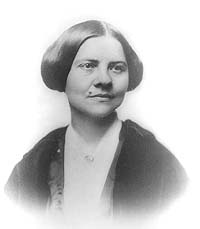
Born in 1818 in Massachusetts, Lucy Stone spent most of her life as a crusader for freedom. Her life was a series of firsts. She became the first woman from Massachusetts to earn a college degree and she did it at Oberlin, the first college to

Lucy Stone
Lucy Stone

admit both women and men. She fought for the abolition of slavery and became a public speaker at a time when women were seldom allowed to speak in public. She also crusaded for the rights of women, especially their freedom to vote.

Because of the inequalities of the rights of husbands and wives, Stone was opposed to marriage, but when she met Henry Blackwell, he persuaded her that the two of them could devise and live as equals. When they were married in 1855, they read a protest against marriage during the ceremony—a protest that was later published in newspapers across the country.

We protest especially against the laws which give the husband:

  1. The custody of the wife’s person.
  2. The exclusive control and guardianship of their children.
  3. The sole ownership of her personal and use of her real estate, unless previously settled upon her or placed in the hands of trustees, as in the case of minors, idiots, and lunatics.
  4. The absolute right to the product of her industry.
  5. Also against laws which give to the widower so much larger and more permanent interest in the property of the deceased wife than they give to the widow in that of the deceased husband.
  6. Finally, against the whole system by which the legal existence of the wife is suspended during marriage, so that, in most States, she neither has a legal part in the choice of her residence, nor can she make a will, nor sue or be sued in her own name, nor inherit property.

The most startling decision of their marriage was for Lucy Stone to keep her own name rather than becoming Mrs. Henry Blackwell. She was praised by a few, but denounced by many for this decision In the years since, her choice has become far more acceptable to many women. Despite the unconventionality of their marriage, the two of them succeeded in building a life together. Their daughter, Alice Stone Blackwell, worked with them for many years and wrote the first biography of her mother.

Now that brides and grooms have so many more choices in in how their married life will function, it is a shame that Lucy Votes_for_womenStone has been forgotten. Without the work that she and other leaders of the suffrage movement did, women planning their weddings this year might be giving up far more than they are. If you want to learn more about Stone and her work, I recommend a thoughtful new biography, Lucy Stone: A Life by Sally G. McMillen. Perhaps that’s a book you should think of when you are choosing a wedding present for young couples.

Memorial Day and Memories

War is no longer declared

Just continued. The unheard-of

Has become the quotidian.

Those words were written more than fifty years ago in postwar Germany by Ingeborg Bachmann and eloquently translated by Eavan Boland in her anthology After Every War. On this Memorial Day the truth of those lines is more evident than ever before. War, endless war, continues year after year, erupting in one country after another like a malignant plague.

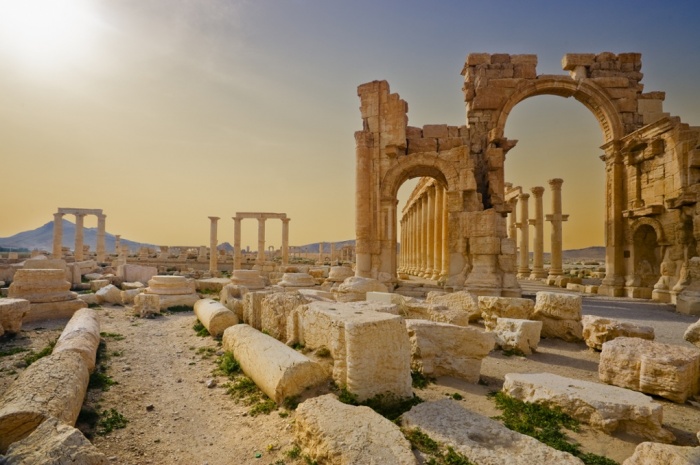
Within the last few days Palmyra, an ancient trading city in Syria, was captured by ISIS forces. The magnificent centuries-old monuments are expected to be destroyed by troops who consider the preservation of them a form of idolatry.  Perhaps religious feelings are at the heart of the destruction, but watching videos of teenage soldiers swinging hammers ruthlessly

Palmyra, ancient Syrian ruins

at stone carvings makes me wonder whether some of the destruction isn’t fueled as much by youthful exuberance as by heartfelt belief. I can’t help wondering whether some of these men may not regret the destruction as they grow older and slowly learn to appreciate the value of the past as well as the fever of the present.

But the real tragedy of war isn’t the destruction of monuments or art or even homes and hospitals but of people. There are no victimless wars. Every drone that explodes in the Middle East kills someone; every bomb dropped during World War II destroyed life as well as buildings; every shot fired from the trenches in World War I and every volley of rifle fire during the Civil War were intended to kill and maim soldiers and to leave children fatherless and families bereft.

Every war that has ever been fought has been a failure—a failure of people to use their human ability to speak and communicate to resolve differences. It is only when people give up the very traits that make them human that they need to turn to war.

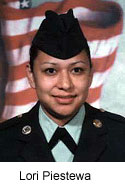
But Memorial Day is a time to remember those who have died as victims of people’s inability to act as humans. For most of our history the fighting forces that were remembered on Memorial Day were all men—the soldiers, sailors, and marines who fought in America’s early wars. Now, of course, women as well as men serve in all branches of the Armed Forces, so today we should remember the first American woman killed in combat—Lori Piestewa, who was killed in combat.Lori-Piestewa-1343 Lori Piestewa was a member of the Hopi tribe and lived on a Hopi reservation in Arizona with her family before she left to serve in the military. Her father had served in Vietnam and her grandfather in World War II, as so many men of the Hopi tribe have served over the years. She left two young children, who by now are probably well aware that the war in which their mother served and died has not yet ended. Perhaps when they are grown they too will serve in one of our endless wars. It certainly seems as though there will be opportunities for that.

Peace is as far from us as it has ever been. So on this Memorial Day, all we can do is remember those who have died and will never again see the world that we, the living, are still enjoying. Lori Piestewa will never again feel the harsh Arizona sun or the see a sandy Arizona landscape.

The sadness in the loss of life, the end of an opportunity to see the world, was expressed almost 100 years ago by a young poet, Francis Ledwidge, who died in World War I. He was writing about Thomas McDonagh, a man executed during the Easter Rebellion in Ireland. This lament serves well as a Memorial Day tribute to all those who died in all of our wars and will never again see our beautiful earth.

He shall not hear the bittern cry

In the wild sky where he is lain

Nor voices of the sweeter birds

Above the wailing of the rain.

Nor shall he know when loud March blows

Thro’ slanting snows her fanfare shrill

Blowing to flame the golden cup

Of many an upset daffodil.

What’s in a Name? Princess Who?

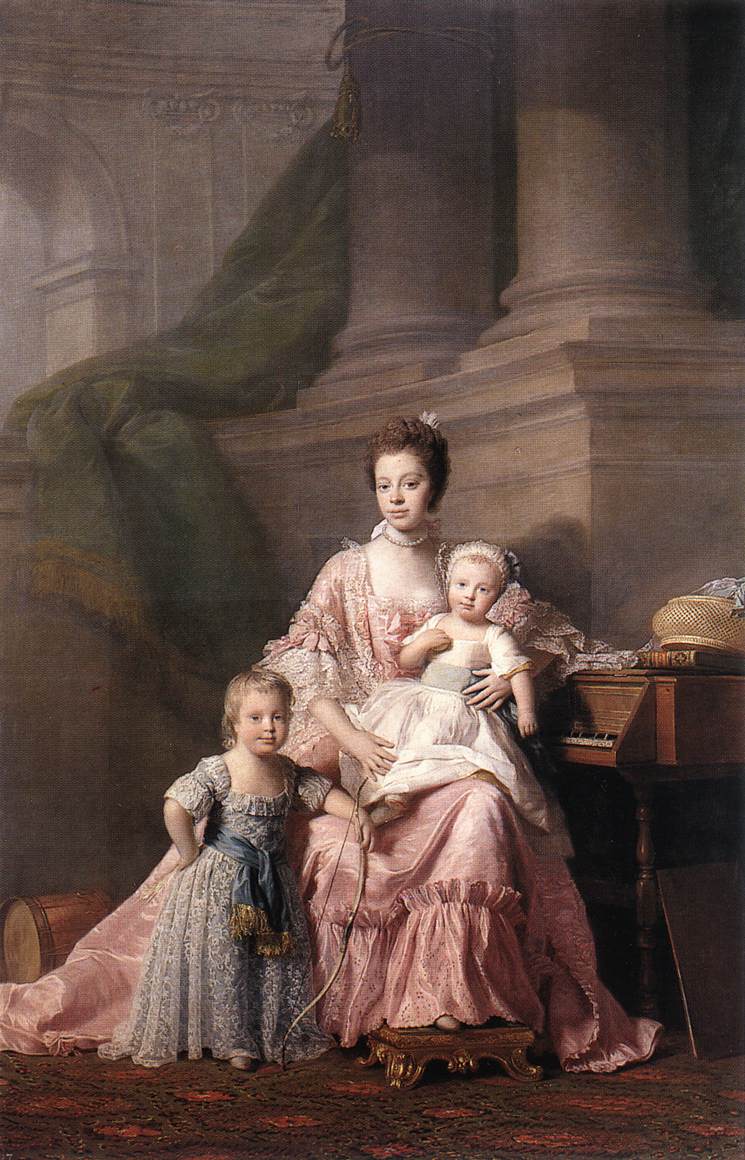
Church bells rang loudly in London last week when a baby girl was born to Kate Middleton and her husband Prince William.The world was told about the birth of the princess and soon the announcement came that the baby would be named

Princess Charlotte May 2015

Charlotte Elizabeth Diana, three names that pay tribute to her grandfather, great-grandmother, and grandmother. The names are traditional, but the baby has been born into a new world, one in which females can inherit the throne of Britain even if they have a younger brother. Charlotte and her family are bringing several innovations to the royal family. Her mother is a commoner, but one who has adapted to her royal role with apparently effortless grace. When you look at history, you see that Charlotte is an appropriate name for a woman who will face a changing world and will be expected to adapt to it gracefully.

Queen Charlotte, wife of George III who ruled England from 1760-1820, was born in Germany and had never been out of her native country until she married George III. And talk about a short courtship—the wedding was performed the day after Charlotte arrived in England and met her future husband for the first time. As a young immigrant girl, as well as a queen, she spoke no English when they married but soon began to serve the crown by producing children. She learned English quickly and became a popular queen as well as a helpmate to her husband who was ill for many years. The Queen bore fifteen children, thirteen of whom survived to adulthood. Family life was difficult as the king had periods of apparent

Queen Charlotte
Queen Charlotte

madness during which he became over-excited and acted erratically. His sons and many members of his court were frantic to control his bouts of irrationality; Queen Charlotte coped with the situation better than most of them. In recent years, doctors have realized that the king’s illness was physical, but during his lifetime he was considered just a madman. Queen Charlotte did not have an easy life, but she adjusted to her new country and her stressful family situation and carried on.

When I decided on a name for the heroine of my series of mystery stories set in the 1840s, I chose the name Charlotte Edgerton because it reflects her life story as an English girl on the edge of the new world of America. The 1840s were one of the most tumultuous decades of the nineteenth century. America endured a great depression in 1837 and people throughout the country decided that the old colonial lifestyle centered on traditional farming could not last. Various experimental social groups sprang up—communal farms such as Brook Farm where Charlotte lived in Massachusetts—were popular and widely copied. Charlotte tried life there but discovered that the idealism of the Brook Farmers was not strong enough to keep out the forces of greed and discord that led eventually to murder. That story is told in the first volume of the series A Death in Utopia.

A Death in Utopia
A Death in Utopia

After leaving Brook Farm, Charlotte moves to New York City, sometimes known as Sin City because of the widespread prostitution and political corruption in the fast-growing metropolis. As young men and women swarm into the city to find jobs and prosperity they can no longer find on rural farms, they encounter temptations and a fast-moving world of entertainment and luxury. When a frightening series of murders occurs, Charlotte and her fiancé Daniel Gallagher become involved in trying to find the killer and stop the terror that hovers over the sporting houses of the city. This story appears in Charlotte’s forthcoming adventure Death Visits a Bawdy House, which will be published in July.

In future books in the series, Charlotte returns to England, but to a far different city of London where poverty stalks the grimy streets and revolution is in the air. Yes, Charlotte is a good name for my heroine who is observant and resourceful and manages somehow to survive and adjust to the complex ever-changing world in which she lives.     

Wrath of God or Natural Disaster–Earthquakes Past and Present

Those of us who live in California are always conscious of the threat of earthquakes. It is not that we walk around in fear, but the idea that one could occur is always lurking in the back of our minds. And now comes the massive 7.8 earthquake in Nepal! The pictures of crumpled buildings and of people camping out on the street are a vivid reminder of what can

Rescue during the Lisbon earthquake 1755

happen. All the threats of crime and terrorism pale beside the scope of what natural forces can bring about. But through the centuries people have  had a hard time accepting the ideas that our lives, hopes and dreams can be overturned merely by natural forces that are not directed at us. As I read the news reports I started wondering when people began to acknowledge how little control we humans have over nature and began reading about earthquakes.

The Lisbon quake, more than 250 years ago was a kind of turning point in how Europeans and Americans viewed the causes of natural disasters. When the earth shook and Lisbon, the magnificent capital city of Portugal, started falling in ruins, the attention of the world was captured. The Lisbon quake was probably the first worldwide—or at least European-wide global calamity. Earlier disasters, from the volcano at Pompeii to the Great London fire, had been of interest mostly within the country or region where they occurred. But by 1755, Europeans had become internationalized. They traded with other countries, exchanged ambassadors, and understood that disasters could spread damage from one country to another. What people could not understand, or didn’t want to understand, was that they had no control over these destructive forces.

The first reaction among many people was to blame Lisbon itself for the tragedy. If only people had led virtuous lives, God would not have punished them by sending an earthquake. John Wesley, the English Methodist preacher wrote:

Woe! To the Men on Earth who dwell,

Nor dread th’Almighty Frown,

When God doth all his Wrath reveal,

And showers his Judgments down!

A century or two earlier the religious reaction might have been accepted and prayer and fasting become the only solution to the damage, but by the 18th century, philosophers had begun to ask other questions. Perhaps God wasn’t regulating everything that happened on earth. Perhaps there were forces that could not be controlled by prayer and repentance. Thoughtful men and women became divided on the causes and appropriate responses to unforeseen events. For the first time a number of governments throughout Europe began sending aid and supplies to Lisbon rather than just advice about purifying the city. George II of England encouraged the House of Commons to send 100,000 pounds to “send such speedy and effectual relief, as may be suitable to so affecting and pressing an exigency.” It was the beginning of international disaster aid which has since become such an important part of the world scene.

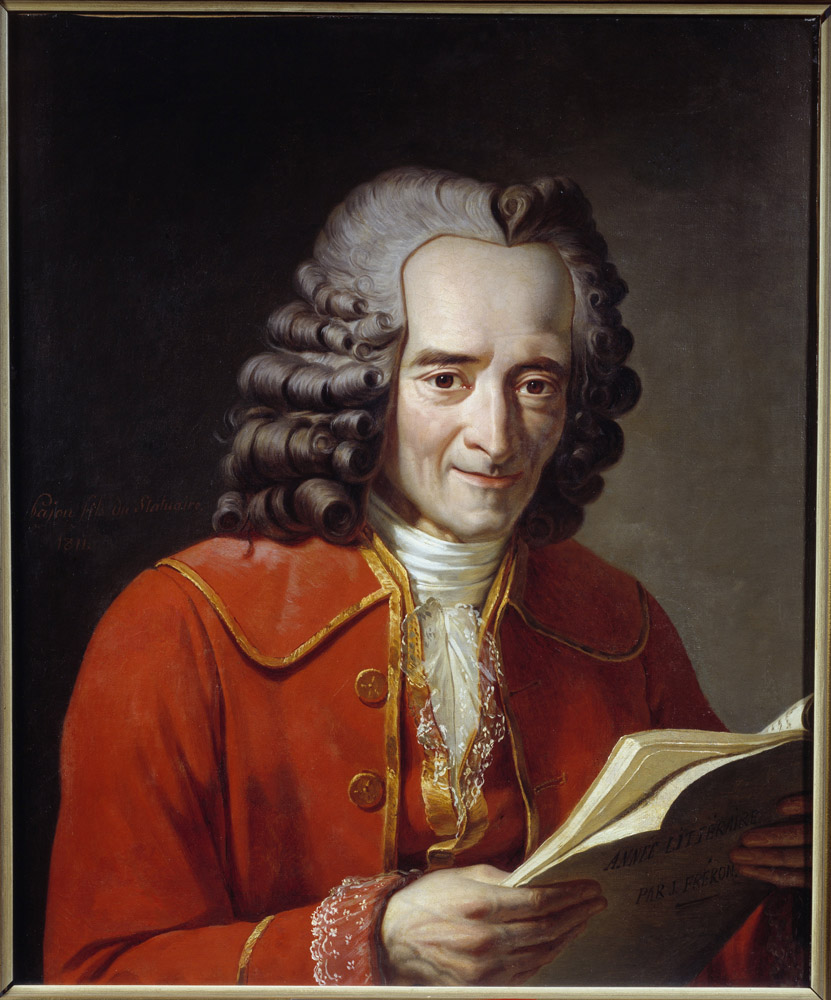
Voltaire
Voltaire

Portugal was lucky to find a leader, the Marquis de Pombal, who brought order to the city and supervised its reconstruction. One of his most surprising innovations was to send out a questionnaire asking people to tell the government exactly what they had seen and experienced during the quake. So, in a way, he was the founder of survey research as well as seismology

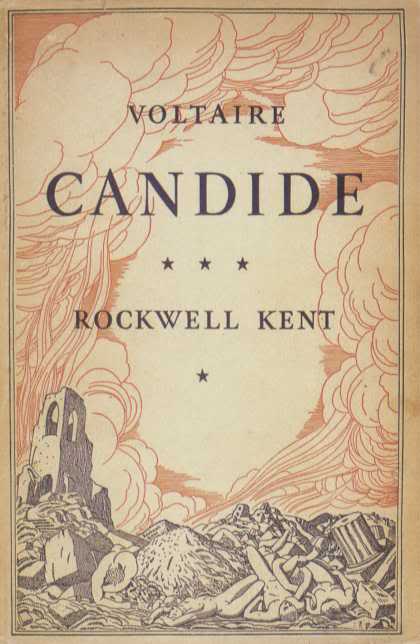
Culturally, however, it was perhaps Voltaire who stamped the earthquake most firmly on the consciousness of the world. He turned from the optimism of his early days when he accepted Alexander Pope’s belief that “Whatever is, is right” and became a skeptic. His story Candide has delighted readers from that day to this and in recent years as a drama it has been produced in theaters throughout the world.

There is so much to be said about the Lisbon earthquake and the lessons the world learned from it. One book that recounts the story vividly is Nicolas Shrady’s The Last Day: Wrath, Ruin, and Reason in the Great Lisbon Earthquake of 1755. It is available in many libraries as well as on amazon.com and it will give you a lot to think about.

Candide (cover art by Rockwell Kent)

Now that the earthquake has hit Nepal, we can at least be thankful that international response and help came immediately. Volunteers from many countries have converged on Katmandu and the surrounding area to help victims. The damage to individuals and families can never be undone, but at least the world has learned to care and not to judge.