Many people throughout the world recognize the name of Helen Keller. Her story is an inspiring one. A movie about her life won two Academy Awards in 1962 and her biography has been a bestseller for several generations. Many people know that Helen Keller overcame the handicaps of being both blind and deaf, but few readers are aware of what a long and influential life she led.
Helen Keller was born in Tuscumbia, Alabama on June 27, 1880. When she was 19 months old, she lost both hearing and sight after falling ill with a disease that has never been identified. Her family was prosperous—her father was a newspaper editor who had served in the Confederate Army during the Civil War. Her mother came from an old slaveholding family and was eager to see Helen get an education. When she read in Charles Dickens’ book American Notes about the Perkins Institute for the Blind, she got in touch with them. It was through that school that Helen and her family met Anne Sullivan, a recent graduate of the Institute, who became Helen’s teacher and companion for the rest of her life.
Helen was a diligent and successful student. After learning how to communicate through sign language, she attended several private schools. Although her voice remained somewhat difficult to understand, Helen learned to spell out words by pressing her fingers on Anne’s hand. Anne would respond in the same way. Eventually Helen went to Radcliffe College and became the first deafblind person to earn a college degree. Her success was noted by a number of influential people including Mark Twain who became a friend and supporter.
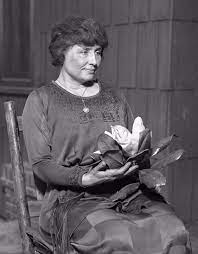
After graduating from college, Helen embarked on a lifelong career of giving lectures and writing. She and Anne would appear on stage together so that Helen could spell out her response to questions and Anne would relay them to the audience.
During the years leading up to World War I, Helen was active in opposing America’s entry into the war. She admired the Soviet Union because she believed that socialism could eliminate poverty. Her political commitment to socialism went up and down over the years, but she apparently never completely lost faith in that philosophy.
Helen joined the American Foundation for the Blind during the 1920s and worked to support the goals of that organization for decades. She tried to help the blind community and others whose abilities differed from the majority. She did not believe that blindness or deafness should force people into a life of retirement or solitude. And she was not shy about publicizing her ideas. Her engagement with socialism led to investigations by both the FBI and Senator McCarthy’s Internal Security Committee during the bitter anti-communist post World War II years.
Several biographies of Helen Keller have been written over the years, but a new one by Max Wallace called After the Miracle: The Political Crusades of Helen Keller (Grand Central 2003) offers many surprises even to those who have read some of the earlier books.
 Teacups and Tyrants-Adele Fasick looks at people, books, and history

Exactly my thoughts: for example, I didn’t know that she had been investigated by the FBI and McCarthy. The insanity of those times never ceases to amaze. And we may be headed back in…
Hi Gerry, It’s good to hear from you. You are certainly right that the world is in bad shape right now. But a new year is coming, maybe something good will happen. In the meantime, we might as well enjoy the holidays. Adele
On Sun, Dec 10, 2023 at 5:43 PM Teacups and Tyrants-Adele Fasick looks
From your lips to the goddess’s ear! Have a good holiday, Adele.
Once again you have educated and inspired me! I’ve known the name “Helen Keller” for decades and *thought* I knew her story, but your post reveals to me how little I actually knew. Helen Keller is an even more fascinating woman than I had realized. Thank you for shedding new light on her life and legacy!