Why, what could she have done, being what she is?
Was there another Troy for her to burn?
William Butler Yeats
Maud Gonne was born in England into a wealthy family. Her mother died while she was a child. Maud and her sister were sent to a boarding school in France and grew up speaking both French and English fluently. Her father, Thomas Gonne, who served as an officer in the British Army, spent time in many countries around the world. In 1882, when Maud was in her early teens, he was sent to serve in Dublin. At that time, he brought his two daughters to live with him. It was during those years that Maud got to know Dublin and observed the poverty of many of its people. These were difficult times in Ireland and Maud became a strong opponent of the British landlords who evicted tenants from their homes when crops failed and the farmers were unable to pay their rent.
After the death of their father in 1886, Maud and her sister were sent to live with an uncle in London but were not happy there. Maud, who had grown into a beautiful young woman, decided to train to be an actress. Unfortunately, her career was cut short when she developed TB and was advised to move to a spa in France. In 1887, she came of age and inherited her share of her mother’s fortune. For the rest of her life, she was wealthy and had no need to earn money. She divided her time between France, England and Ireland and maintained a lively social life in each of those countries.
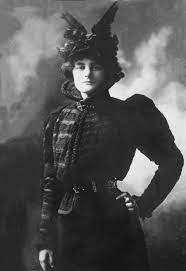
In Paris, Maud met Lucien Miklevoye and began her first serious love affair. Miklevoye was married, and a divorce was almost impossible to obtain in France, but the two of them remained devoted to each other for several years and eventually had two children, although the eldest died very young. As was usual in wealthy families, the children were raised mainly by a devoted governess. When Maud spent time in Ireland, she never acknowledged the children but referred to her daughter as her niece. Yeats, who was a close friend for many years, knew almost nothing of Maud’s Parisian life or about her children. He fell in love with Maud and repeatedly asked her to marry him, but she turned him down without apparently telling him about her relationship with Miklevoye or about her children. It was several years before he learned about Maud’s private life.
The 1890s were difficult years in Ireland, and Maud spent much of her time in Dublin working with other activists to oppose British rules. She supported the Boers during their war to drive the British out of South Africa and started a women’s association. She is credited with starting the Sinn Fein (“ourselves alone”) organization, which became a powerful anti-British association.
Gonne’s private life remained turbulent. She met John McBride, a hero of the Boer War, and married him. They had one son, but the marriage was not a happy one. In 1905, she sued for divorce in France (divorce was illegal in Ireland), but she lost her case and the divorce was denied. McBride later became a hero of the Irish republican movement and was executed by the British in 1916.
As the years went by, Maud became more and more anti-British and was accused of supporting the Germans. In 1918 she was jailed for six months after being accused of supporting a pro-German plot. During the years between the two World Wars, Gonne’s strongly anti-British feelings led her to support the anti-Semitic actions of German fascists. She never spoke out against the prison camps or the deaths of many Jews during Hitler’s rule. She did much good during her lifetime, but also sometimes supported cruelty and caused pain.
A recent biography The Fascination of What’s Difficult: A Life of Maud Gonne by Kim Bendheim (OR 2021) tells the story of Maud Gonne’s life and achievements. The author gives a clear and detailed account of Gonne’s life, but mysteries remain. Maud’s own writings, including her letters and memoirs, are not always accurate and sometimes raise more questions than they answer. Perhaps we will never be able to understand all the complexities of Maude Gonne, but we can be grateful that her life inspired some of the best poetry written by one of the greatest poets of her time, William Butler Yeats. Perhaps he was thinking of her when he wrote these lines:
How many loved your moments of glad grace,
And loved your beauty with love false or true,
But one man loved the pilgrim soul in you,
And loved the sorrows of your changing face.
 Teacups and Tyrants-Adele Fasick looks at people, books, and history
Fascinating! I’ve read many of Yeats’s poems and knew that he loved Maud Gonne for many years, but I had no idea that she was such a complicated, many-sided woman. Flawed indeed! But certainly worth remembering for her own activities as well as for Yeats’s poems.