In 1890, when Agatha Miller was born into a middle-class family in Southern England, no one would have predicted that she would still be remembered today. Not only is she remembered, but her books continue to be sold worldwide and movie and tv adaptations of her works continue to be produced. Many of her fans are looking forward to September 2023 when they will be able to see A Haunting in Venice, Kenneth Branagh’s adaptation of Christie’s Halloween Party, a sequel to Death on the Nile. Who was this woman who holds such a grip on audiences from England to Ethiopia and from North America to Southern Asia?
Agatha’s family was prosperous, but not influential. Her father had been born in the United States but lived much of his life in England. He was not particularly interested in being a businessman and was better at squandering the wealth he had inherited rather than adding to it. Her mother believed that girls did not need much education so she did not encourage Agatha to learn to read. Nonetheless, Agatha was curious about books and with the help of her grandmother, she learned to read by the time she was four years old. Like most middle-class girls at that time, Agatha assumed she would not need to earn a living because she would marry and devote her time to her husband and family. But the world was changing and Agatha’s life did not follow the traditional pattern.
As she grew into her teens, Agatha was given a taste of formal education by attending boarding school in France, but her social life was more important to her than education. She began to attend parties, where she met many young people of her class, notably Archie Christie, a handsome young man who pressed her to marry him.
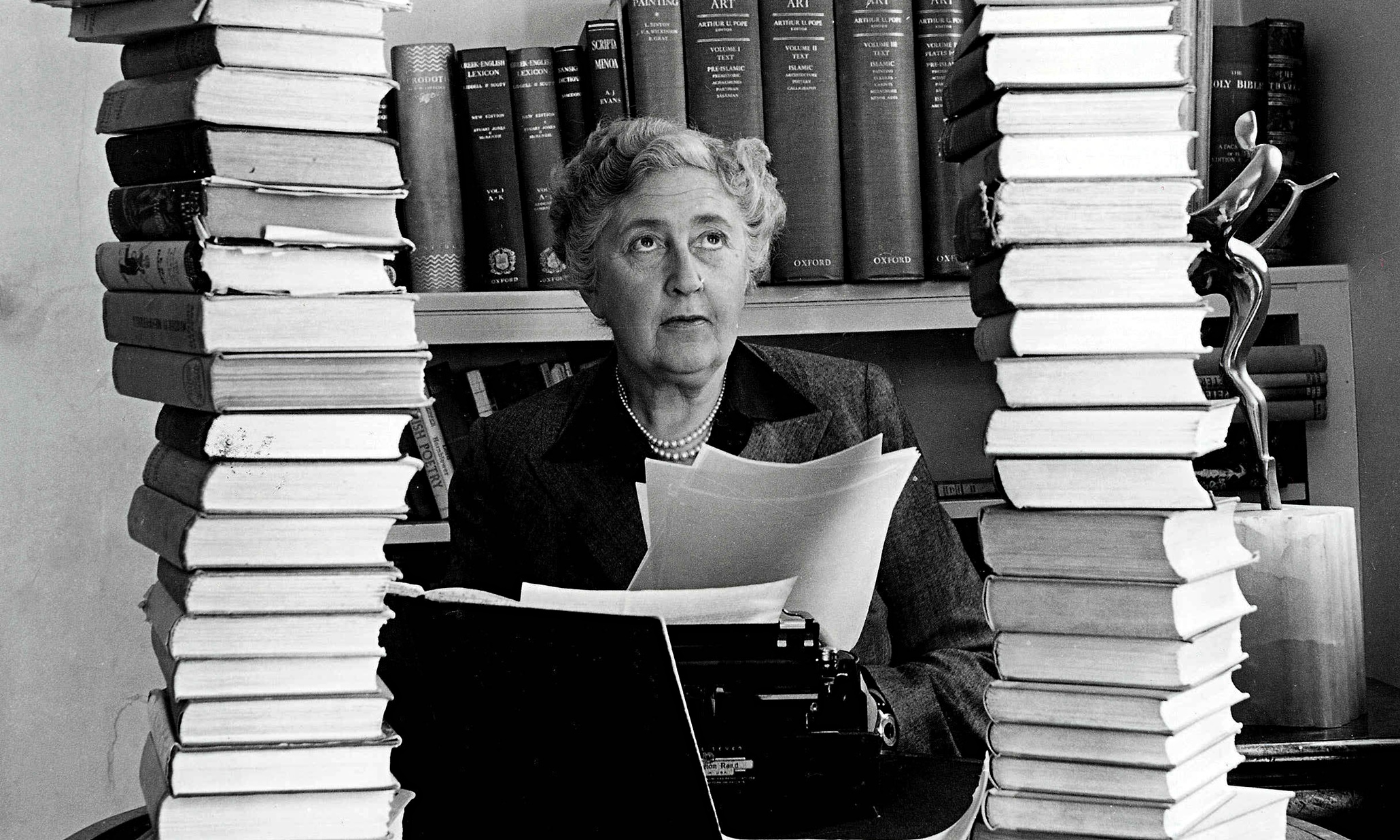
The start of World War I in 1914 brought dramatic changes to all of Europe including England. Earlier British wars had been fought mainly in distant countries such as India and Afghanistan. Suddenly battles were being fought close to home and wounded soldiers were being sent home to hospitals in England. Most young men joined the army, including Archie Christie, who was soon sent overseas to fight in France.
Like many other women in those days, Agatha volunteered to work for the Red Cross in British hospitals. It was a full-time volunteer job, and Agatha learned a great deal about nursing and especially about handling drugs, tending the sick, and dealing with death. During one of his home leaves, Archie and Agatha got married.
Settling down to peacetime life was not easy. Neither Archie nor Agatha was wealthy, although they were accustomed to living as if they were. Their only child, Rosalind, was born in 1919. Archie found jobs in business while Agatha was responsible for taking care of the house and of Rosalind. She wrote her first novels during these postwar years, but finding a publisher was difficult. Finally, she tried writing mystery stories, basing her major character, Hercule Poirot, on the Belgium soldiers she had met during her wartime work. The first Hercule Poirot story, The Mysterious Affair at Styles caught the public’s attention and has held it. Played by a series of actors during the years, Poirot is still appearing in movies and television productions more than a hundred years after he was first introduced.
Agatha continued to write mysteries and soon became one of the most popular and well-known British novelists. Unfortunately, her marriage did not fare so well, and in 1926, this led to the most dramatic episode in her life. The year had not gone well for Agatha, starting with her mother’s death in the spring. In December, Archie asked for a divorce because he wanted to marry his assistant. The day after his announcement, after leaving Rosalind with her sister, Agatha disappeared. Her empty car was soon discovered, but Agatha had vanished. Newspapers worldwide seized upon this story and the search was on. There were reports that Agatha had been seen dancing at a health spa, and later at a resort hotel, but it was ten days before she was finally discovered. She was registered under an assumed name at a spa not far from her country house.
Agatha never completely explained what had happened. After she was discovered, she went into seclusion at her sister’s house leaving the public to argue whether her disappearance had been a publicity stunt or the result of genuine mental illness. Gradually she recovered and returned to normal life. But her marriage to Archie was ended. Her divorce was finalized and Agatha continued her writing career. For the most part she led a quiet, successful life. She had a happy second marriage with anthropologist Max Mallowan, raised her daughter, and enjoyed domestic life. But through all of her years she continued to write and publish more stories that entranced thousands of readers.
Several biographies have been written about Agatha Christie and many of them focus on the few days of her mysterious disappearance in 1926. Fans still argue about the causes and effects of that event, but probably the more important mystery is the question of why her career lasted so long and why it was so successful. The statistics are startling. During her lifetime, Christie published 66 mystery books as well as 14 short story collections. Her play, The Mousetrap, set a record as the world’s longest-running play. All of her works were written in English, but they have been translated and published in 44 different languages.
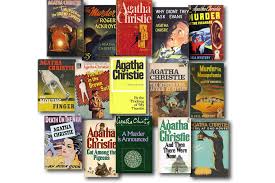
What is the secret of Agatha Christie’s success? That is the biggest mystery of all. She wrote most of her books during between 1920 and 1970. Other authors of that time have published other mysteries that were popular, but none of them approached the perennial appeal of Christie. Some critics have suggested that it is the cleverness of her best-known detectives, Hercule Poirot and Miss Jane Marple, that keeps readers entranced. Others say that the complexity of Christie’s plots are the secret ingredient that wins her fans. Her mysteries are honest in the sense that the clues are laid out clearly so the clever reader can match wits with the fictional detectives. And year after year the books continue to be reprinted and produced in electronic versions and readers continue to seek them out.
The only way to judge whether or not Agatha Christie’s work deserves the popularity it has achieved is to read the books for yourself or perhaps to view the film adaptations. Then you too can decide whether or not you are one of Christie’s fans and whether you can solve the mystery of her lasting appeal.
 Teacups and Tyrants-Adele Fasick looks at people, books, and history
A follow-up to your post, which led me to read the biography of Agatha Christie. I was intrigued to learn about her odd and fascinating life. I’m sorry that the bit about the advantages of being married to an archeologist is apocryphal, I’ve dined out on it many times!
I then went on to read (or reread?) The Mysterious Affair at Styles, even though Poirot was not my favorite. I was a Marple boy. I always found his deductions a bit facile — like pulling rabbits out of hats, showy. Miss Marple depended more on character analysis.
It is, however, an amazingly competent and confident book, especially given that it was her first. I was a little disconcerted by a couple of references to Jews, and a single use of the word ‘nigger’. But as the bio made clear, she was very much a product of her time and her class. The problem, of course, is that most contemporary readers (like my adolescent self) would not be aware of that social context, and the references might seem to validate a certain salon anti-Semitism. The book is largely ahistorical and apolitical– it takes place during WWI, but that conflict, apart from providing us with a wounded narrator on medical leave, and a possible German spy who is also a Jew, has no bearing on the story. You’d have to know about her, and her life, to be inclined to read social history into her books. Which is a bit of an argument, I think, for doing the unthinkable and editing the remarks out. But it probably isn’t that simple, since the villain of the piece is described in decidedly un-English and possibly semitic terms. I guess providing a gentle explanation of the context in a foreword would be an option, but I doubt readers of murder mysteries read forewords.
Anyway, a long ramble, just to say thanks for the recommendation! I hope all is well with you.
gerry
Hi Gerry, It’s good to hear from you. I’m glad my blog post inspired you to go back to read Agatha Christie books. They deserve a rereading even though, as you mention, some of her language is problematic. Her language is out-of-date, but her plotting certainly holds up.
I am doing pretty well, although getting slower and slower as the years go by. But I do enjoy going back to reread some of the books I enjoyed when I was younger and also discovering new books. I’m grateful that so many of them are available in Kindle editions these days.
I hope all is well with you and that you are looking forward to a happy 2024. Adele
On Fri, Jan 26, 2024 at 7:24 PM Teacups and Tyrants-Adele Fasick looks
Thanks, Gerry, for catching my mistake about calling Christie’s second husband an anthropologist instead of an archeologist. I’m afraid I am not as meticulous as Agatha was in getting small details right. She would never make such a mistake. That’s probably why I sometimes miss the clues she gives in her books. I agree with you that her plotting is what makes the stories fascinating.
I read one Agatha Christie, age 10 or so, and had nightmares, but went on to own and read virtually every one as a teenager, Miss Marple a big favorite. It’s the plotting, of course (and Roger Ackroyd is a classic), not the prose, that stands out.
And just a note: her second husband was an archeologist (she joined him on many digs), not an anthropologist, and I’ve heard the following attributed to her: “the advantage is, the older you get, the more interested he becomes”.
I never knew that Agatha Christie worked as a volunteer nurse during WW I! Just as you write, that experience must have given her a lot of first-hand insights into the workings of drugs, not to mention other things that would be relevant to her mysteries.
Thanks for another fascinating post!
Hello. I’ve read some of her books in recent years. The one I like best is The Murder Of Roger Ackroyd.