African Dorcas Society—an early PTA?

Trouble is brewing in California over the inequities inherent in having schools subsidized by Parent Teacher Associations which buy iPads, musical instruments and books for school libraries. Sometimes these parent groups pay for music and art teachers to supplement the regular classes. According to an NPR story I heard on the radio last week, some California schools receive an average parent donation of $1000 per pupil each year. Naturally school districts where families cannot contribute money for these extras cannot offer their students equal opportunities. Is it fair in a democracy for wealthier parents to be able to provide extra funding for their own children but not for others? That is a question taxpayers should be asking themselves, but it is certainly not a new one.

Back in the pre-Civil War days when education for Free Blacks was just starting in the Northern States, a group of women in New York City formed the African Dorcas Society. Slavery was abolished in New York in 1827, and the Black population in the city increased dramatically.engraving of African Free School Leaders of the Black community, and some white leaders, recognized that the children of these newcomers would need education. Several schools had been established for this purpose, but many families did not send their children to school. The reasons were easy to understand. Not only was children’s labor valuable to the parents, many of whom were struggling, but often the children did not have warm clothing and shoes that would make it possible for them to get to school in bad weather.
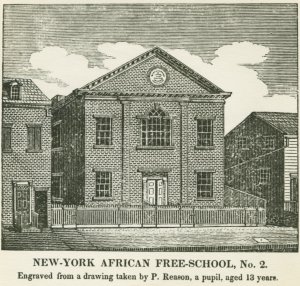
The African Dorcas Society was organized by Black women and was one of the first societies in which women met independently and planned their work without the supervision of men. The women divided themselves into sewing circles to make, mend and alter clothing for poor children. They also solicited contributions from well-wishers. For several years the group flourished and supplied clothing to enable children to attend schools. Unfortunately there were many New Yorkers who did not believe that former slaves could or should be educated and there was opposition to the Society’s work as well as the schools themselves.

We all know what happened in the decades that followed, leading up to full emancipation for all American slaves and to the slow establishment of education for all Americans. The struggle still continues to ensure that all children are given the resources necessary for them to attend schools and to take full advantages of education. But during this Black History Month, we should pay special tribute to the multitude of anonymous men and women who worked to make education available to all the children in their community. It’s been a long, hard struggle and it is not over yet. Equal education for all is one of the ideals we have to struggle for every month year after year.

You can read more about how the Black community fought for education and equality during the early 19th century in Leslie M. Alexander’s detailed history African or American? Black Identity and Political Activism in New York City, 1784-1861. It’s a fascinating account of forgotten history.


Prof. Lee Lorch, a long-lasting light in a dark world

Almost twenty years ago, in 1994, I made my first trip to Cuba as an adult. I had visited as a child with my family during Lee Lorchthe days of close U.S.-Cuban ties, but after Fidel Castro’s successful revolution, it was difficult for Americans to travel there. The 1994 trip was to a conference of the International Federation of Library Associations so participants came from all over the world. The trip was an eye-opener for all of us as it gave us a chance to see for ourselves what Cuba was really like. For me a special bonus was getting to know Lee Lorch, a most unusual academic and activist who has had an impact on people and events in several different societies.

Lee contacted me through mutual friends to see whether I would join an effort to send secondhand computers to Cuba. Having seen the shortage of technology in the schools and libraries in Cuba, I was glad to participate. As time went on I discovered that helping Cuba was only a small part of Lee Lorch’s efforts to improve the world. As a mathematician at York University he taught students and wrote scholarly papers, but being a scholar wasn’t enough for him. He had spent many years fighting racism in the United States and every time I met him there were new revelations about events he had participated in. He fought to open an apartment complex in New York City to African-Americans; he and his wife escorted students into the newly-desegregated Little Rock High School during the turmoil of school desegregation. He lost teaching jobs and had to move from one university to another as his notoriety grew.

In 1959, Lee and his family moved to Canada when he took a position at the University of Alberta. Later he moved to York University in Toronto. After all the turmoil of his life in the U.S. he found friends and a new life in Canada, and he never gave up fighting for justice. One of his interests was to encourage women mathematicians who were routinely discouraged from entering the field and often treated unfairly if they persisted.

People today find it almost inconceivable that even in the 20th century academics openly discriminated against non-white people and women. Until you read the story of someone like Vivienne Malone Mayes, it is hard to imagine the determination needed for women, and especially African American women, to be accepted in science and mathematics. Lee Lorch was among the pioneers in encouraging women to enter the field and in supporting their efforts for advancement.

I know I am late in finding out about this, but it made me very happy to learn that last year Professor Lee Lorch received a distinguished scholar award from CAUT—Canada’s organized voice of academic scholars. At the age of 97, he has participated in many struggles for justice and fair treatment for all people. He is a credit to the universe, and I hope the honors continue to flow during these crowning years of his long life.

When Will There Be Justice for Rachel Jeantel?

Is anyone surprised that Rachel Jeantel, a young woman who was called to testify in the George Zimmerman trial, was reluctant to appear? After watching the way she was treated by the defense lawyer, surely even more people believe that a court appearance leaves them vulnerable to harassment. Fewer and fewer will want to open themselves to such treatment.

gavel_large_rs_1What does the ability to read cursive writing have to do with the power of observation? Many schools no longer teach cursive writing and many young people cannot read it. Does the fact that we as a nation refuse to provide the kind of education that is wanted in a court of law mean that the students should suffer? If the ability to read and write cursive is necessary to be a credible witness then surely our schools should make that a requirement rather than abandoning it.

Are we going back to the days a hundred or more years ago when girls were not allowed to study Latin or Greek and then, as they grew up, were told they were unfit to vote or to govern because they could not read the classic texts? Talk about setting up impossible hurdles! It is our fault that we don’t provide the kind of education that students need.

Why is it that only women are judged on the shape of their figure or the style of their hair? Many a male politician is taken very seriously indeed even though his excess weight would cause a personal trainer to blanch.

Why do tweeters around the country feel they have the right to post cruel remarks about a witness in an important trial who is obviously suffering grief at the loss of a friend? Americans pride themselves on being kind and generous people, but at the moment many of us are demonstrating that we can be cruel bullies.

Rachel Jeantel deserves our respect for doing her civic duty in coming forth to testify. Let’s treat her with the dignity she deserves and apologize for the attacks she has received.

What a difference a century makes

The recent death of Helen Gurley Brown, the longtime editor of Cosmopolitan magazine calls to mind the scope and influence of earlier women editors in America. The appointment of Brown as editor of a traditional women’s magazine in 1962 shook the publishing world. Her emphasis on the acceptance of the right of single women to have sex was a bombshell in many conventional suburban communities. I remember as a young mother living in a sprawling housing development in New Jersey the startled reaction of some of my neighbors. One morning I saw a woman down my street sitting on her steps crying because she worried about her husband being seduced by secretaries made daring by Cosmopolitan. Within a few years the domestic life of many women was being reshaped by the bold ideas implanted by Helen Gurley Brown and her magazine.

Portrait of Sarah Hale

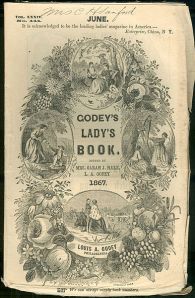
Long before Brown, however, women editors had shaped the lives and expectations of American women. Sarah J. Hale, who for forty years ruled over Godey’s Lady’s Book, one of the country’s most influential magazines, had a different agenda for her journal. Instead of seeing sexual freedom as the most important empowerment tool for women, Hale crusaded for education. Offering young women an education similar to their brothers was a radical idea. She strongly supported economic independence for woman and wanted them to become teachers and doctors to serve both the community and their families. Unlike Brown, Hale never saw the role of women as extending far beyond the family circle. She wanted women to use their new strength and independence to educate their children and serve their husbands. She never thought of herself as a feminist, but her influence on women’s lives went far beyond what she intended. By supporting and publicizing the founding of Vassar College, she opened the door for girls to leave home to study and work independently of their families.

Education for women wasn’t the only cause Hale worked on. She also created Thanksgiving as a national holiday rather than the quiet New England celebration it had been when she was young. After a long campaign, she persuaded Abraham Lincoln to proclaim the first national Thanksgiving holiday in 1863. Perhaps her work on this had a more lasting effect than any other single goal she pursued. Just think of the millions of dollars spent every year on advertising and merchandizing food and decorations for Thanksgiving celebrations.

Journalists who pull together the work of others to create a magazine, newspaper, or perhaps a television program are often underrated as thought leaders, but many of them have a greater effect on society than the “great books” that cause a stir. It’s the inexorable repetition of a periodical that gradually shapes our ideas far more than one book read during a few days. Perhaps we’ll never know how much Helen Gurley Brown of Sarah J. Hale changed women’s lives, but let’s take at least a few minutes to honor their memories.

Elizabeth Blackwell–Changing American healthcare

This week attention has been focused on the Supreme Court and its decision on the Affordable Care Act. People have strong opinions about health care and who ought to provide it. It made me think of the early days of America, before the Civil War, when one of the problems women had to face getting medical treatment was having to discuss their intimate concerns with male doctors. Elizabeth Blackwell an ambitious young immigrant from England became aware of this when a friend of hers died of a medical problem that she was too embarrassed to name.First day cover of Elizabeth Blackwell stamp.

“Would you like to have a woman doctor?” asked Elizabeth. Her friend thought this would be a blessing, but quite impossible to achieve because women could not become doctors. In fact, Elizabeth discovered that the term “lady doctor” at the time meant a female abortionist. Elizabeth, who was a devout Christian, shuddered at the thought of being compared to an abortionist, but she determined that she would become a doctor. It was not an easy task.

The first task was to find an individual or institution that would help her study medicine. When she wrote to one sympathetic doctor friend, he responded in a long letter saying that “it is appropriate that man be the physician and woman the nurse”. Others told her that women would never accept treatment from another woman. A Quaker friend wrote to her when she applied to medical schools, “Thee cannot gain admission to these schools. Thee must go to Paris and don masculine attire to gain the necessary knowledge.” Elizabeth rejected the idea of disguising herself in her pursuit of education and continued to look for smaller medical schools that needed more students.  She would not take no for an answer. Eventually she found a college in Geneva, New York, that accepted her on condition the students would vote to accept her. To her delight, the students proved more accepting than the faculty. They voted unanimously to accept her and pledged that “no conduct of ours shall cause her to regret her attendance at this institution.”

The students kept their word. They treated the 26-year-old Elizabeth with respect, almost like an older sister, she reported. She completed her studies, even being allowed to attend the anatomy classes and dissections that had been considered impossible for women to endure. In January 1849, Blackwell became the first woman in the United States to receive a medical degree.

Gaining a medical degree did not, of course, erase the prejudice that remained against women practicing medicine. Elizabeth and her sister Emily, who also became a doctor, struggled for years to gain acceptance in the medical profession. Eventually they opened an infirmary for women and children in New York City. They practiced during the Civil War and, being strong abolitionists, prepared nurses to work with the Union troops.

In later life Elizabeth Blackwell divided her time between England and the United States. She gradually turned to social reform and spent less time on medicine, but the breakthrough she had made by becoming a doctor changed medicine forever. Another legacy she has left for us today is her book Pioneer Work in Opening the Medical Profession to Women, which is now available free of charge on Amazon.com as an ebook. The book quotes many of her journals and gives us a lively down-to-earth sense of what life was like for one of the pioneers of healthcare in America.

What are the children learning?

An article in the NY Times today tells a worrying tale about how some high school students in high-achieving schools are using so-called “study pills” to increase their performance on exams. The drugs are legally prescribed to many teenagers who complain about an inability to concentrate or a tendency “to stare out the window” during classes. Well, most of us who have finished school can remember long periods of staring out of windows (if we were lucky enough to have classrooms with windows) during classes that seemed long and boring. I remember staring longingly out of an open window from which I could hear the thump of the school baseball team practicing every afternoon during my history class. History was one of my favorite subjects, but when spring came and the sun was shining on bright new grass outside, even stories of Henry VIII and his many wives couldn’t compete. When did staring out of a window become a symptom needing treatment instead of a natural response for young people? Being distracted by new sensations isn’t necessarily a bad thing and surely it would be better for parents and teachers to help kids learn how to cope instead of sending them to a doctor for medication. But trying to produce outstanding children motivates lots of parents.   

The urge to push children into ever-higher achievement isn’t new; the Victorians did the same.  John Stuart Mill is an example of a child whose parents wanted him to excel. His father, a famous philosopher, decided his son would follow in his footsteps, and he started early. According to a Wikipedia article, John Stuart was taught Greek when he was three years old. “By the age of eight he had read Aesop’s Fables, Xenophon’s Anabasis and the whole of Herodotus, and was acquainted with Lucian, Diogenes Laërtius, Isocrates and six dialogues of Plato. He had also read a great deal of history in English and had been taught arithmetic.” The lessons came thick and fast all through his teenage years and he studied dutifully until at the age of twenty he suffered a nervous breakdown, which he later thought was caused by the heavy emphasis on early intellectual achievement. Fortunately for Mill, he pulled out of his depression and went on to have a distinguished career.

Margaret Fuller is another example of an individual whose early life was dominated by a father’s insistence on intellectual distinction. Her position was unusual for a woman, because most fathers in the early 19th century would not have bothered educating a daughter. While I was writing my biography of Margaret Fuller, I found ample evidence that Margaret had very mixed feelings about her precocious education and how it affected her life. Before Margaret was four years old, her father started teaching her to read. She learned easily and within a few months she was reading stories and enjoying them. Almost as soon as she had mastered reading in English, she started on Latin. By the time she was six years old, Margaret was spending her days bent over a book instead of playing with other children. Although she too grew up to have a distinguished career, she sometimes wondered whether her father’s early pushing made her life less happy than it might have been.

It seems as though we haven’t learned much over the years about letting children find their own paths in life. I guess it’s just something every generation has to learn all over again. Meanwhile we can only hope that pharmaceuticals won’t become a regular part of high school life.