We Have Enough Veterans

Last night on the TV news, the signoff story was about Veterans Day. “Tell us about how a veteran affected your life” said the anchor. How to begin? When I was growing up, all the men I knew were veterans. On long Thanksgiving afternoons my father and uncles would sit in the living room smoking cigars and telling stories of their army days. My brother was allowed to sit and listen to them while my sister and cousins and I helped our mothers and aunts in the kitchen. War was a closed male circle that we knew little about.

Service men and women

I’ll never forget one story my father told about his war—World War I. When he was in the Army on the Western Front, he and his company marched across a desolate battlefield. Wearing gas masks in case of attack, they stumbled across the fields and into a wooded area. When it became so dark that moving forward was dangerous, they were ordered to lie down and get a few hours sleep. My father was lucky to find a spot on the ground that was not too rocky and he slept soundly. When morning came the men woke up and saw that the soft spots they had found and where they had rested their heads were the bodies of dead German decomposing in the mud. The horror of that morning discovery never left him. Even though he returned home safely, married and raised a family, and led a successful life, the scene was still in his head. Even when he was close to death at the age of 93 he could recall those grim hours on the battlefield seventy years earlier.

All veterans have been marked by their experiences. Some of them are scarred so badly they can never be the same; others seem to return to everyday life without deep trauma, but all of them remember. All of America’s wars—all of the world’s wars—have left indelible scars on those who fought in them. William Dean Howells, the American novelist, describes the impact of the Civil War on President James Garfield. At the sight of these dead men whom other men had killed, something went out of him, the habit of a lifetime, that never came back again: The sense of the sacredness of life and the impossibility of destroying it,”

The Civil War, the two World Wars, and the Korean War were almost universally felt by Americans. Every family had people serving, every community lost friends and neighbors. The wars since then have directly affected far fewer people, but those who served come back with the same kind of memories and scars. We see Vietnam veterans among the homeless on our city streets, and Iraq and Afghanistan veterans in our colleges and workplaces. Some of them carry physical wounds that will affect their lives and the lives of their families for decades to come. Others carry only memories that are not visible to the rest of us, but which will live with them all of their lives.

And yet we continue to have more wars and more veterans. Why can’t we remember how terrible it is? Why do we forget so much of the pain and suffering? I recently read Julie Otsuka’s book When the Emperor Was Divine which gives a vivid account of the unnecessary pain we Americans inflicted on people of Japanese ancestry who lived among us. Many veterans of the Japanese internment camps are still alive and still carrying memories of the pain of their exclusion from the country they had chosen.

The drones we are sending now to bomb people in the Middle East are creating more memories and more suffering. Children in Pakistan today who lose family members to American drones will carry that pain through most of the 21st century. More wars—more veterans. When will it ever stop? When will the world learn that we already have enough veterans to honor? Let’s honor the veterans we have and work to prevent more wars that will continue the cycle of suffering and remembrance forever.
Hedy Lamarr–an Inventive Movie Star

Beauty is a tricky gift for a woman. It can open doors to winning beauty contests, finding boyfriends, lovers, and powerful patrons, but it can also slam doors in your face if your ambitions rise above being someone’s trophy. As Rosalind Russell warbled years ago in the movie Wonderful Town “Just throw your knowledge in his face; He’ll never try for second base…” The amazing beauty of Hedy Lamarr brought her international fame as a movie star, but when she used her talents as a mathematician and inventor her contributions were

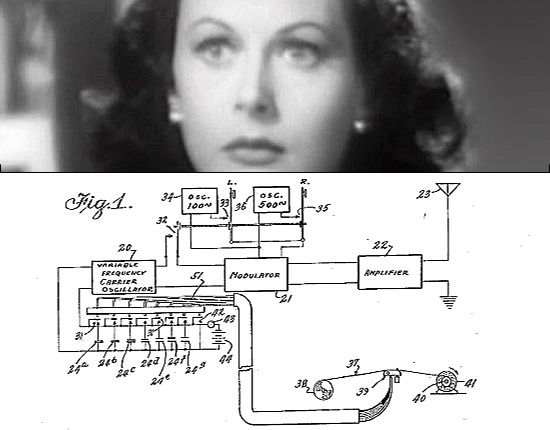
picture of Hedy Lamarr and her invention.
Hedy Lamarr (photo from Business Week)
pushed aside by military leaders who couldn’t believe a beautiful actress could possibly devise a useful system for thwarting attacks. And when she died in 2000, her obituary in the New York Times devoted only two short paragraphs to her scientific and mathematical interests. Far more space was given to a description of her legendary beauty, her modestly successful film career, and her six marriages.

The story of how Hedy Lamarr came to live in Hollywood was not an unusual one for the 1930s when the movie capital was a beacon to so many European artistic exiles. She had been born in Vienna as Hedwig Eva Marie Kiesler, the daughter of a prosperous banker and his concert pianist wife. As an only child she was encouraged by her devoted parents to develop her interests in art and science. She studied drama, decided she wanted to become a Hollywood actress, and while still a teenager talked herself into a small role in a film. At 16 she dropped out of school and determined to become a movie star. Her startling beauty eased her way into films and she made the movie Ecstasy, which made her famous, more because of the brief nude scenes than because of her acting.

Soon she was being courted by Friedrich Mandl, one of the richest men in Austria, and the owner of a munitions factory. By the time she was 19, Hedy was married and living a life of luxury, but the price she had to pay was Mandl’s insistence that she give up her career. She later described her life with him as being “like a doll in a beautiful, jeweled case”. She left the world of the theater and gave dinners for businessmen and their wives. She wasn’t interested in munitions or weapons, but she heard many discussions about these subjects which later provided the basis for her inventions.

By 1937, Hedy had suffered enough from the restrictiveness of her marriage with Mandl. She wanted to return to acting and finally worked up the courage to do that as well as to file for divorce and to escape to London. From there she booked passage for America on the same ship that Louis B. Mayer was traveling on. Her beauty and her popularity with the male passengers persuaded Mayer that she would be an asset to his movie studio, so he offered her a contract.

Life in Hollywood was not quite as easy or as much fun as she had expected. She had to learn English, lose some weight, and wait until Mayer found suitable roles for her. She was not very interested in the socializing that was a part of Hollywood life. She didn’t drink and she was concerned about the war looming over Europe. Instead of spending her time at parties, she set aside a corner of her living room as her “inventing” space. Her hobby was trying to come up with ideas for new gadgets that would make life easier. She also became absorbed in the idea of doing something to help the war effort and this was where those long dinners in Germany finally paid off.

After meeting the composer George Anthill, she joined with him in trying to devise a way to prevent the enemy from jamming the radio signals that American ships and planes used to communicate with one another. She and Anthill devised a way to use frequently changing or “hopping” frequencies that would make American messages sound like gibberish to the listening Germans.

The two inventors patented their device in 1942 and Hedy Lamarr offered it to the Navy Department, but it was turned down. We’ll never know why the Navy didn’t recognize the value of the invention, but perhaps it had something to do with the fact that one of the co-inventors was a woman, and a spectacularly beautiful woman at that. How could she possibly know anything about engineering or math?

Whatever the reason, it wasn’t until after the war that the device Lamarr and Anthill invented was used by the military in the Cuban missile crisis of October 1962. Since then it has been used to develop cell phone technology and other electronic devices. All of this happened after the patent had expired, so neither Hedy nor Anthill ever earned a penny from their invention.

In 1997, the Electronic Frontier Foundation presented Hedy Lamarr with a special Pioneer Award and she became the first woman to receive the BULBIE Gnass Spirit of Achievement Award.

To find out more about Hedy Lamarr and her extraordinary life, you really should read Hedy’s Folly: the Life and Breakthrough Inventions of Hedy Lamarr the Most Beautiful Woman in the World by Richard Rhodes. It will give you a whole new perspective on glamorous movie star life. The book is available on Amazon.com and no doubt at your local public library.

Ada Lovelace and the numbers she loved to crunch

Almost every day of the year has been declared a commemoration of one individual or another and most of us ignore them. This week brings a day that should be celebrated more than most—Ada Lovelace Day on Oct. 15, 2013. The celebration will take an unusual form in some places. At Brown University in Rhode Island, students will honor Ada Lovelace by writing articles for Wikipedia. To understand this Wikipedia party, you may need some background.

Who was Ada Lovelace and why is she celebrated? You can still get a few arguments about whether she deserves the distinction, but she certainly had an unusual

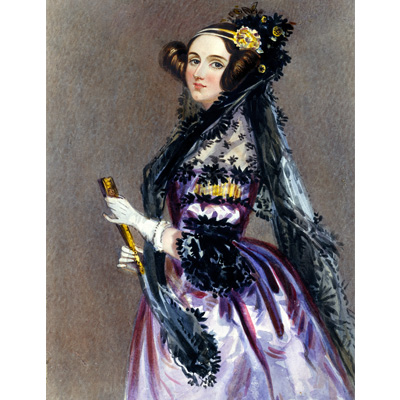
Ada Lovelace, computer programmer
life. She was born in England in 1815 and was the legitimate daughter of Lord Byron, quite a feat in itself because the famous poet fathered all of his other children with women who were not his wife. Still, being born legitimate is not an achievement for the baby, who has no choice in the matter. Ada Lovelace (born Augusta Ada Byron) had to be an unusual woman to earn a reputation of her own and gain lasting fame. And she was.

Despite having an irregular upbringing with a mother so focused on hatred for her husband, Byron, that she had little time for her daughter, Ada Lovelace had a good education. Her mother encouraged tutors to teach Ada mathematics as a way to ward off the tendency toward madness that she believed affected Lord Byron and his family. Ada took to numbers and became a competent mathematician as well as mastering several languages.

Ada Lovelace moved in high social circles. She became Baroness King when she married William King. The couple had three children, but Ada still had time to continue her friendships with both men and women. She became an avid gambler and tried to find mathematical models to help her and her friends find formulas which would increase their winnings. That, unfortunately, didn’t work and she went deeply into debt. However love of mathematics continued.

It was her friendship with Charles Babbage, the inventor of the Analytical Engine, a first attempt at a computer, which led to her developing an algorithm to allow the analytical engine to compute Bernoulli numbers. It was this which led to her being considered the first computer programmer.

Scholars have debated how much of the programming work was done by Ada and how much by Babbage, but perhaps it doesn’t matter. Whether or not she actually was the world’s first programmer, she certainly achieved far more than anyone would have expected of a 19th century woman. And all that she achieved was done before she died of cancer at the age of 36.

It is very fitting that we now have an Ada Lovelace Day celebrated every year in mid-October. The day is dedicated to honoring the past achievements of women in science, engineering, technology and mathematics and to encouraging young women to enter these fields.

You might wonder what Ada Lovelace has to do with Wikipedia, but the connection is the gender-bias that has resulted in having far more men than women represented in the encyclopedia. Not only are women under-represented in Wikipedia, they are also under-represented in technology and scientific studies. Girls today have very few role models who inspire them to enter the STEM fields of study. Let’s hope the students at Brown University will come up with some articles that may inspire young girls today and in the future to become the scientists, technologists, engineers and mathematicians that are needed to keep our future growing.

Taking to the open road–Saudi Arabian women

Sometimes all it takes is a movie to open our eyes to some basic injustices. Yesterday I saw the Saudi Arabian movie Wadjda about a determined young girl—ten or eleven years old—who wants to have a bicycle so she can race with a boy who is her friend and neighbor.

two Saudi girls in school
Saudi girls memorizing verses from the Koran.
The movie gives us an intimate glimpse into the life of a lively Saudi girl. She has a quiet family life as the only child of a warm, caring mother and father, although the father is only with the family on weekends.

Gradually we glimpse the stringent and seemingly meaningless restrictions on the lives of both Wadjda and her mother. In the girls’ school that Wadjda attends, the children are not allowed to play in the schoolyard when construction workers are working in the distance—the men might catch a glimpse of them. They cannot laugh or talk loudly because “a woman’s voice is her nakedness” and must never be heard by men outside of her family. Wadjda’s mother goes to work every day, but has to travel in a van with a male driver because women are not allowed to drive nor to walk on the streets. She and her daughter cannot even go shopping without asking the driver to take them to the store.

Although pre-pubescent Wadjda is allowed to walk through the sandy lots of the city and to have her face uncovered (although her hair must remain hidden), we leave the theater knowing that far more restrictions await her when she grows older.

Saudi woman at a mall
Surely every American woman who walks out of the movie must wonder why Saudi women continue to submit to the stringent rules that limit their lives so drastically.

There are a few far-off glimmers of hope for women’s freedom in Saudi Arabia. The king has proclaimed that starting in 2015 women will be allowed to vote and to run in local elections. That is a start. Most women, however, long for the freedom of driving more than they long for the vote. BBC World News reports that a new campaign asking for the right of women to drive has attracted more than 11,000 signatures. The day on which Saudi women are planning to take to the roads is October 26, 2013. To some activists, the right to drive seems trivial, but if you think about what it would mean to be unable to leave the house until some man can be found to drive you on any errand or visit, it’s easy to understand. Day after day women suffer the embarrassment, expense, and humiliation of being totally dependent on the wishes of a male who has the key to a car.

Even though the number of Saudi women who have learned to drive must be tiny—only the educated members of a wealthy family would ever be able to learn—it is at least a start. When women have the ability to travel locally and to visit one another without supervision, who knows what independent plans they may foster? Those of us who live in the West should all support the Saudi women in their efforts. Let’s join together to hope that someday Wadjda could have not only a bicycle, but the keys to a car so she can grow into the kind of strong, independent woman that is needed in Saudi Arabia and the world.

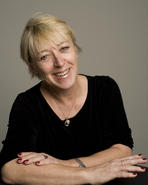
Blessed are the peacemakers—Jody Williams

This week when most Americans are breathing a sigh of relief because it looks as though the Syrian crisis may be ended without bombs, it’s a good time to think of some of the other peacemakers who have worked to remove some of the worst weapons from the world. Jody Williams and the people who worked with her to ban the use of landmines is one of the most prominent.

Jody Williams
Jody Williams

Just over twenty years ago, in 1992, Williams started the International Campaign to Ban Landmines (ICBL) which worked tirelessly to convince countries and international organizations to join together to outlaw the use of landmines. These mines have been used for several centuries in wars in Asia, Europe and the Americas, but their use increased toward the end of the twentieth century. Television brought sickening pictures of the victims, many of them children, into the world’s living rooms.

Victims of landmines
Landmines are shocking weapons when they are used to kill and maim soldiers, but their use goes far beyond that. Anti-personnel landmines stay buried in the earth for years—for generations—and the damage they do can be seen in the number of people with only one leg, or no hands, or other body parts missing. Small children hobble around on crutches because a seemingly harmless walk through a field led to a devastating explosion that brought pain and misery. No number of free crutches or doctor services can undo the lasting harm.

When Jody Williams decided to start the International Campaign to Ban Landmines, it must have looked like an overwhelming job. Slowly and painfully through collecting enough money to raise the issue publicly and finally shame most governments into signing the ban, the organization made headway. 161 states have signed the Ottawa Treaty banning the use of anti-personnel landmines although neither Russia nor the U.S. has done so. The U.S. has said that it needs to have the freedom to use landmines in the DMZ between North and South Korea. Americans still need to push our legislators into finding other ways to fight wars—methods that don’t involve the killing and maiming of innocent civilians.

But this week Russia and the U.S. are working together to find a way to stop the use of chemical weapons in Syria. It’s not a perfect solution to the violence in Syria; the civil war continues there, but it is an important effort. If Syria can be persuaded to give up chemical weapons and destroy them, the world will have moved one small step toward greater peace.Perhaps someday John Kerry and his Russian counterpart Sergei Lavrov will join the roll of peacekeepers. If Jody Williams and her colleagues can persuade countries to ban landmines, surely two powerful government officials can work together to eradicate another one of the world’s devastating war tools—chemical weapons. That would surely be a blessing for all of us.

Fighting for rights for labor

Labor DayJudging by the store ads in my Sunday paper, Labor Day means nothing more to most Americans than a day off for shopping and barbeques. A hundred years ago, having a special holiday to honor working people seemed much more important. People felt united as workers, as employees struggling to decent working conditions. One of the triumphs of the labor movement was the establishment of the Department of Labor in May 1913.

Why was it such a big deal? Well, despite the lack of enthusiasm in the Washington establishment, union leaders across the country hoped that having a voice for labor in the cabinet would make a difference. And believe it or not it has. For one thing it changed the composition of the cabinet to include the non-wealthy. Dwight D. Eisenhower’s cabinet in the 1950s was called “Nine millionaires and a plumber” Can you guess which department the plumber headed?
Take a look at the website for the Dept. of Labor and look at the timeline there. You’ll be surprised at the changes that started at the department.
• Supported the Workman’s Compensation Act to get benefits for injured workers
• Started the women’s bureau in 1920
• Started collecting unemployment statistics—previously had only collected employment statistics and not worried about the unemployed
• Limited working hours for children
• Pushed to get Social Security benefits for workers

Perhaps as we share a holiday with family and friends, we should spare a thought for the people who fought to bring us some measure of security in our jobs.

I find it interesting to think about the women who were leaders in the early labor movement. Frances Perkins, the longest serving Secretary of Labor is largely responsible for shepherding Social Security and other New Deal programs through Congress. Her method of being a leader in a man’s world of politics was to downplay her femininity and her sexuality. She was famous for wearing drab, old-fashioned clothes and at social gatherings was not seen as a threat to the wives of her colleagues. Perhaps at that time in Washington her nonthreatening appearance was an important part of her being able to outmaneuver those husbands in politics.

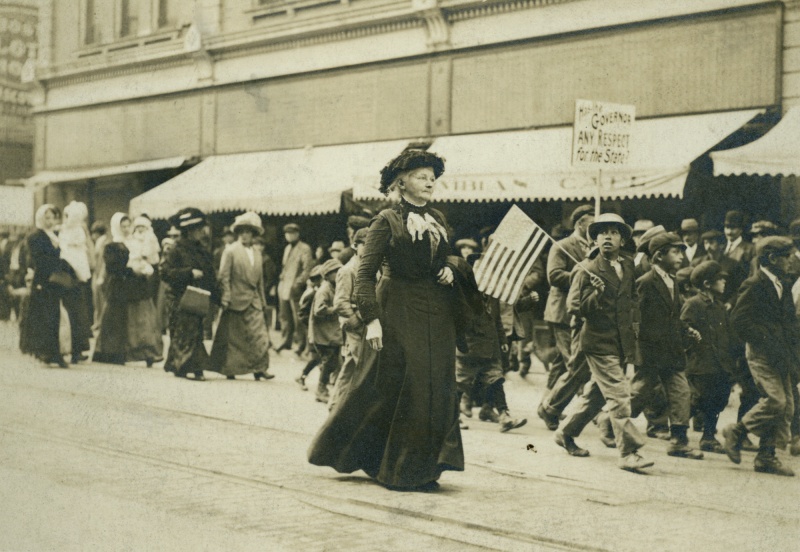
An even earlier labor leader, Mary Harris or “Mother Jones” took the same approach. She claimed to be older than she really was and she too wore old-fashioned black dresses. She gloried in being called “Mother”. Surely there was no better way for her to protect herself from unwanted sexual advances or harassment. She was able to win many labor

Mother Jones in Colorado
battles by enabling male workers to take the lead and fight the bosses to achieve some famous labor victories. There isn’t time here to go into the wonderful story of how Mother Jones won so many victories for “her boys”. They are well told in Elliott J. Gorn’s biography Mother Jones; the Most Dangerous Woman in America. But let’s raise a toast and remember an early verse written in her honor in the United Mine Workers Journal:

We love her for her constant voice.
Raised ever ‘gainst wrongs and ills,
For healing the bodies, bruised and torn,
In the factories, mines and mills…

Celebrate Women’s Equality Day

August 26, 1920 was the day that American women finally got the right to vote. It took a long, hard fight to win this right. Let’s celebrate!

Everybody counts in applying democracy. And there will never be a true democracy until every responsible and law-abiding adult in it, without regard to race, sex, color or creed, has his or her own inalienable and unpurchasable voice in government. -Carrie Chapman Catt

Mercy Warren –The Costs of Revolution

We can’t read the newspaper or watch the news these days without hearing about the desperate struggle of Egyptian people to get a government that will rule democratically. Americans are inclined to be a little smug about the way we set about separating from England and establishing our own democracy. After all, we had those enlightened gentlemen in elegant clothes sitting decorously at a table and writing a document that would stand for centuries as the cornerstone of a stable democracy.

Mercy Warren
Mercy Warren
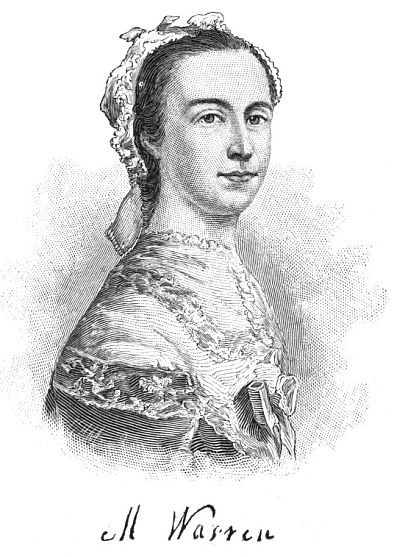
A closer look back at our revolutionary leaders gives us a better grasp of reality. I’ve been reading a biography of Mercy Otis Warren, who, like her good friend Abigail Adams, influenced many of the men who fought in the Revolution. Mercy and John Warren’s home became a meeting place for leaders who organized the Boston Tea Party and fought for the rights of the colonies to organize their own governments. Even though women were not encouraged to participate in public life, Mercy Warren began writing pamphlets and satirical verses and dramas that supported the Revolutionary cause.
At leisure then may G[eor]ge his reign review,
And bid to empire and to crown adieu.
For lordly mandates and despotic kings
Are obsolete like other quondam things. (1775)

The years following the Revolution brought little peace to Mercy Warren and her husband as they disagreed with many of the decisions of the Federalists who controlled the government. James Warren, who had been a leading figure in the war for independence, was shut out of government service and his sons struggled to find posts.

When a new constitution was drafted and presented to the states, Mercy Warren opposed its ratification. She wrote a pamphlet “Observations on the New Constitution…” in which she urged the states to reject the draft. One of her major objections was the lack of a bill of rights “There is no provision by a bill of rights to guard against the dangerous encroachments of power” she wrote. She was also concerned about the six-year terms given to senators. “A Senate chosen for six years will, in most instances, be an appointment for life…” (Well, she was right about that, wasn’t she? Many Senate terms have lasted for a generation or more.) She worried that there were no defined limits to judiciary powers and that the executive and legislative branches were dangerously blended together. The Constitution certainly did not seem a sacred document to her.

As we all know, the Constitution was ratified and has become the basis of American law. Some of Mercy Warren’s concerns were addressed very early. The passage of the Bill of Rights can be attributed in part to her demands. Other aspects of government continue to be addressed such as the power struggle between the Legislative and Executive branches. But the Constitution survives and so does the country.

Reading about the early struggles for democracy in America can give us some hope for the several countries around the world that today are moving down the same path. Perhaps they too will eventually find a way of building a democracy. Revolution is never easy, and it never solves all of a society’s problems, but we can’t give up hope that eventually most citizens will join together to build a livable country.

If you want to read more about Mercy Otis Warren, there is information about her in Cokie Roberts’s book Founding Mothers. For a complete biography, I highly recommend Muse of the Revolution: the Secret Pen of Mercy Otis Warren by Nancy Rubin Stuart.

An anniversary to celebrate–Ruth Bader Ginsburg

Twenty years ago this month Ruth Bader Ginsburg became a Supreme Court justice and ever since then she has been making history. Her opinions, whether in agreement or dissent on a wide range of cases have kept the Court on an even balance over the years.

Justice Ruth Bader Ginsburg

Media pundits have been talking and writing about Ginsburg’s legacy and they often seem surprised that at the age of 80 she is still going strong in her demanding job. But there is one factor that no one has mentioned so far that might have improved her vitality and her long-lived success. She went to Cornell University, graduating in 1954, not too far off from the year I graduated from Cornell. In those days men far outnumbered women at the university, and one of the popular folk beliefs among the men was that coeds lost their good looks because they had to climb the hills of Ithaca to go to classes. It was said that our legs became too muscular and we looked more like athletes than “real women”. Well, Ruth Bader Ginsburg, and all of the women of our generation who are still alive and participating in the world, were probably strengthened by all that walking on those snowy hills. Justice Ginsburg regularly goes to the gym and is reputed to be strong and fit. Perhaps the world owes a vote of thanks to the good start she got on the hills of Ithaca.

Of course physical vitality is only a tiny part of Justice Ginsburg’s many extraordinary attributes. She proved herself a brilliant lawyer and a staunch advocate of the rights of women and of all citizens to equal treatment before the law. Unlike some justices, she does not believe that the Constitution is an unchanging text set in stone, but rather a document written by humane leaders setting forth the basic principles of democratic government. As the world and society changes, Justice Ginsburg’s view of the Constitution is not bound by the 18th century meaning of words but rather by the deepest values of our ever-changing population.

Let’s all wish Justice Ginsburg a happy anniversary of service and hope that she continues to add her valuable voice to the Supreme Court for many more years!

Prof. Lee Lorch, a long-lasting light in a dark world

Almost twenty years ago, in 1994, I made my first trip to Cuba as an adult. I had visited as a child with my family during Lee Lorchthe days of close U.S.-Cuban ties, but after Fidel Castro’s successful revolution, it was difficult for Americans to travel there. The 1994 trip was to a conference of the International Federation of Library Associations so participants came from all over the world. The trip was an eye-opener for all of us as it gave us a chance to see for ourselves what Cuba was really like. For me a special bonus was getting to know Lee Lorch, a most unusual academic and activist who has had an impact on people and events in several different societies.

Lee contacted me through mutual friends to see whether I would join an effort to send secondhand computers to Cuba. Having seen the shortage of technology in the schools and libraries in Cuba, I was glad to participate. As time went on I discovered that helping Cuba was only a small part of Lee Lorch’s efforts to improve the world. As a mathematician at York University he taught students and wrote scholarly papers, but being a scholar wasn’t enough for him. He had spent many years fighting racism in the United States and every time I met him there were new revelations about events he had participated in. He fought to open an apartment complex in New York City to African-Americans; he and his wife escorted students into the newly-desegregated Little Rock High School during the turmoil of school desegregation. He lost teaching jobs and had to move from one university to another as his notoriety grew.

In 1959, Lee and his family moved to Canada when he took a position at the University of Alberta. Later he moved to York University in Toronto. After all the turmoil of his life in the U.S. he found friends and a new life in Canada, and he never gave up fighting for justice. One of his interests was to encourage women mathematicians who were routinely discouraged from entering the field and often treated unfairly if they persisted.

People today find it almost inconceivable that even in the 20th century academics openly discriminated against non-white people and women. Until you read the story of someone like Vivienne Malone Mayes, it is hard to imagine the determination needed for women, and especially African American women, to be accepted in science and mathematics. Lee Lorch was among the pioneers in encouraging women to enter the field and in supporting their efforts for advancement.

I know I am late in finding out about this, but it made me very happy to learn that last year Professor Lee Lorch received a distinguished scholar award from CAUT—Canada’s organized voice of academic scholars. At the age of 97, he has participated in many struggles for justice and fair treatment for all people. He is a credit to the universe, and I hope the honors continue to flow during these crowning years of his long life.