February is the shortest month on our calendar and this year it somehow slipped away from me entirely. Computer problems caused me to lose several files and some pesky health problems slowed me down. But now March has come. The days are getting longer and I hope my blog will get back on schedule.
One of the best-kept secrets of most best seller lists is that sometimes the real bestsellers never appear on the lists. While critics choose the bestselling books of the week or the year, readers may be spending their time reading books written centuries ago. The New York Times has a careful set of criteria for its bestseller lists. The details of their criteria are not public, but the Times does not include all the books that appear in a given year. They do not include books published by religious publishers even though these attract large audiences. The Bible, for example, is a perennial best seller that never makes best seller lists.
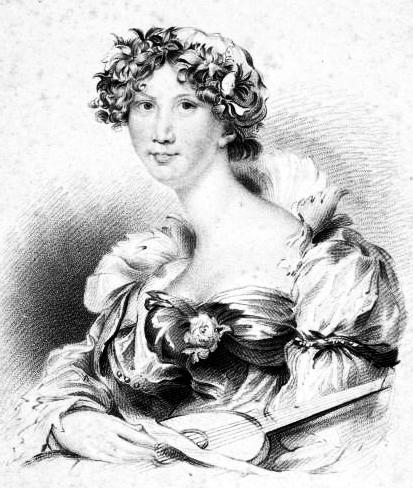
Ann Radcliffe
Ann Radcliffe was born on July 9, 1764 in London. She moved to Bath with her family a few years later. She might have attended school in Bath, although there are no records of this. She certainly grew up to be a reader. In 1787, she married William Radcliffe. Her husband was a newspaperman who encouraged his wife to read and to write. The couple had no children and Ann devoted most of her time to those activities and to travelling. Her first book was a series of travel letters.
Radcliffe’s first novel, The Castles of Athlin and Dubnayne was published anonymously in 1789. The following year she wrote another book, A Sicilian Romance. Each book increased her audience and by the time she wrote her third, she began to publish under her own name.
For her most famous book, The Mysteries of Udolpho, Radcliffe received 500 pounds, while the average author in England at that time received only 10 pounds for a novel. She was soon earning far more than her husband did for his newspaper work, but the difference did not seem to interfere with their relationship. They remained a devoted couple.
Even though Radcliffe was a successful writer, she did not publish a great many books. While her books continued to be read and discussed by readers and other authors, she herself stopped writing quite early in her career. Her audience, however did not stop reading.
Radcliffe was the most popular writer in England during the early nineteenth century. She was admired by both Jane Austen and Sir Walter Scott. And her influence did not end at England’s shore. Even the great Russian novelist, Dostoyevsky, read and admired her books.
You might want to try reading a few of Ann Radcliffe’s books too. They are easily available online and in libraries and bookstores. Although they are not on our best seller lists these days, they are a refreshing reminder that we can still enjoy books written long before we became readers. Not all books lose their charm as time goes by. Why not try one of them and find out what Jane Austen read before she started writing books of her own?
We live in a world full of problems—as if climate change and the difficulties it brings weren’t enough to worry about, people continue to manufacture problems of their own. Listening to the speeches of some of our politicians, it would seem that one of the biggest ones for the U.S. is integrating strangers into our country. Donald Trump often rails that “immigrants are poisoning our country” and some of his followers echo those words.
But over the years many of our greatest writers have recognized that almost all Americans can trace their family history to other countries. Immigration is what has built the society that we know today. Willa Cather, one of our most important authors, wrote many of her books about people who had left their homes and chosen to settle in America. Cather herself moved from one part of the country to another and was interested in how the moving and resettling affected her and her neighbors.
Willa Cather was born in Virginia in 1873 although as she grew older, she sometimes did not acknowledge her correct age and claimed to be a year or two younger than she was. She moved with her family to Nebraska when she was nine years old. The family first settled in a rural area where their neighbors were mostly immigrants from Northern Europe, but they soon moved to the city of Red Cloud, Nebraska.
Cather thrived in school where she learned quickly and enjoyed her classes. She quickly discovered that writing was what she did best. While she was still a student, several of her articles were published in local papers. After attending the University of Nebraska, she moved to Pittsburgh to work as a journalist and teacher, but as her writing success grew, she realized that New York City was the place to be. She moved there in 1906 and for the rest of her life that city was her home base.
One of Cather’s greatest strengths was her ability to see life from different points of view. A.S. Byatt, the British novelist who died earlier this year, once wrote that Cather “reinvented the novel with every book she wrote”. Cather’s best-known novel, the one that often appears on high school reading lists today, is My Antonia, whose title character is part of a family that came to America from Bohemia. These immigrants from Northern Europe were similar to the people Cather knew when she was growing up in Red Cloud. The characters and the hardships they endured give a vivid picture of life among some of the immigrants who settled the northern plains where Cather’s family lived.
Unlike some regional writers who continue to focus on a particular group throughout their careers, Cather had a much wider vision. She was a traveler as well as a writer, and when she travelled, she immersed herself in the lives of the people she met and the history of the places she visited. After visiting the Southwest In 1927, she wrote Death Comes for the Archbishop a novel exploring the life of a priest who settled in New Mexico.
In a somewhat less known work, Cather wrote Shadows on the Rock about the French people who had settled in Quebec. Although Cather did not write directly about immigration as an issue, the people in her books were examples of groups who had moved to America and built new lives there. Some of her books may seem old-fashioned now, but they give vivid accounts of the various people who integrated their cultures into American life. At this time, when we are seeing a new wave of immigrants entering the country, looking back at some of Cather’s work gives a reassuring picture of how different people from many parts of the world have become part of western life.
Many good biographies of Willa Cather have been published. One of the most recent is Chasing Bright Medusa: A Biography of Willa Cather by Benjamin Taylor (2023 Random House).
Just about half a century ago, in February 1968, the New York Times printed a front-page obituary of one of the most popular writers of the twentieth century—Fannie Hurst. Today her name means almost nothing to an average American reader. Her books have disappeared from most public libraries and bookstores, although films based them are easy to find in film study classes and on YouTube. Who was this woman who loomed so large for half a century and then fell so far?
Fannie Hurst was born on October 18, 1889, in Hamilton, Ohio. Her only sibling, a sister, died soon after Fannie’s birth. Her parents were an immigrant couple from Germany. Fannie grew up in St. Louis, attended public schools there and graduated from Washington University at the age of 24. During her last year in college, she wrote the book and lyrics for a production of a comic opera. After her graduation, she began submitting stories to magazines, but had a difficult time getting them accepted. Her parents wanted her to stay in St. Louis and find a suitable husband, but Fannie was determined to build a career. Finally, after two years, she persuaded her parents to allow her to move to New York City and find out whether she could succeed as a writer.
Fannie fit easily into life in New York. She wandered around the city to visit different neighborhoods and took jobs as a salesgirl and as a waitress in a Childs restaurant to study city life. She also visited night court sessions to learn more about criminal activity and punishment in the city. But always, she wrote. In 1912, she sold a story to the Saturday Evening Post and after that her sales to magazines increased. The Post asked her to write exclusively for them and she soon became a well-known author. In 1921, her first novel, Star Dust, the Story of an American Girl appeared. It was not long before her career took off. Within a few years she was one of the best paid writers in the country.
Fanny was an energetic and diligent worker who was never at a loss for devising new twists for her stories. She was also a good businesswoman who had no qualms about demanding high paying contracts with magazine editors so that she could plan on writing a number of stories for publication as a series. In New York, she quickly made new friends with whom she shared social life as well as market information. Perhaps equally important in her success, she was a healthy, disciplined worker who fulfilled her obligations and never developed the bad habits that prevented many other writers from fulfilling their promises. She did not drink alcohol nor get involved in passionate love affairs. Despite family obligations—her parents demanded many visits and frequent letters—she did not let depression or annoyance interfere with her writing schedule. Editors could count on her.
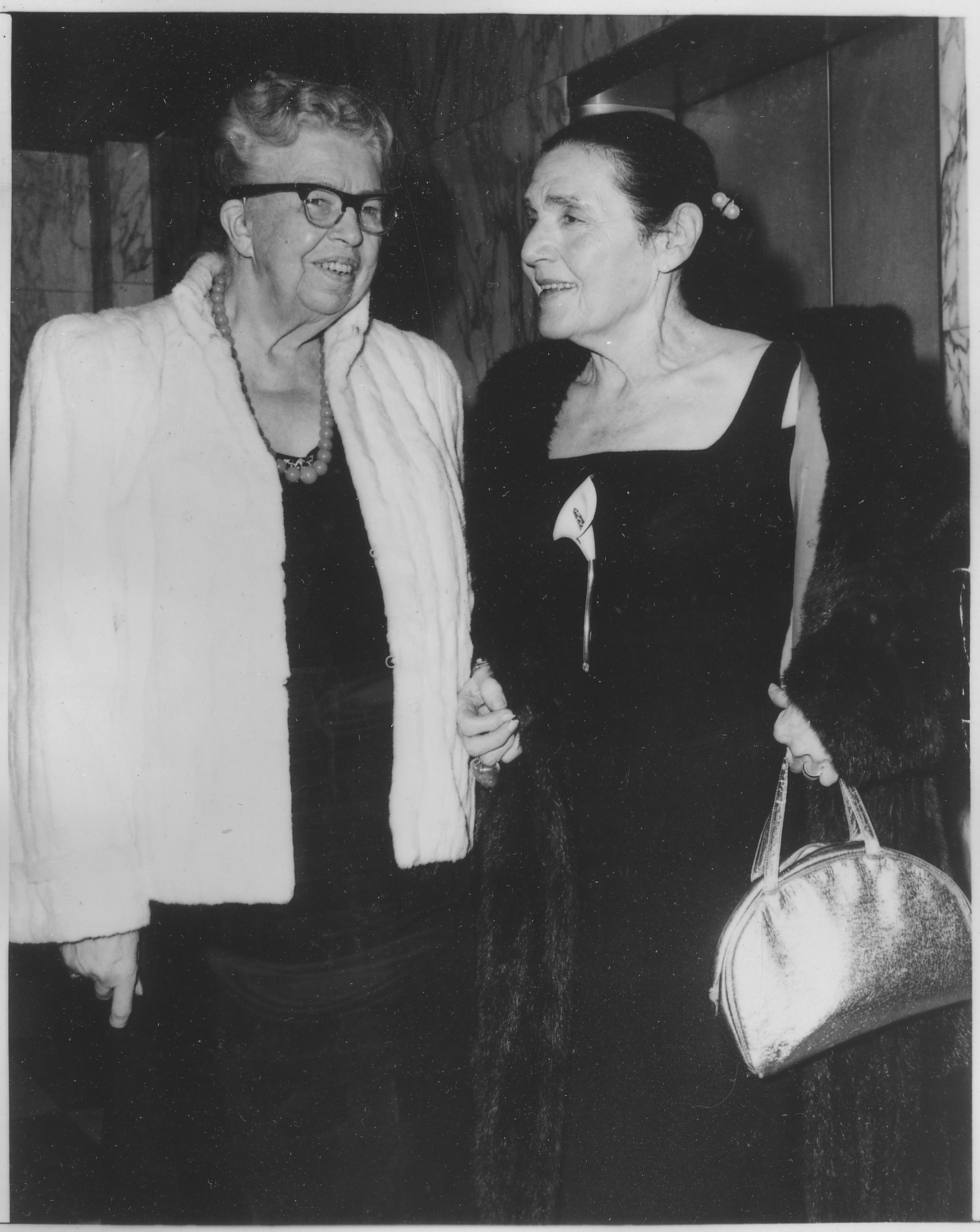
Fannie Hurst with Eleanor Roosevelt
The public too could count on her to come up with plots that offered endless variations on the familiar themes of family life and love affairs. Her audience was primarily women, who struggled with the endless issues of maintaining satisfactory lives in a fast-changing world. No doubt she introduced many American women to neighborhoods they had never seen and the kinds of people they had never met. She didn’t spare words in describing the settings for her stories and novels. The first sentence of her novel Humoresque uses 53 words to set the stage for the neighborhood where her characters live:
On either side of the Bowery, which cuts through like a drain to catch its sewage, Every Man’s Land, a reeking march of humanity and humidity, steams with the excrement of seventeen languages, flung in patois from tenement windows, fire escapes, curbs, stoops, and cellars whose walls are terrible and spongy with fungi.
Few of her readers would have ever seen such an inner-city neighborhood, but Fannie spread it out before them so readers in small town Idaho could visualize the lives of immigrant New Yorkers and sympathize with their troubles. Some critics and reviewers complained about the wordy details Fannie provides, but readers loved them and her books sold widely.
As Fannie’s work became more popular, her social life expanded. She became more interested in women’s rights and other causes and was an early member of the Lucy Stone League, a group dedicated to allowing married women to keep their own name rather than adopting their husband’s name. Her own marriage demonstrated her determination not to become labelled as “wife of…”.
In New York, Fannie met and fell in love with a Russian émigré, the musician, Jacques S. Danielson, but when she took him to meet her parents in St. Louis, they objected strenuously to the marriage. They looked forward to having a daughter conventionally married to an American from the Jewish community in which they lived rather than a foreigner. Instead of openly defying her parents, Fannie and Jacques had a quiet wedding in New Jersey and stayed in their separate apartments in New York. For five years they told no one about the marriage and carried on their usual social lives. When a reporter found a record of the marriage and wrote a story about it, the news caused a sensation. Nonetheless, Fannie and Jacques continued their separate social lives although they eventually moved in together. Their marriage lasted until Jacques’s death in 1952. Fannie mourned him for the rest of her life.
By the late 1920s, Fannie was a well-known public figure and one of the most popular and well-paid writers in the country. When the movie industry started during the early 1920s, it was natural for producers to turn to her stories for material to be filmed and made available in the new format. The movies made it possible for Fannie’s readers to see the settings in which her stories took place without reading Fannie’s lengthy prose and so it opened up a new audience. Her fame and popularity with both viewers and readers continued throughout the development of the movies. She was fortunate in her timing because her stories could be filmed more than once as movie technology changed from silent films to talkies and eventually to technicolor films.
During the 1930s, Fannie’s high energy life continued and it was not restricted to writing and publishing. She became more involved in social issues, especially as her friendship with Eleanor Roosevelt grew. She was invited to the White House for lunches and events and she supported the first lady in her campaigns to establish racial equality and to increase support for women’s causes.
During her long and busy life, Fannie maintained the discipline that kept her writing and publishing short stories and novels. She became a host on several radio and TV stations, although her popularity in these media never reached the heights of fame that her writing did. Gradually, during the postwar years, Fannie’s earning power diminished. Nonetheless, she remained prosperous and led an active life until, after a short illness, she died of cancer on February 23, 1968.
A recent biography by Brooke Kroeger, Fannie: The Talent for Success of Writer Frances Hurst (2022) tells the full story of Fannie Hurst, an unforgettable woman whose achievements should not be forgotten even by people who no longer read her books. She left an indelible mark on the culture of twentieth century America.
In 1890, when Agatha Miller was born into a middle-class family in Southern England, no one would have predicted that she would still be remembered today. Not only is she remembered, but her books continue to be sold worldwide and movie and tv adaptations of her works continue to be produced. Many of her fans are looking forward to September 2023 when they will be able to see A Haunting in Venice, Kenneth Branagh’s adaptation of Christie’s Halloween Party, a sequel to Death on the Nile. Who was this woman who holds such a grip on audiences from England to Ethiopia and from North America to Southern Asia?
Agatha’s family was prosperous, but not influential. Her father had been born in the United States but lived much of his life in England. He was not particularly interested in being a businessman and was better at squandering the wealth he had inherited rather than adding to it. Her mother believed that girls did not need much education so she did not encourage Agatha to learn to read. Nonetheless, Agatha was curious about books and with the help of her grandmother, she learned to read by the time she was four years old. Like most middle-class girls at that time, Agatha assumed she would not need to earn a living because she would marry and devote her time to her husband and family. But the world was changing and Agatha’s life did not follow the traditional pattern.
As she grew into her teens, Agatha was given a taste of formal education by attending boarding school in France, but her social life was more important to her than education. She began to attend parties, where she met many young people of her class, notably Archie Christie, a handsome young man who pressed her to marry him.
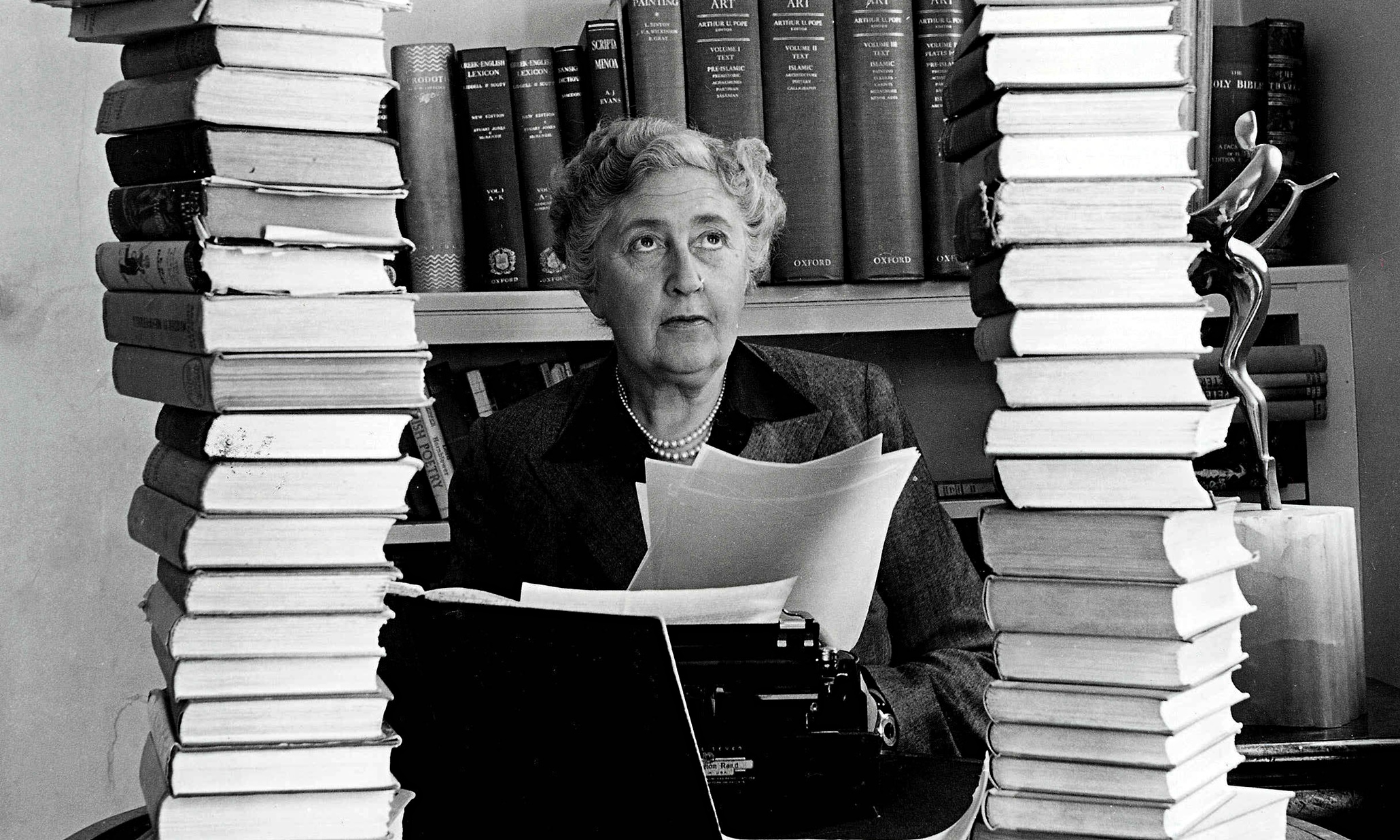
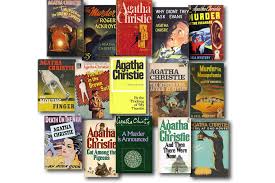
Agatha Christie and her books
The start of World War I in 1914 brought dramatic changes to all of Europe including England. Earlier British wars had been fought mainly in distant countries such as India and Afghanistan. Suddenly battles were being fought close to home and wounded soldiers were being sent home to hospitals in England. Most young men joined the army, including Archie Christie, who was soon sent overseas to fight in France.
Like many other women in those days, Agatha volunteered to work for the Red Cross in British hospitals. It was a full-time volunteer job, and Agatha learned a great deal about nursing and especially about handling drugs, tending the sick, and dealing with death. During one of his home leaves, Archie and Agatha got married.
Settling down to peacetime life was not easy. Neither Archie nor Agatha was wealthy, although they were accustomed to living as if they were. Their only child, Rosalind, was born in 1919. Archie found jobs in business while Agatha was responsible for taking care of the house and of Rosalind. She wrote her first novels during these postwar years, but finding a publisher was difficult. Finally, she tried writing mystery stories, basing her major character, Hercule Poirot, on the Belgium soldiers she had met during her wartime work. The first Hercule Poirot story, The Mysterious Affair at Styles caught the public’s attention and has held it. Played by a series of actors during the years, Poirot is still appearing in movies and television productions more than a hundred years after he was first introduced.
Agatha continued to write mysteries and soon became one of the most popular and well-known British novelists. Unfortunately, her marriage did not fare so well, and in 1926, this led to the most dramatic episode in her life. The year had not gone well for Agatha, starting with her mother’s death in the spring. In December, Archie asked for a divorce because he wanted to marry his assistant. The day after his announcement, after leaving Rosalind with her sister, Agatha disappeared. Her empty car was soon discovered, but Agatha had vanished. Newspapers worldwide seized upon this story and the search was on. There were reports that Agatha had been seen dancing at a health spa, and later at a resort hotel, but it was ten days before she was finally discovered. She was registered under an assumed name at a spa not far from her country house.
Agatha never completely explained what had happened. After she was discovered, she went into seclusion at her sister’s house leaving the public to argue whether her disappearance had been a publicity stunt or the result of genuine mental illness. Gradually she recovered and returned to normal life. But her marriage to Archie was ended. Her divorce was finalized and Agatha continued her writing career. For the most part she led a quiet, successful life. She had a happy second marriage with anthropologist Max Mallowan, raised her daughter, and enjoyed domestic life. But through all of her years she continued to write and publish more stories that entranced thousands of readers.
Several biographies have been written about Agatha Christie and many of them focus on the few days of her mysterious disappearance in 1926. Fans still argue about the causes and effects of that event, but probably the more important mystery is the question of why her career lasted so long and why it was so successful. The statistics are startling. During her lifetime, Christie published 66 mystery books as well as 14 short story collections. Her play, The Mousetrap, set a record as the world’s longest-running play. All of her works were written in English, but they have been translated and published in 44 different languages.
What is the secret of Agatha Christie’s success? That is the biggest mystery of all. She wrote most of her books during between 1920 and 1970. Other authors of that time have published other mysteries that were popular, but none of them approached the perennial appeal of Christie. Some critics have suggested that it is the cleverness of her best-known detectives, Hercule Poirot and Miss Jane Marple, that keeps readers entranced. Others say that the complexity of Christie’s plots are the secret ingredient that wins her fans. Her mysteries are honest in the sense that the clues are laid out clearly so the clever reader can match wits with the fictional detectives. And year after year the books continue to be reprinted and produced in electronic versions and readers continue to seek them out.
The only way to judge whether or not Agatha Christie’s work deserves the popularity it has achieved is to read the books for yourself or perhaps to view the film adaptations. Then you too can decide whether or not you are one of Christie’s fans and whether you can solve the mystery of her lasting appeal.
During the early 1800s, more and more people in England were leaning to read. In 1800, 60% of men and 40% of women were literate, but the numbers were growing every year. Supporters of public education declared that the purpose of reading was to give people access to the Bible. But the secret passion of the new readers was often to read fiction—stories that brought excitement and pleasure into their lives. And the people who wrote the stories that people clamored for were often women.
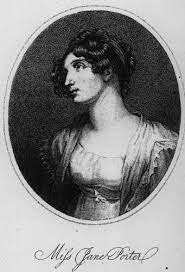
Two of the women who provided popular fiction for the masses were the sisters Jane and Maria Porter. They were born in the 1780s to an Irish doctor and his wife who were then living in Durham, England. Besides Jane and Maria, there were three sons in the family and their father encouraged them all to read, write and learn as much as they could. Unfortunately, the father died young, shortly after Maria was born, leaving them without a secure income. His widow moved the family to Edinburgh where the two girls attended a charity school. Both of them were attracted to reading and writing and as they grew older, they began publishing short articles. In 1790 the family moved to London.
While the boys in the family tried to earn their livings by joining the army or becoming diplomats, both of the girls turned to writing. Between them, they may have invented the historical novel. Jane Porter’s first novels, Thaddeus of Warsaw (1803) and The Scottish Chiefs (1810) were based on well-known figures and were written in a popular style. Both became bestsellers. Many of Jane’s books went through numerous editions and some remained in print for more than 100 years. In fact several editions of The Scottish Chiefs are still available on the Amazon website. But, despite the pleasures of fame, being a bestselling author during the nineteenth century was not easy, especially for a woman.
At the time when the Porter sisters were writing, women were expected to be dependent on men for economic security. Either their fathers or their husbands were supposed to earn money; women stayed at home. The three Porter brothers should have taken on responsibility for supporting their widowed mother and the two girls, but instead they spent much of their time building up debts of their own. The girls took over, but writing and publishing novels was not an easy way to earn money.
Today, authors expect to earn royalties on the books they write. The more popular a book becomes, the more money the author earns. During the early 1800s, there was no such thing as royalties. Books were sold to the publisher for a flat payment and if they were reprinted and sold widely, the publisher made the money, not the author. The only way the writer could earn more money was to update and change the story and sell it to a publisher as a new book.
The Porter sisters were always short of money, because they supported themselves as well as their mother. The best solution to find security would have been to marry a man with a good income. Both Maria and Jane were attractive women and men clustered around them at social events. Several times they met men who appeared ready to suggest marriage, but somehow, when a wealthier young woman appeared on the scene, each of the Porter’s suitors decided to marry for money rather than to propose to a penniless writer.
Besides not having royalties, the Porter sisters also suffered from the lack of international copyright. Their books sold well in America, but the authors received no money at all from these sales. Late in her life, after Maria died, and while Jane was struggling to keep going, her American publisher wrote to her to say that he believed she deserved some share of the profit he was making from her books. Instead of sending money, however, he sent a gift—a large chair, which turned out to be useless because Jane had no place to keep it.
Both Jane and Maria Porter have been almost forgotten, but fortunately for us, they exchanged numerous letters with one another and the letters have survived. In 2022, their lives were retold in a remarkable book–Sister Novelists: The Trailblazing Porter Sisters Who Paved the Way for Austen and the Brontes (NY: Bloomsbury 2022) by Devoney Looser. It makes me happy to know that Jane and Maria are being honored at last and I’m sure many readers will join me in celebrating their lives.
If you were asked to name the most popular woman author of the early twentieth century, what names would you recall? Perhaps it would be Edna Ferber, author of Showboat and Giant, Pearl Buck, who wrote exotic stories about China, or Betty Smith whose novel A Tree Grows in Brooklyn topped the best-seller list for weeks.
But what about Elsie Robinson? Her name is unlikely to spring to mind, yet during the first half of the 1900s, she was the most widely read female author in America. Why has she been forgotten?
Elsie Robinson was born in 1883, in Benicia, California, a town at the outer edge of the San Francisco Bay area. The community had been developed during the last years of the California gold rush and was still filled with the adventurous spirit of the miners who had built it. Elsie was sent to the only public school in town and was an excellent student, but when she graduated, her parents did not have the money to send her on for higher education.
There were few opportunities at that time for an ambitious girl to get education or to find work, so Elsie turned to the traditional option of marrying an educated and prosperous man. Elsie felt that she was lucky when the pastor of her church introduced her to Christie Crowell, a young widower, who had come to California to visit friends and recover after the death of his wife. He was introduced to Elsie by the pastor of her church and soon found they had many interests in common. After months of courtship, Elsie and Christie became engaged, but their path to marriage was not smooth. Crowell’s family refused to sanction the marriage unless Elsie travelled to their home state, Vermont, and attended finishing school. Elsie agreed, so she took the train across the country by herself, to spend a year at the boarding school. After graduation, she and Christie had a quiet wedding at the Crowell family home. Elsie’s own family was not at the wedding because they could not afford the long trip across the country.
Elsie tried to fit herself into a traditional married life, but there was trouble from the start. She did not feel at home with the Crowell family and had difficulty fitting in with their conservative ideas, while her husband accepted their views completely. In those days women were often told that having a baby would ensure a happy marriage, but even that didn’t work for Elsie. Her only son, George, was born in 1904 with severe asthma, which he did not outgrow. Even after he started school, he was frequently confined to his home when he should have been in the classroom. Elsie, of course, was confined with him.
During her long, quiet days at home, Elsie began writing and illustrating stories to entertain her son and soon realized that she was good at the work. She began to search out opportunities for publishing her stories. When she gathered her courage and sent a story to the local newspaper, they published it and asked for more. Finally she found an agent who specialized in publishing articles and stories for children and distributing them by mail. At last she had an outlet for her energy. Before long she was hired to illustrate two books for children and she began to believe she might have found a career for herself.
But still she and her husband continued to drift apart and George continued to suffer from bouts of asthma. Eventually, Elsie made up her mind to take George to California where she believed his health would improve.
Elsie took George to California in 1912 and was able to find several jobs in writing and editing. Her ability to illustrate her own work made her more valuable than most other writers. Unfortunately, she was not able to earn enough money writing books to support herself and her son.
But Elsie would not give up. In 1915, she moved to a mining community and started working as a laborer in the gold mines. Few other women would have attempted such hard, physical labor, but Elsie was determined to survive. It was a difficult life, and she was the only woman working in the mine. As months went by, she was able to succeed and to earn the respect of the other miners. Gold mining, however, was a dying industry in California and the mine closed in 1918.
Elsie moved back to San Francisco, more determined than ever to find a career in writing. She persisted, sending material to newspapers and publishers. She wrote articles for newspapers in both Oakland and San Francisco and her readership grew with each new column. Her most famous column was called Listen World, which soon became known nationwide.
By 1921, she was hired by William Randolph Hearst to write for his string of newspapers. She signed a contract for $20,000 a year, making her the highest paid journalist in the country. After that, Elsie Robinson did not have to worry about being able to earn a living.
A few years after reaching this goal, however, in 1926, Elsie lost her son George. He had never completely overcome his asthma and died of a respiratory illness. Elsie never got over his loss. Her life then became filled with work. Having lived through a scandalous divorce from her first husband, Elsie wrote a memoir that sold well. She had two other husbands, both of whom seemed better at spending her money than in earning their own.
When Elsie died in 1956, she was still writing columns and influencing people. But today most of her work has disappeared from public view. Fortunately, we now have a biography, Listen World: How the Intrepid Elsie Robinson Became America’s Most-Read Woman by Julia Scheeres and Allison Gilbert (2022). It is good to see samples of Elsie Robinson’s columns available again.
During the 1800s, life for women was a constant battle to stay within the rules of society while still winning the battle for security and prosperity. For a beautiful girl born in poverty, this battle could be won or lost by one indiscrete kiss. Miriam Leslie, who is better known by the name of Mrs. Frank Leslie, was one woman who managed to escape this trap, but it was not easy.
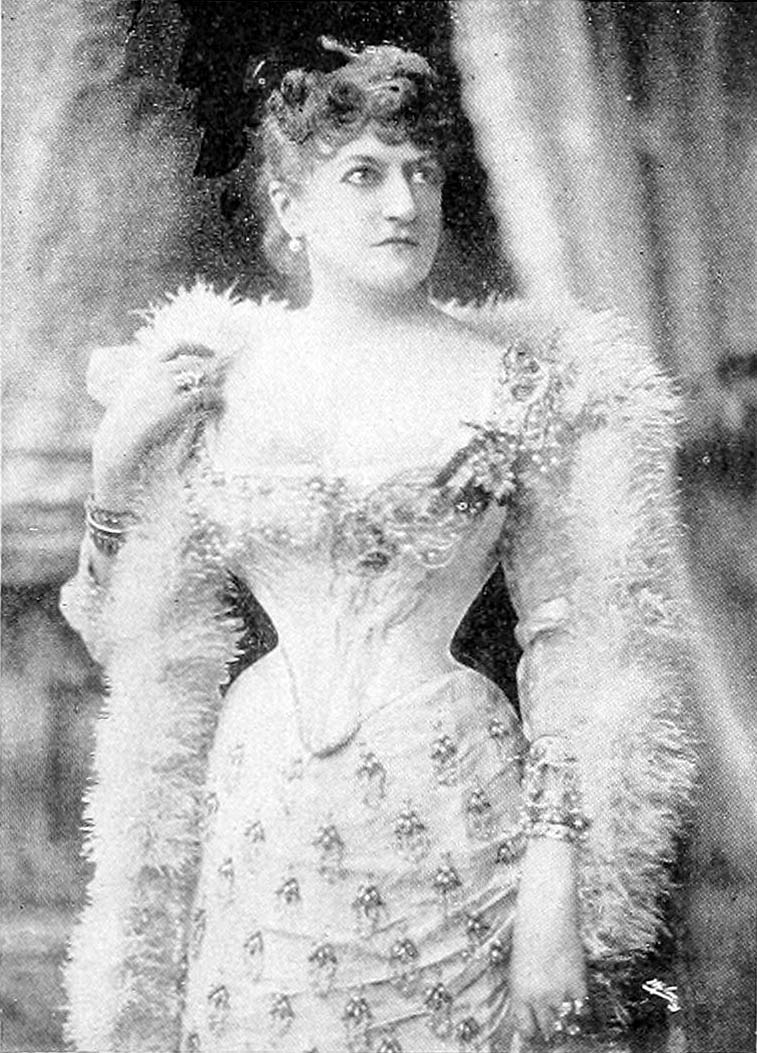
Miriam Leslie
Miriam Leslie was born in Louisiana in 1836. Her father’s family had emigrated from France and settled in the area at some time during the 1700s. They started out as farmers, but by the time Miriam was born, they had lost their farm and were struggling businessmen. Miriam’s birth was never recorded. Her father was divorced at the time and we have no record of who her mother was; however, she acquired a stepmother when the family moved to New York a few years after her birth. It seems most likely that Miriam’s mother had been an enslaved woman, but no one has been able to prove that. (Many years later, that elusive mother became the basis for an attempt to keep Miriam from disbursing her fortune.)
Miriam’s life was never well-documented and she tried hard to keep much of it secret, so there remain many patches of uncertainty about her biography. She often made-up stories about her ancestors and her family, so historical sources differ. Where she was educated, and by whom, is not clear, but, somehow, she managed to get a better education than most women of her time. Her father encouraged the girl to read widely and Marion had a gift for languages. As an adult she spoke French, Italian, and Spanish fluently.
Despite giving Marion a good education, her father continued to pile up debts and neglected to provide for his family. It is not unlikely that both Marion and her stepmother engaged at least part time in prostitution, which was one of the few options women had for earning money. Eventually, however, Miriam’s skill with languages helped her to get a job with the dancer and actress, Lola Montez. They became a successful entertainment team and Marion learned how to dress and keep herself looking fashionable and attractive.
Miriam, however, fell out with Lola after their successful tours. She found other acting jobs but was not content to remain an entertainer. Her ambition was to become a socialite and join the highest ranks of New York society As soon as she had a chance, she left the stage to marry Ephraim Squier (usually known by his nickname, E.G.) a scientist and businessman with plans to build a railroad across Argentina.
Unfortunately, like Marion’s other husbands, E.G. was not a successful businessman. He soon discovered that building an Argentinian railroad was not feasible and turned to other schemes. He started writing travel pieces for publication in the growing market of magazines in New York. Marion soon began to write for publication and both of them were encouraged by meeting Frank Leslie, editor of Frank Leslie’s Lady’s Magazine.
Leslie soon became a family friend. He left his wife and moved in with Marion and E.G. and the three of them continued to have an active social life. Marion soon found that her unconventional living arrangement meant that she was unable to gain entry into the highest New York society, but she had a wide circle of friends and entertained lavishly. Her writing and her editorial skills kept the family afloat for several years.
Both Frank Leslie and Marion were eventually able to divorce their inconvenient spouses and get married. When they did, Marion legally changed her name to Mrs. Frank Leslie thus firmly leaving behind her birth family and her other marriages. After Frank Leslie died in 1880, Marion was able to take over his publications and keep her place in the ever-changing publishing world of the early twentieth century. She divided her time between New York and Europe and maintained her social contacts on both continents.
The greatest irony of Marion’s life was that despite having never supported the idea of women’s suffrage in any of her publications, she nonetheless left all of her money to Carrie Chapman Catt. Despite efforts by long lost relatives to break her will, it survived. The fortune was eventually spent on supporting the 19th Amendment that gave American women the vote and on founding the League of Women Voters to help women take advantage of their new rights.
Despite the limited documentation available about Marion Leslie’s life, we are lucky this year in having a valuable biography recently published: Betsy Prioleau’s Deadlines and Diamonds: A Tale of Greed, Deceit and a Female Tycoon (2022). Prioleau paints a vivid picture of Marion Leslie’s life and the times in which she lived. Reading it helps us understand how one woman managed to triumph despite poverty and the limitations placed on women. Marion Leslie deserves to be remembered.
Even though it is only the beginning of April, this year of 2022 has already brought us startling news from around the world. Western media is focused on the fighting in Ukraine as Russian troops continue to bombard cities and force thousands of people to leave their homes and seek safety elsewhere.
A hundred years ago, in 1922, things were much the same. Western newspapers were carrying stories of fighting, destruction, and hunger in Eastern Europe. The first World War had triggered a revolution in Russia. The Tzarist government fell and the Bolshevik party, under Vladimir Lenin, changed the face of Russia forever. During the early 1920s, as Lenin’s health declined, there was a struggle to take over leadership of the new government. The eventual winner of that struggle was Joseph Stalin whose power would determine the future of Russia and all of Eastern Europe for decades to come.
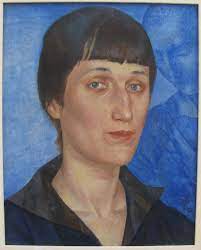
Russian writers and artists who had grown up during the Tsarist regime were deeply affected by this change in government; perhaps none more so than Anna Akhmatova. She had been hailed as one of Russia’s greatest poets but was to lead a very different and more difficult life under the new regime.
Anna was born near Odessa in 1889. Her father came from a Ukrainian Cossack family and was a stern, harsh man. He did not want poetry published under the family name, so at a very young age Anna chose the pen name Akhmatova, the name by which she was known for the rest of her life. Her father divorced his wife, Anna’s mother, and left the family while Anna was a child, so she grew up mostly in St. Petersburg. Her education was informal, but she soon joined a circle of young poets, artists and writers and began publishing poetry.
When her second book of poetry, Rosary, appeared in 1915, it became immensely popular. The poems she wrote were short lyric pieces filled with images of life and love:
Anna Akhmatova
The sun fills my room,
Yellow dust drifts aslant.
I wake up and remember:
This is your saint’s day.
(Translated by D.M. Thomas)
The poems were so popular that by 1916 many young people began playing a game called “Telling Rosary”. Someone would start reciting one of the poems and someone else would finish it. There was no shortage of fans who memorized her works.
Akhmatova flourished in the vibrant cultural world of St. Petersburg. She was young, beautiful, and fascinating to both men and women. In 1910 she married her first husband, Nikolay Gumilev, two years later their son Lev was born. During the first few years of their marriage Akhmatova continued to write and publish poetry, even after the Russian Revolution started in 1917 and brought new turmoil to the country. Although many young writers and intellectuals left Russia and moved abroad during the years of revolution, Akhmatova refused to leave. As usual, she expressed her feelings in poetry I am not one of those who left their country/ For wolves to tear it limb from limb. (Translated by D.M. Thomas)
When the revolution ended in 1921 and Lenin became the country’s leader, Akhmatova and her friends hoped that a new, more democratic society would develop. Unfortunately, when Lenin died, his leadership role was taken by Joseph Stalin, who quickly became a harsh, unforgiving dictator. Soon after he came to power, Akhmatova’s poetry was denounced as “no longer relevant.” Akhmatova began to have difficulty finding a publisher and she was unable to continue giving the public readings that had been popular and an important source of income. For more than ten years her voice was almost silenced in Russia.
During the 1920s and 1930s, Akhmatova’s personal life was difficult. She was virtually penniless for many years; her former husband, Nikolay Gumilev, was imprisoned. Their son, Lev, was denied entry into schools. Eventually he was sentenced to ten years imprisonment in Northern Siberia. Akhmatova depended on the generosity of friends and lovers for her survival. During World War II she survived the 800-day siege of Leningrad, although her health deteriorated badly. Records of these years are difficult to find because she destroyed letters and journals so the authorities could not seize them and use them to justify additional punishment for her son or their friends.
Akhmatova’s health never completely recovered after the deprivations she suffered during World War II, but after the war, her reputation and fame began to return. In 1963, her masterpiece, a series of poems called “Requiem” was published in Germany, although it was not available in Russia until after her death. In 1965, Akhmatova was nominated for the Nobel Prize in Literature and later that year she was allowed to travel to England to receive an honorary degree from Oxford University. These tributes must have been precious to her as she neared her end, but by the time they came, she was very ill. She died of a heart attack in 1966.
Since her death, Akhmatova has been recognized as one of Russia’s most important poets. She is also one of the most popular. Her poems have been published around the world in many different languages. The translations that I have included above are by D.M. Thomas and are available in the Everyman Pocket Poets series (Knopf). Various translations of her work can be found in libraries and bookstores everywhere.
Details of Akhmatova’s life are still difficult to find, but a fascinating biography Anna of All the Russians: A Life of Anna Akhmatova (Vintage 2007) is available in libraries and bookstores. Feinstein gives a good picture not only of the poet, but also of Russia and Eastern Europe during the difficult years of the early twentieth century.
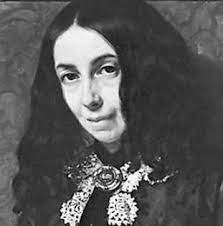
Many people have listened to one of Elizabeth Barrett Browning’s most familiar sonnets which begins: How do I love thee/ Let me count the ways… These words are often recited as a part of wedding celebrations. The sentiment expressed is just as relevant for couples today as it was when the sonnet was written more than a century ago. Barrett’s picture may look old-fashioned, but her ideas live on. All the little-girl curls and flowing skirts mask a very modern woman.
Today is Elizabeth Barrett Browning’s 216th birthday. She was born on March 6. 1806 in Durham, England. Her father, Edward Moulton-Barrett came from a family that had lived for several generations on the island of Jamaica, which was then a British colony. The family became wealthy by producing sugar on plantations that relied on the labor of enslaved people. Like many other families who lived in the West Indies, there was considerable mingling and sometimes marriage among the European settlers and their African workers. Elizabeth Barrett, like her siblings, had dark skin and eyes and she always considered herself to be of mixed-race. Although there is no evidence to prove this one way or the other, the fact that she believed it had an important influence on her life.
Elizabeth Barrett Browning
Many of Barrett Browning’s poems express feelings and ideas that speak to readers now as clearly as they did when they were first written. But the times during which Elizabeth Barrett lived, meant that she had to struggle to become a poet. She lived in a society where women were supposed to be readers, not writers. Fortunately, Elizabeth’s parents did not entirely agree with this idea and they provided her with a good education and encouraged her writing.
Elizabeth was the oldest of the twelve children and they formed a close-knit family group. Each child had a nickname—Elizabeth was known as “Ba”, a name she used all of her life. Like her siblings, Elizabeth never had to look far for companionship. The girls in the family were educated at home while the boys were sent to schools to be trained for business. Living on a country estate, the children turned to books and writing for entertainment. Elizabeth started writing poetry at the age of four, and when she was 14, her father had some of her poems privately published for distribution within the family.
Life at the Barrett’s was not without hardship though, especially after Elizabeth fell ill with a spinal disorder during her early teens. From that time on, she was an invalid and led a very restricted life. She took opiates to ease the pain of her spinal injury, but this medication led to further deterioration of her ability to live normally. On the other hand, being an invalid meant she was relieved of the household duties that kept her sisters busy and allowed her to work diligently at becoming a poet.
Almost everyone who has read and studied English poetry knows the story of EBB’s adult life. After living in seclusion with her family until she was almost forty years old, she eloped with the poet Robert Browning. Her father disowned her when she married, and the two were never reconciled. For the rest of her life, EBB lived in Italy, although she often visited London and kept in touch with many old friends. Her life centered around her poetry and her family. She and Robert had one son, but family life never kept her from being a dedicated writer. She wrote about current social issues such as child labor, the abolition of slavery, and the right of every woman to have a life of her own. Her reputation as a poet grew steadily after her marriage, culminating with the publication of her novel in verse, Aurora Leigh, which the critic John Ruskin called it “the greatest long poem of the nineteenth century”. This poem was an immediate best seller and is still read and studied.
In 1861, a year after the publication of Aurora Leigh, Elizabeth Barrett Browning died at the age of 55.
During the late 19th century and down to the present day, EBB has been famous more for her life than for her work. Thousands of people have seen the play The Barretts of Wimpole Street either on stage or in one of several movie versions. But this presentation concentrates on the romantic elopement of Elizabeth and Robert and downplays her long career as a writer. For all of her crinolines and curls, EBB was a serious poet who worked steadily at becoming a great writer. Her husband and child were important in her life, but she never gave up her artistic ambitions.
There have been several biographies of EBB and last year the British scholar Fiona Sampson gave us a new one that sheds a great deal of light on Barrett’s life. Two Way Mirror: theLife of Elizabeth Barrett Browning (Norton 2021) shows us Barrett as a social activist and a thinker. I highly recommend the book and as an introduction you might watch the video webinar that Fiona Sampson made for the National Library of Scotland.
You may not want to read Aurora Leigh. Few people today have the patience to read a novel in verse, but we all should remember the poet who was perhaps the first woman to be recognized as a professional poet. She was even nominated to be Poet Laureate when that post became empty, although that honor finally went to Tennyson. EBB is often pictured as a frail, semi-invalid, which she certainly was, but she was much more. Rather than being defeated by her physical weakness she used it as a springboard into a successful career as a professional artist.
Last Sunday (February 11, 2022), the New York Times featured an article about the growing importance of translated books in the United States. Now that many Americans are becoming used to watching international movies, television, and websites, it’s natural that books from around the world are also becoming more popular. The Author’s Guild and other writers’ associations encourage publishers to acknowledge this importance by including the name of the translator on the front cover of every translated book. We will no doubt see more attention paid to translators in the future, but today I want to pay tribute to a woman whose pioneering work in translation influenced some of the most important English-language writers of the twentieth century, including D. H . Lawrence, Joseph Conrad, and Ernest Hemingway.
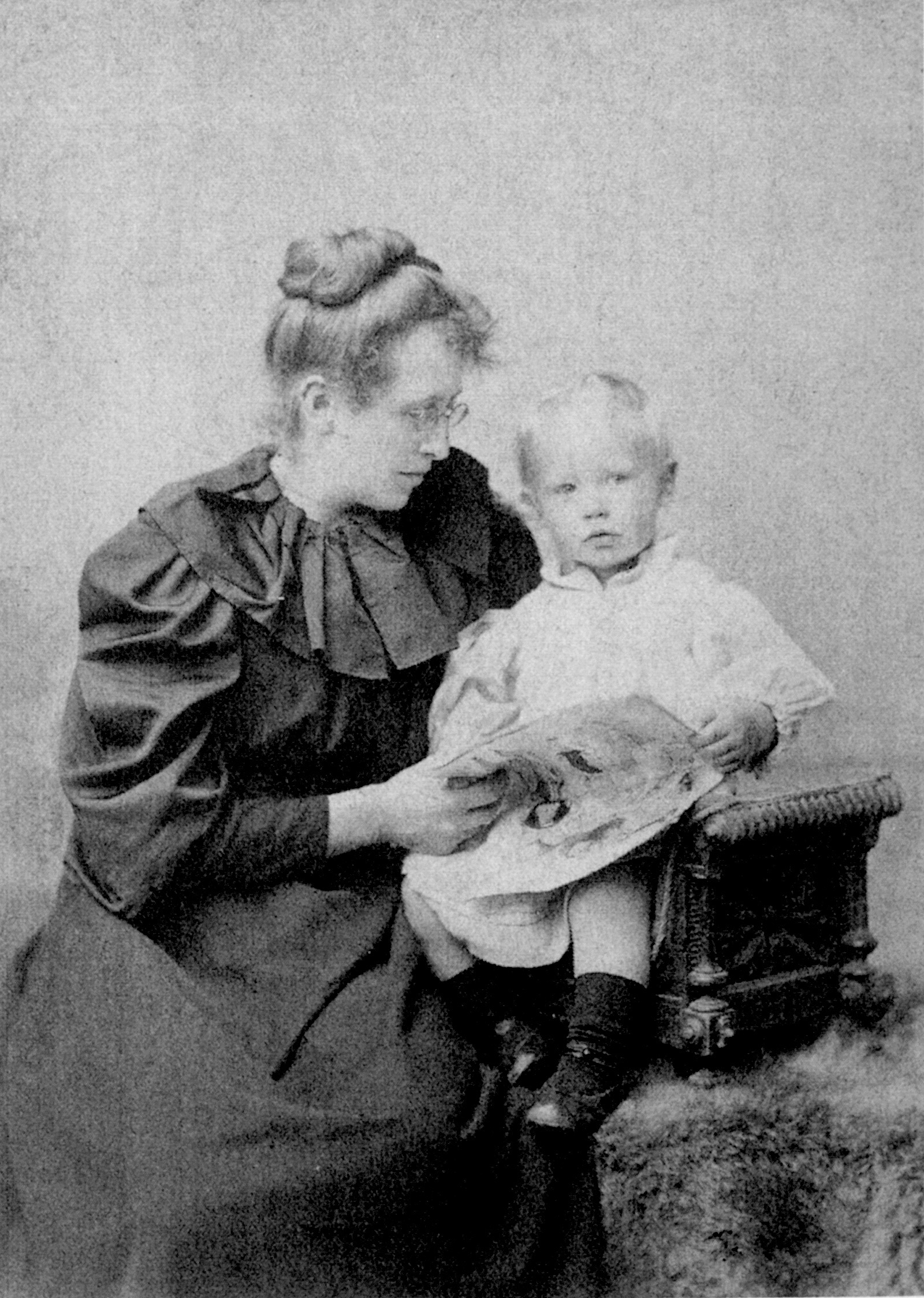
Constance Garnett was born in Brighton, England, in 1861. She was educated at Brighton and Hove High School and then studied Greek and Latin at Newnham College, Cambridge. In 1883, she moved to London and worked as a governess and later as a librarian. In London she met Edward Garnett, who was a reader for a publishing company. The two married in 1889, and two years later, her husband introduced her to several Russian exiles with whom the couple became friendly. The exiles encouraged Constance to try translating some Russian writers into English to make them available to a wider range of readers. Before long, Constance started studying Russian and plunged into the work.
Constance Garnett with her son David
Ivan Goncharov’s A Common Story was Garnett’s first translation to be published, and that was the beginning of a long, industrious career. During her lifetime, Garnett translated works by Tolstoy, Gogol, Dostoyevsky, Turgenev, and Chekhov. Works by these authors had been almost inaccessible to most English-speaking readers until Garnett translated them and they were published in England and then in the United States. By the time her career ended, she had translated and published 71 Russian books. Many of these versions still remain in print, although other translators have produced newer translations.
How did Constance Garnett manage to translate so quickly? She did it mostly by working incessantly. It was her habit to sit in her garden with a pile of Russian manuscripts beside her as she worked. She would translate quickly, seldom stopping to look anything up, and not planning ahead, but somehow she produced readable versions of books that usually caught the spirit of the original. Her translations have been both praised and criticized by Russian scholars and still remain controversial. A 2005 article in the New Yorker“The Translation Wars” by David Remnick tells the story of some of the arguments and disagreements about her work.
The widespread availability of Russian translations had a dramatic impact on English-language literature during the 20th century. One result, which is unfortunately no longer available to us, was the appearance of a play called “The Idiots Karamazov” at the Yale Repertory Theatre during the early 1970s. Starring in the role of Constance Garnett was a young student named Meryl Streep. Wouldn’t it be fun if we could find that show streaming on our TV screen and watch it before settling down to read Dostoyevsky?


 Teacups and Tyrants-Adele Fasick looks at people, books, and history