Queen Victoria and Angelina Jolie–two courageous women

Queen Victoria's family
Queen Victoria’s family
Angelina Jolie, the beautiful film star who has been at the center of so many media stories, has reached new fame with her decision to have a double mastectomy as a way to avoid breast cancer. Her decision has sparked some controversy, but also an outpouring of informative stories describing different types of the breast cancer and different options for treatment. Ms. Jolie’s candid explanation of her choice in a N.Y. Times op-ed piece has encouraged more discussion about the risks women face. She joins a long line of prominent women who have had the courage to try new solutions to women’s enduring health issues. One of the most surprising of them was Queen Victoria, the ultra-proper ruler who presided over the stringent rules of the Victorian era, showed courage in taking the initiative in her own healthcare.

More than 150 years ago Victorian women endured an often painful and sometimes dangerous succession of childbirths. Even Queen Victoria, despite her position as monarch of the British empire and the most powerful woman in the world, went through the same pains of childbirth as she bore nine children in fairly quick order. Having many children and enduring the struggle of their births without complaining was a demonstration of her status as a virtuous wife. But eventually even Victoria felt rebellious, it seems, and her loving husband Prince Albert, agreed with her that she deserved some help in easing the pain of childbirth.

Although women had been seeking relief from the pain of childbirth for centuries, when anesthesia finally became available during Victorian times, many people condemned its use. Men of religion proclaimed that if God had wanted childbirth to be painless, He would have designed it that way, so using anesthesia was against God’s wishes. The pain of childbirth was described by at least one English minister as suffering that women owed to God. There were few women ministers at that time to argue against that. Finally women began to demand some easing of their pain. We can imagine the arguments in homes across the Western world as women began to demand relief.

When Queen Victoria led the way by having chloroform administered during the birth of Prince Leopold, she gave courage to many women across England. Just like Angelina Jolie today, her decision was reported in the news and started conversations and discussions. Nowadays some women choose to have childbirth without anesthesia while others prefer the medication. Either decision is accepted as a woman’s right. In just the same way, Angelina Jolie’s decision to choose preemptive mastectomy will broaden the choices that women in her situation feel empowered to make.

Three cheers for the powerful women who have the courage to set an example that gives other, less well-known women, more choice in their lives!

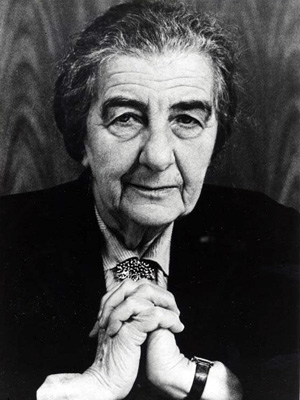
Golda Meir and Margaret Thatcher–two Iron Ladies

Margaret Thatcher
Margaret Thatcher
Golder Meir
Golder Meir
Margaret Thatcher’s funeral this coming week will be the final act in a very public life. Known throughout England and much of the world as the ‘Iron Lady’ Thatcher’s death will be marked by a very public ceremony at St. Paul’s cathedral in London which will be hailed by devoted supporters and may be protested by bitter opponents. Women who are political leaders (even though there have been very few of them) seem to attract more emotions, both love and hate, than male politicians do. But both the memory and emotions will fade with time. How many today spend much time thinking about the earlier Iron Lady who led Israel through some of its crucial years? Golda Meir inspired many emotions in her time and was celebrated in America by plays and movies, but interest has dwindled in recent years.

Golda Meir lived a far more cosmopolitan life than Margaret Thatcher did perhaps that is what gave her such wide sympathies. She was born in Kiev in 1898, and remembered the fear of Russian pogroms that haunted her childhood. But she moved to the United States with her family when she was eight years old. She grew up in poverty and resisted her mother’s wish for her to quit high school and get married. Instead she went to college where she became an ardent Zionist. When she married, she and her husband moved to Palestine. They joined a kibbutz in 1921. There she found more poverty and hard work and eventually she moved the family to Tel Aviv and entered politics.

The Jewish population in Palestine grew during the decades following the first World War, but the arrival of World War II and the Nazi persecution of European Jews demonstrated that something more drastic had to be done. In 1948, Golda Meir was one of the 25 signers of Israel’s independence declaration. Her obituary in the New York Times quotes her as saying on this occasion “When I studied American history as a schoolgirl and I read about those who signed the Declaration of Independence, I couldn’t imagine these were real people doing something real. And there I was sitting down and signing a declaration of independence.”

From then on her life was dedicated to preserving the state of Israel. She became a member of the Israeli Parliament and served as Minister of Labor and later Foreign Minister. She became Prime Minister in 1969 and served until 1974. Israel was still fighting for its life. The murder of athletes at the 1972 Olympics occurred during that time and in 1973 the Yom Kippur War started. She was blamed for not being prepared for war and for hesitating too long before doing anything. To a woman who had always sought peace, it was difficult to accept the fact that Israel would continue to be a battleground. She hated having to send troops to war and said “A leader who doesn’t hesitate before he sends his nation into battle is not fit to be a leader”. That was not a popular stance at the time, and was in sharp contrast to the quick decision by Margaret Thatcher to dispatch armed forces quickly to the brief war in the Falklands.

Two Iron Ladies—two different countries and two different times. Golda Meir is now remembered as a hero of Israel and is almost universally admired. Will Margaret Thatcher’s final fate be the same or not?

March–a good month for changing the world

Slogan of Women's History month 2013How long does it take us to recognize a good idea? When Margaret Fuller, the well-known feminist and writer, visited Europe in 1845-46 she recognized the needs of working women. She endorsed the idea of the government providing crèches which could be supervised and where children would receive adequate food and care. More than 150 years later, American society has still not managed to accept that idea although almost every country in Europe provides public crèches or nurseries for preschool children.

The news during this Women’s History month has several stories that echo the concerns of nineteenth and twentieth century women that are still unfulfilled. Some women with children at home (as well as many men and women without children) have seized upon the idea of working at home, telecommuting to their offices. This month the CEO of Yahoo has decreed that employees will no longer be allowed to work from home, but must come into their workplaces every day. Mingling with other employees is thought by many people to stimulate innovation and creativity. Certainly being with other workers engaged in tasks similar to yours can be stimulating and inspiring, but why must it always be talked about in sweeping generalizations? Doesn’t it seem to you that there is a natural rhythm to work? Talking with other, exchanging ideas and listening to suggestions can get you started on a task, developing a project or writing a report, but once started it is often better to have a quiet location to work in isolation. Pulling ideas together and shaping them is a solitary occupation. Many kinds of work should offer some flexibility. Employees who have the freedom to choose the location in which they work often make stronger contributions to an organization than those who are rigidly forced to conform to the rules designed to suit the majority but not the individual.

This discussion about employee flexibility, of course, only applies to a subset of women who work outside the home. Teachers usually have to stay in the location where their students are (although that is changing in online teaching), clerks in stores have to be available at check-out stations, mechanics usually have to be where the cars are, and crossing guards had better be at their crossings. These women need flexibility not so much in where they are but in where their children are.

This leads to the second big news story for Women’s History month—the call for universal preschool education. President Obama talked about the need to start educating children while they are young. Once again America loiters behind the rest of the developed world in offering education to young children. What are we afraid of? Scientists and educators agree that children who start pre-reading activities while they are young and who learn the habits and social skills important in their future success, do far better than those who spend their preschool years in front of a TV. Let’s all push to finally achieve this goal. Women’s History month is a time not just for looking back but for looking ahead to new achievements. The theme of the 2013 celebration is Women Inspiring Innovation through Imagination. What better way is there to achieve this goal than by helping all children start young on the path toward learning and fulfillment?