Mrs. Satan will not be president

Victoria Woodhull’s declaration that she would be a candidate for President of the United States was a bold move that electrified voters in 1870.  Two years later, when the presidential election actually came around, everything had changed. Victoria believed she would win because of her strong faith in what her spirits told her, but she didn’t take account of what other people were thinking and doing.  During the years 1870-72, the Women’s movement became split into warring groups over policy. Leaders like Susan B. Anthony and Elizabeth Cady Stanton resented the fact that the government gave former slaves the right to vote but refused to do the same for women. Cartoon showing Victoria Woodhull as Mrs. SatanThey opposed the adoption of the Fifteenth Amendment which gave “all citizens” the right to vote “regardless of race, creed or previous condition of servitude” but did not include women.
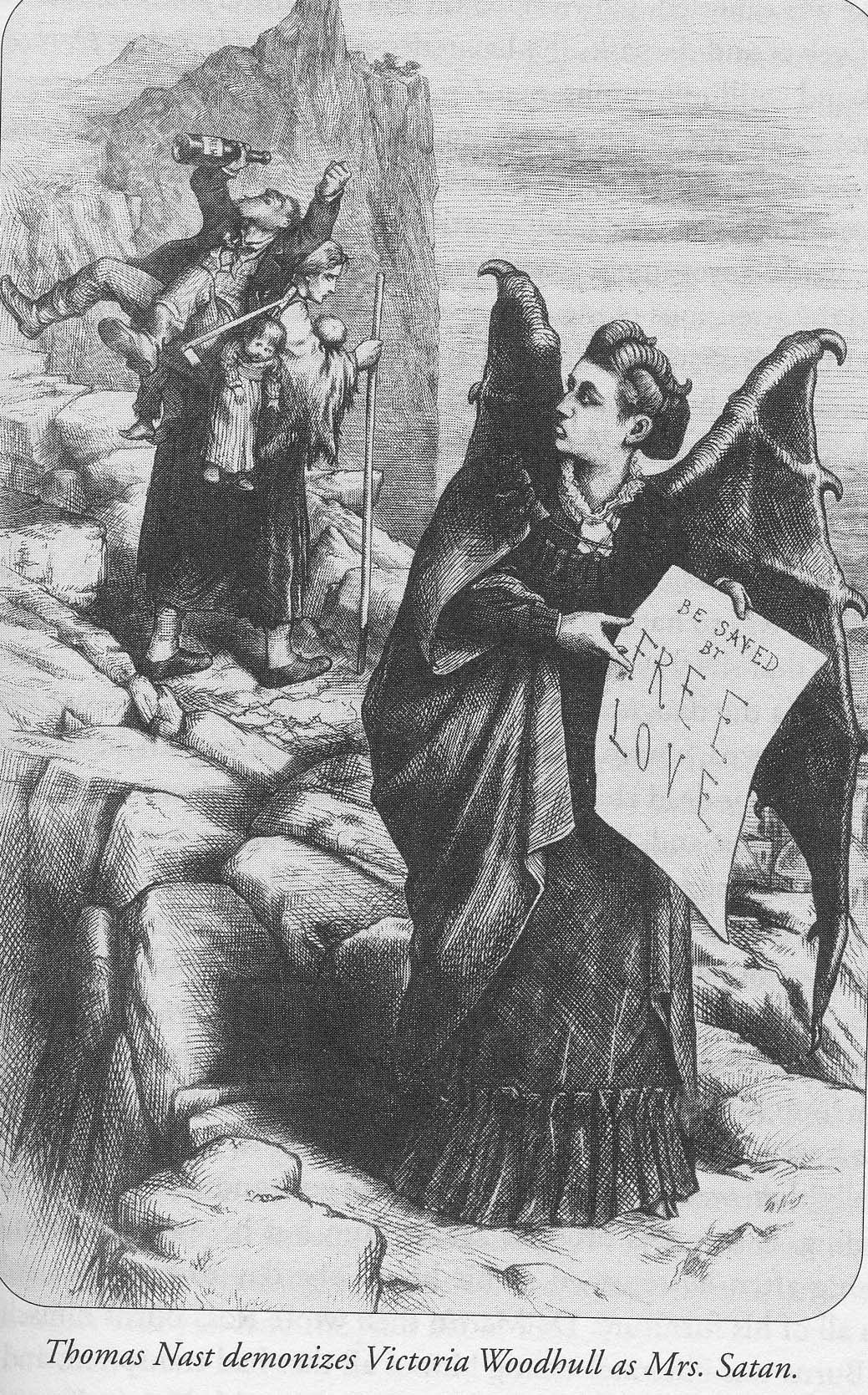
In May 1872, the name of Victoria’s People’s Party was changed to the Equal Rights Party. The party officially nominated Victoria for president and she chose Frederick Douglass, the well-known ex-slave and public speaker, as her vice-presidential running mate. (He later said that he had never heard anything about it.) Both Elizabeth Cady Stanton and Isabella Beecher Hooker supported Victoria’s candidacy, but neither of them believed she had a chance to be president. Because Victoria’s spirit counselors had told her she was destined for high office, she herself firmly believed this would happen. This was the first presidential election in which women’s suffrage was an important issue, because it was the first held after the formation of the National Woman Suffrage Association and the American Woman Suffrage Association in 1869.

While the three different suffrage groups were arguing among themselves, the traditional political parties also struggled over their candidates. Ulysses S. Grant, a Republican, was seeking a second term, but the so-called Liberal Republicans split from the main party and nominated Horace Greeley, founder of the New York Tribune. Greeley also got the Democratic nomination. After the turmoil of nominations the campaign itself was one of the most bitterly-fought campaigns in American history.

Victoria’s unquestioning faith in her spirits led her astray when it came to politics. In the end it wasn’t the search for voting rights that brought her down, it was the familiar question about sexual purity and scandal. Victoria and her sisters had lurid pasts compared to those of the other women leading the suffrage movement, but these respectable women also had many secrets to hide. The intrigues and infidelities of leading male citizens touched the lives of their wives as well as their mistresses. Henry Ward Beecher, a distinguished minister and civic leader, was especially vulnerable. His sister Isabella Beecher Hooker was one of Victoria’s strongest supporters, but when rumors about her brother started circulating, she was torn. Unfortunately, Victoria, because of her friendships with brothel managers and prostitutes, knew many of the most scandalous stories in New York.

Victoria Woodhull believed in sexual freedom, as many of the suffragettes did, but she practiced it more than many others. This made her vulnerable to political opponents who spread stories about her and pilloried her in the press. Thomas Nast in his cartoons made her a special target as “Mrs. Satan”. After that cartoon appeared Victoria’s political life was dead. Her speaking engagements were cancelled and her supporters fled to other candidates. Embittered by the desertions, Victoria finally printed an article revealing the affairs of Henry Ward Beecher and other leading citizens. This is what led to her arrest and was the reason she spent Election Day in jail rather than at the polls. Some of the women’s suffrage leaders did attempt to vote; Susan B. Anthony cast a ballot, but her vote was not counted and she was given a $100 fine for the attempt. The election which seemed to promise vindication for women’s rights proved to be a miserable failure for them. The struggle continued for another fifty years.

Today, as we look back from the enormous new freedoms in sex and marriage that have been gained over the last hundred years and more, it’s hard to know what to think of Victoria Woodhull. She pioneered many of the ideas we now accept as desirable. Who would go back to the bad old days when women weren’t allowed to vote or manage their own money or divorce their husbands and keep custody of the children? At the same time, we have to admit that Victoria would have been a terrible president. Going into trances and listening to the voices of spirits got her a long way, but they probably wouldn’t have provided a clue about how how to reconcile the North and South after the long destruction of the Civil War. We can admire her spirit in making public some of the sins of hypocrites who were running the country, but we have to admit that her unsavory activities (and her disreputable family) set back the suffrage by decades. Women didn’t finally get the vote in the United States until the passage of the 19th amendment 1920.

If you have become as fascinated by this tumultuous period in American history as I have, you may want to read Barbara Goldsmith’s book Other Powers: The Age of Suffrage, Spiritualism, and the Scandalous Victoria Woodhull. It covers the period thoroughly and gives an amazing account of the character and lives of some of the men and women who made America the country that it is today.
Presidential candidate listens to the spirits

Following Victoria Woodhull’s trail offers some tantalizing clues about what 19th century America was like. The more I read the more fascinated I become. Who knew that these women in their long skirts and corsets were asking the same questions we are asking today? Certainly I had never known how much Victoria’s spiritualist beliefs had influenced the women’s rights movement. She was not the only member of the group who believed that spirits speaking to them from beyond the grave, gave them ideas to help in their campaign. Spiritualism, which had started about 1848, the same year of the first Women’s Rights Convention, attracted many American radicals. Campaigners for both abolition of slavery and for women’s rights tended to gravitate toward the group because it welcomed new ideas and encouraged individualistic thinking. Victoria Woodhull first gained fame, and made a living, by going into trances and predicting what would happen in the future. She believed firmly that spirits spoke directly to her and guided her in her life. Perhaps it was only natural that people who lived unconventional lives and supported unconventional ideas were attracted to the idea that they could find truth on their own with the help of spirits rather than through conventional religion with its strict and unbending rules.

Whether or not Victoria found the truth in spiritualism, she certainly found worldly success. At least she, her second husband, Captain Blood, and her sister Tennessee Claflin became rich through their association with Cornelius Vanderbilt. Victoria and her sister met Vanderbilt, whose wife had recently died, when they moved to New York. Victoria and Tennie (as she was called) charmed the elderly Vanderbilt, who had been famous for being attracted to beautiful women. When Victoria began to offer him advice about investments, he decided to set up the two sisters as brokers. Their unconventional business attracted many customers and they made a great deal of money for themselves. Perhaps it was Victoria’s business success that gave her the courage to enter political life.

Victoria Woodhull’s presidential campaign raised questions from the time it started. Whether it was legal or not is still an undecided question.

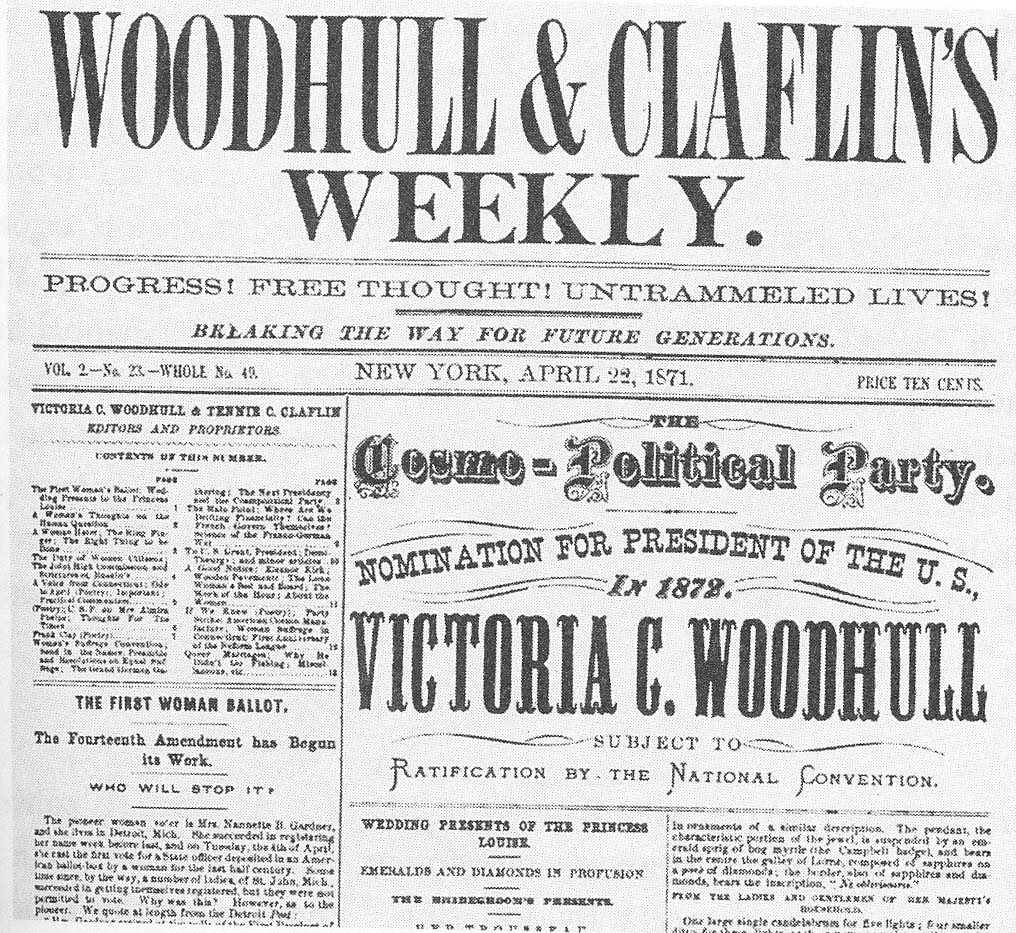
Victoria Woodhull’s newspaper

Victoria and other members of her Equal Rights party claimed that women were defined as citizens in the U.S. Constitution and there had the right to vote and run for office. She based her claim on the Fourteenth Amendment’s provision that “All persons born or naturalized in the United States, and subject to the jurisdiction thereof, are citizens of the United States and of the State wherein they reside.” Women are persons and are therefore entitled to vote. The argument persuaded some people, but it was especially strong among women, who had never been allowed to vote whether they were citizens or not. Isabella Beecher, sister of Henry Ward Beecher, became a devoted follower of Victoria Woodhull and introduced her to many influential people. With the help of these friends, and especially Cornelius Vanderbilt, Victoria and Tennie started the newspaper Woodhull & Claflin’s Weekly devoted mainly to supporting Victoria’s candidacy. The story of what happened during the 1872 campaign will be continued in my next post.

The woman who celebrated voting

Today we celebrate a holiday seldom marked these days. What with the Republican Convention poised to start whenever the threatening storm Isaac eases up, and Florida residents leaving their homes to escape the hurricane, there has been little notice of Women’s Equality Day. Why a holiday in August so close to Labor Day? Because it marks the anniversary of the day in 1920 when the 19th Amendment, giving women the vote, was signed into law. That date is important. It has revolutionized the way women live and operate in our society. And the date might not be remembered at all except for the work of a woman born in 1920 a month before the amendment was proclaimed. Her name was Bella Abzug.

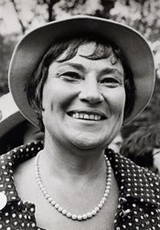
For women living in New York and much of the rest of the country, Bella Abzug became a familiar figure during the 1970s when she was a Congresswoman from New York City. One of her many achievements was being the first Jewish woman elected to Congress. Bella Abzug was a figure made for the age of television. She had a distinctive look—she wore a broad-brimmed hat whenever she appeared in public—and a distinctive voice that was hard to ignore. The hats were the result of her Photo of Bella Abzugbecoming a lawyer in the days when few women practiced law. She started wearing a hat in the office so people would not assume she was a secretary. It was a trademark and gave her more recognition than most other members of Congress.

Abzug was a labor lawyer who fought for the rights of unions, workers, and members of minority groups. In Congress she sponsored a bill for immediate withdrawal of troops from Vietnam War. It didn’t pass. She also called unsuccessfully for universal health care. Her crusades were often unsuccessful, but she cared deeply about politics and would not relinquish her insistence on fighting for what she thought was right even though she lost. She was a fighter and she raised issues that were unpopular in her day but have since been accepted.

In 1971 Bella Abzug achieved success with her bill to establish Women’s Equality Day on August 26. Congress passed the resolution she had introduced:

Joint Resolution of Congress, 1971[2] Designating August 26 of each year as Women’s Equality Day

WHEREAS, the women of the United States have been treated as second-class citizens and have not been entitled the full rights and privileges, public or private, legal or institutional, which are available to male citizens of the United States; and [2]

WHEREAS, the women of the United States have united to assure that these rights and privileges are available to all citizens equally regardless of sex; [2]

WHEREAS, the women of the United States have designated August 26, the anniversary date of the passage of the Nineteenth Amendment, as symbol of the continued fight for equal rights: and [2]

WHEREAS, the women of United States are to be commended and supported in their organizations and activities, [2]

NOW, THEREFORE, BE IT RESOLVED, the Senate and House of Representatives of the United States of America in Congress assembled, that August 26 of each year is designated as “Women’s Equality Day,” and the President is authorized and requested to issue a proclamation annually in commemoration of that day in 1920, on which the women of America were first given the right to vote, and that day in 1970, on which a nationwide demonstration for women’s rights took place


So now on this quiet weekend before Labor Day let’s remember Bella Abzug and the other courageous women who fought so hard to give women the freedom to vote and to influence political life. We have all benefitted from their work.

Blooming Late and Long

Emily Carr was a precocious artist—when she was a child she surprised her parents by drawing the family dog, “I sat beside Carlow’s kennel” she writes in her autobiography, “and stared at him for a long time. Then I took a charred stick from the grate, split open a large brown-paper sack and drew a dog on the sack.” Emily was eight years old at the time.  Her talent was obvious to her parents from that picture and so she was allowed to study drawing, but both of her parents died while she was young and there was little encouragement for her to do anything except to follow her sisters’ examples and prepare for marriage and families. Her path to becoming a recognized artist was long and difficult. As a teenager she persuaded her guardian to let her go from the family home in Vancouver down to San Francisco to study art, but later she returned home and gave up painting.

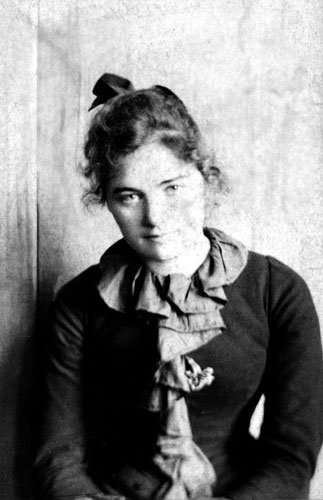
Emily CarrFor several years she pursued an eccentric life, keeping a boarding house to earn money and to pay for a menagerie of animals as pets. Her family, she believed, were stuffy and conventional and limited her artistic possibilities. She spent years, which grew into decades, in pursuit of skills that would allow her to become the artist she wanted to be She had a passion for the natural world around her in western Canada. As a child she rode a pony into the woods where she marveled at the sights and sounds around her. On a trip to Alaska in her twenties she discovered the arts of the Native peoples of the Northwest and the towering totem poles they carved. All of these sights would eventually fuel her art, but it was a long time before the transformation began.

Vancouver was on the outskirts of the art world of the time—the turn of the twentieth century—and Vancouver was so far outside the center that Carr was not aware even of the art being produced in Toronto and the rest of Ontario. She became discouraged about her painting and even after she had a chance to study for a while in Paris, she still did not feel that she was capable of being an important artist. She suffered from the familiar female feeling that artists were men, and many of the male artists she met were content to patronize the women who attempted to become part of the art world. Then at last she met the artists who would open the world for her.

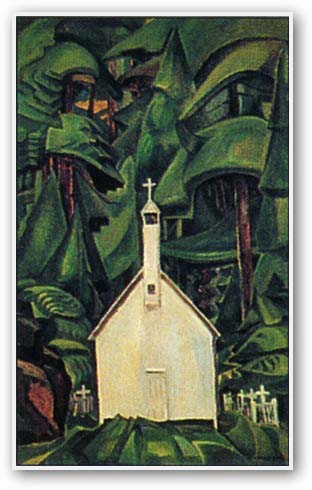
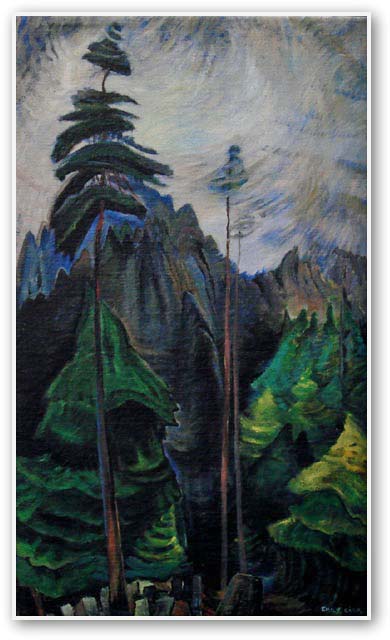
The Group of Seven painters who worked mainly in Ontario were Canadian artists who had found a new way of presenting the beauty of the North to others. Lawren Harris, in particular, became a mentor to Emily Carr and helped her to see that the pictures she was struggling to make of Northwestern Canada and the Indian life there were worth doing. When A.Y. Jackson, another member of the group, told her that “Too bad, that West of yours is so overgrown, lush—unpaintable,” Harris told her to keep faith in what she was doing. When she went back to Vancouver, she was able to continue and in the last decades of her life produced works that have lasted. Even though they are not yet as well known outside of Canada as they deserve, those of us who see them believe that Emily Carr may have been a late bloomer, but her work will live long.Indian Church

Anyone who is interested in knowing more about Carr’s life should read her autobiography “Growing Pains”. She tells a good story and for a reader who wants more detail and more objectivity, there are several good biographies to choose from Best of all, however, try to see her paintings, either in person or in the reproductions available online and in print.

Elizabeth Blackwell–Changing American healthcare

This week attention has been focused on the Supreme Court and its decision on the Affordable Care Act. People have strong opinions about health care and who ought to provide it. It made me think of the early days of America, before the Civil War, when one of the problems women had to face getting medical treatment was having to discuss their intimate concerns with male doctors. Elizabeth Blackwell an ambitious young immigrant from England became aware of this when a friend of hers died of a medical problem that she was too embarrassed to name.First day cover of Elizabeth Blackwell stamp.

“Would you like to have a woman doctor?” asked Elizabeth. Her friend thought this would be a blessing, but quite impossible to achieve because women could not become doctors. In fact, Elizabeth discovered that the term “lady doctor” at the time meant a female abortionist. Elizabeth, who was a devout Christian, shuddered at the thought of being compared to an abortionist, but she determined that she would become a doctor. It was not an easy task.

The first task was to find an individual or institution that would help her study medicine. When she wrote to one sympathetic doctor friend, he responded in a long letter saying that “it is appropriate that man be the physician and woman the nurse”. Others told her that women would never accept treatment from another woman. A Quaker friend wrote to her when she applied to medical schools, “Thee cannot gain admission to these schools. Thee must go to Paris and don masculine attire to gain the necessary knowledge.” Elizabeth rejected the idea of disguising herself in her pursuit of education and continued to look for smaller medical schools that needed more students.  She would not take no for an answer. Eventually she found a college in Geneva, New York, that accepted her on condition the students would vote to accept her. To her delight, the students proved more accepting than the faculty. They voted unanimously to accept her and pledged that “no conduct of ours shall cause her to regret her attendance at this institution.”

The students kept their word. They treated the 26-year-old Elizabeth with respect, almost like an older sister, she reported. She completed her studies, even being allowed to attend the anatomy classes and dissections that had been considered impossible for women to endure. In January 1849, Blackwell became the first woman in the United States to receive a medical degree.

Gaining a medical degree did not, of course, erase the prejudice that remained against women practicing medicine. Elizabeth and her sister Emily, who also became a doctor, struggled for years to gain acceptance in the medical profession. Eventually they opened an infirmary for women and children in New York City. They practiced during the Civil War and, being strong abolitionists, prepared nurses to work with the Union troops.

In later life Elizabeth Blackwell divided her time between England and the United States. She gradually turned to social reform and spent less time on medicine, but the breakthrough she had made by becoming a doctor changed medicine forever. Another legacy she has left for us today is her book Pioneer Work in Opening the Medical Profession to Women, which is now available free of charge on Amazon.com as an ebook. The book quotes many of her journals and gives us a lively down-to-earth sense of what life was like for one of the pioneers of healthcare in America.

Sarah Belzoni; Another forgotten wife

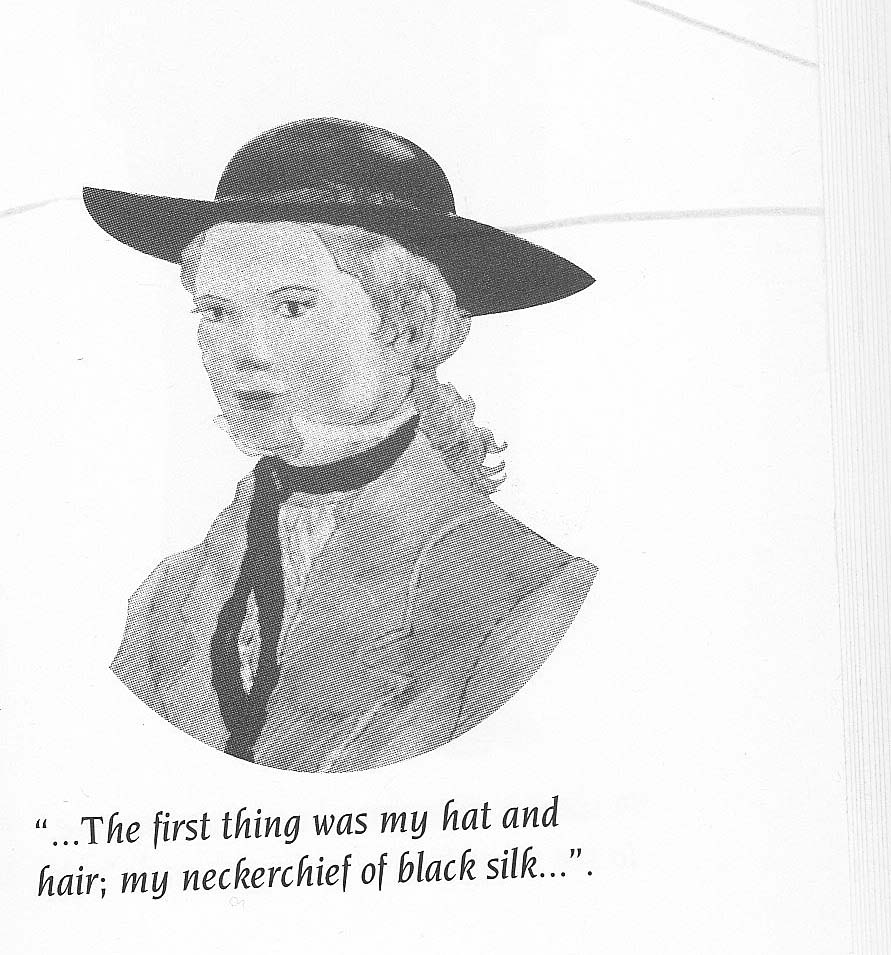
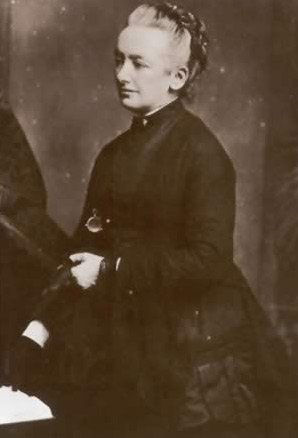
When I read biographies of men who have explored exotic countries or started revolutions I’m often more intrigued by the lives of the wives who stand behind them—or don’t stand—than I am of the men themselves. One of my favorites is Sarah Belzoni,  Portrait of Sarah Belzoniwho spent her life following the Italian strongman who became an explorer of Egypt.

Giovanni Belzoni was a giant of a man. He was born in 1787, at a time when most European men were about five and a half feet tall, but he stood six feet seven inches. He was smart too. As a boy in Italy, he studied to be an engineer, but when he finished school, Napoleon’s troops were invading Italy, so he was forced to go to England to find work. It wasn’t easy to find work, but he did find a wife, Sarah, who may have been Irish, although no one knows for sure.

Instead of building bridges or roads, Belzoni had to take a job as a strong man in a circus to make money. Audiences gasped when he performed his closing act. He put on a harness fitted with a series of planks on either side of his shoulders. They formed a triangle of planks narrowing toward the top. One by one, other actors would climb up and sit on them. In the finale, Belzoni balanced ten or eleven men on his shoulders as he stood on stage.

Belzoni was ambitious and wanted to be an engineer, not a performer in a circus and Sarah agreed that he should give up the circus. Belzoni worked on his engineering ideas, but he had to keep performing in circuses and fairs to earn a living. He and Sarah traveled to Spain, Portugal and the island of Malta performing but looking for other jobs. In Malta, Belzoni met a man who worked for the Pasha of Alexandria. The Pasha had sent his assistant to Europe to find engineers and other workers who could build modern projects in Egypt. This was Belzoni’s opportunity. He had studied irrigation and had invented a water wheel that would raise water from wells more efficiently than a worker could. He was invited to Egypt to demonstrate his invention.

Giovanni and Sarah Belzoni traveled to 1814 taking with them a young Irishman named James Curtin to help with the work. Day after day Belzoni and Curtin worked building his machine. Some of the Pasha’s workmen worried that the new machine would be so efficient they would no longer have jobs. After four months, Belzoni was finally able to give his demonstration. His wheel pumped more water than the ones being used and it worked faster. It would make sense for the Pasha to install Belzoni’s wheel. Unfortunately, several workmen, who were afraid of losing their jobs, arranged an “accident” that caused James Curtin to get caught in the wheel and break his thigh. After that the Pasha gave up any idea of buying Belzoni’s wheel. Belzoni, Sarah, and James Curtin were stranded in Egypt.

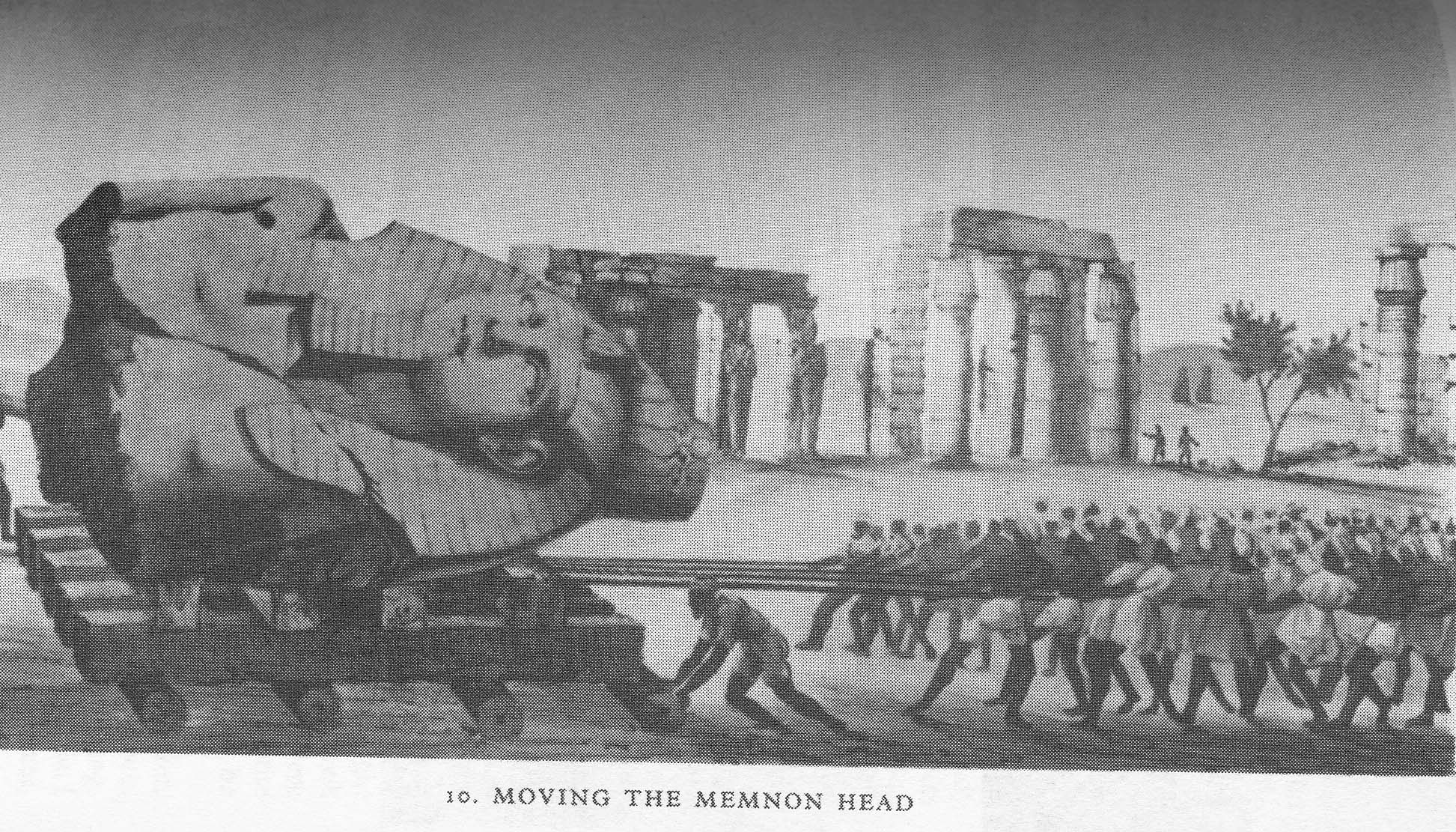
As usual, Belzoni thought of a new scheme. He had heard of a gigantic head lying in the sand near Thebes, a city 700 km south of Cairo. Several European explorers had seen the head and knew how much money it would be worth in Europe, but no one could figure out how to move it. There were no roads in the desert. After the head was dug out of the sand, it would have to be dragged to the river. Then a boat could take it down the Nile River to Cairo and load it onto a ship to England. Belzoni decided he was just the man to do it, but he had to find someone to pay for equipment and workers.

Luckily for Belzoni, Britain had just sent a new representative to Egypt, Henry Salt. Part of his job was to find Egyptian objects for the new British Museum in London. When Salt met Belzoni, he realized had found a strong, adventurous man who could help him. Belzoni told him about his plans for the giant head. Salt provided money and wrote to the Egyptian leaders asking them to help Belzoni move the head.

Belzoni wasn’t sure what kind of equipment he would need for the work. He gathered planks of wood and logs to use as rollers for a cart and found a cheap boat to hire for the trip. On June 30, he set off with Sarah and James Curtin on the long trip up the Nile River to Thebes. By mid-July the group had reached the ruins at Thebes and for the first time they saw the massive head. The stone head had fallen off a statue of the pharaoh Ramses II and was half-buried in the sand. Because no one remembered the name of the pharaoh, the Europeans called the statue Memnon after a Greek hero. Historians believe the statue was toppled during an earthquake in 27 B.C.E. No one at that time knew how large the head was, but scientists later figured out that it weighs seven and a half tons and is 2.67 meters high. 

Belzoni needed to hire local men to work with him, but that was difficult. Many Egyptians could not understand why the head would be valuable unless it was filled with gold. Belzoni finally persuaded them he really was willing to pay for their help in digging out the head and moving it to the river. He worked with them to build a flat platform of planks. Then he used other planks as levers to lift the front of the head far enough to get it on the platform. Gradually, using levers and ropes made of palm fiber, they got the head on the platform. Slowly lifting the front of the platform, they inserted one of the logs as a roller underneath and pulled the platform forward.

It took 80 men, working with ropes to insert four rollers under the platform and pull it forward. Each time it moved a few feet ahead, the men would pull out the roller at the back and move it to the front. Slowly, slowly, the head moved forward over the sand and rocks toward the river. Without knowing it, Belzoni had hit upon the same method the ancient Egyptians probably used to move the statue to where it stood. Finally, after twelve days of hard work, but statue was at the edge of the river and ready to begin its journey down to Cairo.

Many women would have rebelled at the idea of living in the blazing desert heat for weeks while their husband struggled with an impossible project, but Sarah didn’t complain. She was very interested in the Arab women of Egypt and spent her time getting to know them. When Giovanni finally succeeded in getting the massive head to Cairo and onto the ship to England, she celebrated with him.

For the next several years Belzoni worked with Henry Salt to collect antiquities, but the number of Europeans traveling to Egypt searching for Egyptian treasures was growing and the competition was keen. Belzoni traveled around the country trying to find objects the British Museum would be willing to buy. When he traveled he often left Sarah behind in whatever lodgings they had found in the city, but she was resourceful and had interests of her own. She took a trip to the Holy Land and she not only went to Jerusalem but traveled by mule to Jericho, Nazareth, and Bethlehem. Before leaving Jerusalem she disguised herself as an Arab merchant and visited the Mosque of Omar, which was prohibited for women and for non-Muslins.

Giovanni and Sarah finally returned to Europe in 1819. Giovanni had become famous, but they still were financially insecure. Giovanni wrote a book about his travels and mounted an exhibition of Egyptian artifacts, some genuine and some plaster copies of statues as well as sketches and pictures Belzoni had made. Sarah helped to organize and publicize the exhibit.

Sarah helped with Belzoni’s book too. She wrote a chapter, called modestly enough, a “Trifling Account of the Women of Egypt, Nubia, and Syria” in which she described the subservient position of women. She noted that Muslim and Christian women led similar lives that were far more restricted than the lives of European women. As the wife of an explorer, Arab men were willing to treat her almost as an equal, offering her coffee to drink and a pipe to smoke. But she was amused to note that they allowed their wives nothing but water to drink and locked the pipes away where women could not touch them. We can only wish that she had written more about her travels and the insights she gained.

Giovanni Belzoni worked hard all of his life, but he died young in 1823 while trying to reach Timbuktu. Sarah lived until 1860 trying to keep Belzoni’s legacy alive, but without much success. The British government finally granted her a pension that kept her from extreme poverty in her old age, but her contributions to her husband’s work and her own personal knowledge of Egyptian life were never acknowledged. She is one of the large group of women who are the indispensible but forgotten wives of famous men.

Amelia Edwards: Woman of the Week

I admire women who follow their own path and have some impact on the world—the ones who stick to their path and don’t get sidetracked when their efforts are thwarted. Amelia Edwards was one of those. How difficult it must have been for a woman growing up in the early Victorian period to live such an independent life. True, she was born into a well-educated middle class family and was given a good education by her mother, which made her life easier than it was for less fortunate women.

Amelia had a flair for writing and and began publishing short stories by the time she was twelve years old. Then she turned to novels, publishing her first one in 1855. She soon became one of the most popular writers in England especially after the appearance of her novel about bigamy, Barbara’s History in 1864. Her novels mirrored the concerns of many English women of the mid-nineteenth century—love, marriage and family—but her own life was more unusual. She seemed uninterested in marriage, and by the time her parents died when she was 30, she was set in her pattern of spinster life and determined to enjoy it.

Travel was what attracted her, so she set off with a friend to visit Europe. They enjoyed the new sights and Amelia, of course, wrote about their trip. The result was one of her long-lasting books Untrodden Peaks and Unfrequented Valleys which recounted their tour through the Dolomites, which at the time was seldom visited by tourists. Both the book and the tour were a success and Amelia turned her attention to travel writing and gave up novels.

Europe was not enough, however, for the travelers. During a sketching tour of France, she and her companion found nothing but wet weather and talked about moving further south to find sunshine. According to Amelia’s account, they decided to go to Cairo without much thought, “Never was distant expedition entered upon with less premeditation.” Without any special knowledge, skills or equipment, they arrived at Shepherd’s hotel in Cairo on November 29, 1873. It was an arrival that would change Amelia’s life.

Like most tourists, their first trip out of Cairo was to see the Pyramids, at that time an easy hour and a half’s drive from the hotel. At first sight, the Pyramids were not impressive but, “when at last the edge of the desert is reached and the long sand slope climbed…the Great Pyramid in all its unexpected bulk and majesty towers close above one’s head, the effect is as sudden as it is overwhelming.” Amelia was enchanted and determined at once to take the long trip up the Nile to see more of Egypt. She would spend the rest of her life traveling, researching, and writing about Egypt.
There is no question but that Amelia’s book A Thousand Miles up the Nile reached thousands of readers and made the subject of ancient Egypt an important part of the popular culture of England and America. From that time until this, pyramids, mummies, tombs and treasure have spawned books, movies, plays and paintings around the world.

Amelia Edwards popularized Egyptian culture, but she did not falsify it. She was interested in expanding scholarly studies of pharaohs and for this reason she started the Egyptological Society for which she became a tireless fundraiser. At that time Egyptology was not an established scholarly field, so the untrained amateur could meet experts and exchange ideas. Amelia became a friend and sponsor of the great Flinders Petrie, one of the founders of Egyptology. As the field developed, scholars became more rigid and as so often happens, they gradually pushed out the amateurs. University men were not hospitable to women who “invaded” their field even thought they might rely on them for funding.

Amelia Edwards was no doubt disappointed in being pushed out of the control of the Society she had founded, but in the end she got her own way. After the years she had spent writing and publicizing Egypt, she suffered a blow when her companion of thirty years died. Their relationship was never a public one, but it seems likely that they were lesbian lovers who had a successful and happy union. Amelia did not recover well from her loss. She died a few years later, but was able to leave enough money to secure the future of the Egyptological Society and the position of her friend Flinders Petrie as the first Professor of Egyptology at the University of London. Her spirit lingers on.

Elizabeth Van Lew: Woman of the Week

We live in an age of dissidents. The well-earned triumph of Aung San Suu Kyi in Burma this week fills us with joy because she has worked so patiently for so long to persuade her countrymen to turn toward democracy. No doubt there are still years of struggle ahead, but something significant has changed in the country and much of it is due to the strength and courage of one woman.

Here in America we haven’t had a nation-changing heroine like Aung San Suu Kyi, but we have had several women who have showed courage in standing up for their beliefs despite the opposition of friends and neighbors. This week I want to honor one of them, who has nearly been forgotten over the years, a woman who fought against slavery even though she lived in Virginia during a time when most Virginians strongly supported the institution.

Slavery had been a problem since the beginning of the country. By 1850s, some Virginians and people in other Southern states were talking about breaking away from the United States over the slavery question. They worried that Northerners would put an end to slavery and this would cause hardship for the South. Eventually the quarreling became so bitter that theVirginialegislature voted to quit theUnited   States. They joined the Confederacy of Southern states to become a new country.

Still many Virginians did not want to leave the United States. Men who opposed joining the Confederacy could join the Union Army and fight to preserve the country. Women weren’t allowed to be soldiers, so they had to find different ways of supporting theUnited States. Elizabeth van Lew was one of these women. She believed that slavery was wrong. She lovedVirginia, but she loved her country more and believed secession was a tragedy.

After fighting broke out close to Richmond, Elizabeth and her mother got permission to nurse wounded Union soldiers.Elizabethhelped the soldiers write letters to their families. She also found another way to help—she became a spy.

A network of people helped get soldiers’ letters to the Northern states. They were taken on boats flying a “flag of truce,” which were allowed to sail between Virginia and the Northern States. General Benjamin Butler, a Union officer, heard aboutElizabeth’s work and asked whether she could send information about the movements of Southern troops. He did this by sending a letter addressed to “my dear aunt” and signed with a false name. The letter was carried toElizabethby a Northern agent who slipped through the Confederate lines. When the letter was treated with acid and heat, another letter written in invisible ink appeared. In this letterButlerasked her if she would “aid the Union cause by furnishing me with information”.

Soon Elizabeth was able to set up a system through which she could send secret messages to a false address in the North. They were then picked up and sent to General Butler.Elizabethcouldn’t travel around the city, because she was a well-known and wealthy woman and people noticed her. Usually she sent a servant, often a young boy, to carry the letters to the ship. People didn’t pay much attention to teenage boys walking around the streets near the port.

Elizabeth got her information just by watching what was going on in the city. She was also able to talk with Confederate army officers and officials. Most of them did not believe a woman could be collecting information for the North. They consideredElizabethjust another wealthy society woman.

Elizabeth not only sent information to the North. She also helped to hide Union prisoners when they escaped from the military prisons inRichmond. She and her mother nursed prisoners who were sick or injured and let them stay in the house until they were strong enough to travel.

When the war ended with the Union victory, Elizabeth was made postmaster of Richmond. This was a tribute to her services to the Union cause. Most of her neighbors, however, never forgave her for being loyal to her country instead of to the South. She lived a sad and lonely life, forgotten by the North and scorned by the Southerners who lived around her. It takes a lot of courage to fight and suffer for an unpopular cause.


Pearl Buck–Woman of the Week

News that China is launching an English-language television service in America started me thinking about how closely we Americans are now entwined with life in China. We hear news about China almost every day and see Chinese faces on TV news frequently. Most of this familiarity is linked to politics and world events, but don’t let’s forget the pioneers who first led Americans to think about Chinese life and to begin to understand Chinese people. One of the most important—a woman writer now almost forgotten—is Pearl Buck.

Pearl Buck grew up in a missionary family in China. From an early age she realized she was different from the children around her. Pearl could feel people staring at her. She remembers how she felt walking to the market one day when she was about six years old. As she passed two boys one of them made a face and yelled “foreign devil”. Pearl knew her blonde hair and blue eyes made her look strange and different to the Chinese children around her. Her family lived near other missionaries and had quite a comfortable life, but she had no friends her age and always felt isolated and alone. Her beloved nurse, Amah Wang, taught her to speak Chinese and told her many Chinese folktales. As she grew up, Pearl was able to read and write both English and Chinese and felt equally at home in both languages. She knew many Chinese folktales, but she also read and reread the complete works of Charles Dickens, one of her family’s prized possessions.

When Pearl went to the United States to attend college, she realized how little she knew of American life. She could tell her classmates stories about life in China—about how many Chinese people were so poor they sometimes let their girl babies die. Once when Pearl was picking flowers near her house, she found the bones of a baby girl who had been buried secretly. She could never forget the poverty and suffering Chinese people endured, but the American students she knew found her stories weird and horrible.

Pearl moved back to China and married a man who worked with the Chinese to develop modern agricultural methods. She and her husband lived in a small Chinese city and again were feeling isolated. In the turmoil of Chinese politics and anti-Western feelings, Pearl had a hard time feeling accepted by either Chinese friends or the missionary community she had grown up with. She turned to writing and produced one of the best-selling novels of the era in The Good Earth which tried to present an honest picture of the lives of average Chinese people. The book won the Pulitzer Prize in 1932 and was a Book-of-the-Month Club selection. The novel has been translated into many languages and remains in print to this day. In 1937, she won a Nobel Prize for Literature, the first American woman to do so. Still, critics complained about her literary qualities and politicians attacked her ideas.

Politically Pearl Buck was controversial. After she moved permanently to the United States in 1935, she became an advocate for civil rights and women’s rights. Horrified by the fate of mixed-race children, she started an adoption service for these children, many of them fathered by American soldiers in Asia during World War II. During the Cold War she was called a Communist in the United States and was refused permission to visit China with President Richard Nixon. The reputation of her books has fluctuated both in China and the U.S. over the years, but there is no denying that they strengthened ties between the two countries by introducing hundreds of thousands of Americans to the lives and struggles of Chinese people living half a world away. Now we can see the lives of these people played out on our TV screens every day, but we owe a lot to the pioneers who started introducing us to them.


Maria Edgeworth: Woman of the Week

Today is foggy and rainy in San Francisco, a perfect day for sitting inside with a cup of tea and thinking about all the women over the years who have done the same. Today I am going to start honoring some of those women by starting a series of “Woman of the Week” posts on this blog. And because this is St. Patrick’s Day weekend, I’ll start with a famous Irish woman you’ve probably never heard of –Maria Edgeworth. She may be forgotten now, but in the earth 19th century her books had made her so famous that once when an American reader wanted to reach her, she addressed her letter to “Maria, Ireland” and it was safely delivered.

One day in 1847, a procession of porters approached the estate in Longford where Maria Edgeworth lived. They brought a hundred and fifty barrels of flour and rice sent from Boston. They were from some of the children of Boston who had read Maria’s stories and wanted to help the famine stricken children of Ireland. The address on the barrels was “To Miss Edgeworth for her Poor”. Even the porters who hauled the barrels to the house would not accept payment for their efforts. In gratitude to these men Miss Edgeworth knitted a comforter for each of them.

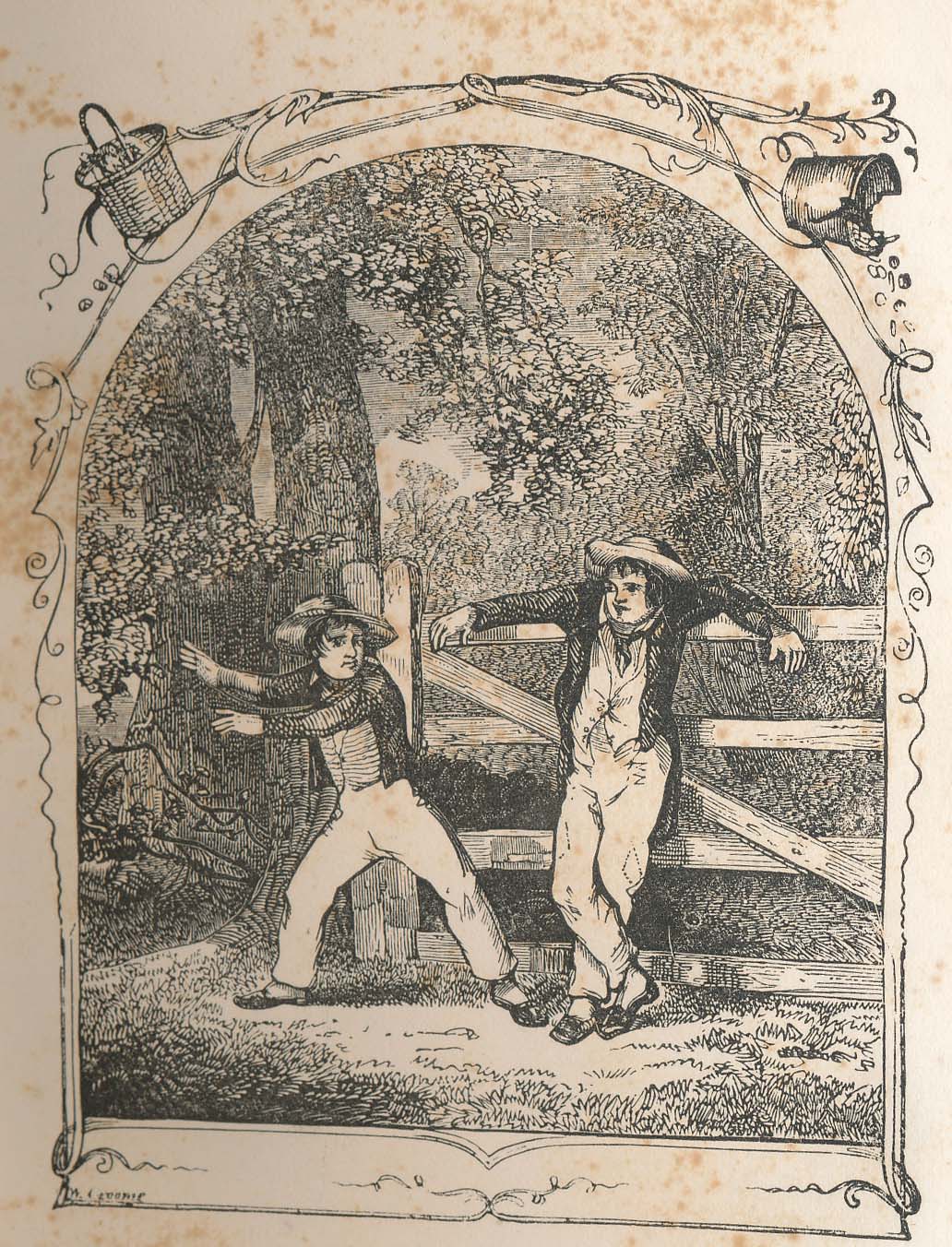
Maria’s stories were known all over the English-speaking world going through one edition after another. They remained in print until the end of the 19th century and generations of children grew up reading them. They introduced characters like Lazy Lawrence, who always tries to avoid doing any work while the hard-working widow’s son Jem takes over his tasks. In the end Jem achieves prosperity while Lawrence falls in with criminals and comes to a bad end. illus. from Lazy Lawrence  And who could forget Rosamond, the girl who begs her mother to buy her a beautiful purple jar that she sees in the chemist’s window instead of purchasing new shoes. Alas, the purple jar turns out to be plain glass when the purple liquid is poured out, and Rosamond’s shoes become so worn and uncomfortable that she can’t go on an outing with her father.

The Edgeworth family wasn’t “really” Irish. They were landlords who had come from England 200 years before Maria’s birth and lived in Longford in central Ireland.  Maria’s father, Richard Edgeworth had gone to England as a very young man and married his first wife there. Maria was the third child in this young family, but she soon became an elder sister as Richard Edgeworth married quickly after his first wife died, then again, and again. In the end he had survived four wives and had 22 children. Perhaps Maria had enough experience in childcare as she was growing up to cure her of the desire to have children of her own. At any rate, she never married but spent much of her life helping raise the children in her own far-flung family and writing stories to help other families raise theirs.

But despite her fame as a writer for children, Maria Edgeworth was much more than that. She was deeply concerned with social conditions and politics. She helped to run the large Edgeworth estate and deserves much of the credit for keeping the family out of debt despite the reckless spending of her brother Lovell, who inherited the estate after the death of their father. When the potato famine hit Ireland in the late 1840s, Maria tried to help their tenants by purchasing new seed for them and arranging emigration for some families. She supported Catholic emancipation, unlike many other landlords, and struggled to make Ireland a more just society where both Catholics and Protestants could live in peace. Let’s honor her today for all the good that she did, although we are still struggling to solve some of the social problems she worried about.