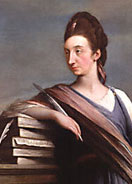
Catharine Macaulay–a woman who inspired the Founding Fathers

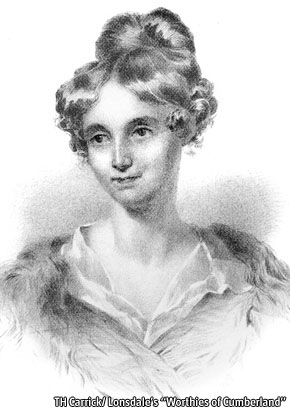
Catharine Macaulay
Catharine Macaulay
In all the Independence Day talk about the Founding Fathers of the American Revolution, nothing has been said about a British woman who was an inspiration to many of these Fathers—Catharine Macaulay. She has been forgotten, not only by Americans, but also by most English writers about history and historians.

Catharine was born in 1731 into a prosperous, but not aristocratic, family. Her mother died while Catharine was young, and her father, John Sawbridge, paid little attention to his children, especially his daughters. Like most girls of her time, she got very little education. While her brothers went to school, she was kept at home, not given tutors, but allowed the run of her father’s library. She quickly learned to read and having started was almost insatiable. Where did these 18th century teenagers get their hunger for ancient history? Today’s young people can barely keep from yawning when they hear stories about 50-year-old wars, but in those days adolescents found excitement in stories about 2000-year-old battles in Greece and Rome.

Not only was Catharine a great reader, she developed an ambition to become a writer. Luckily at 29 she married George Macaulay, a physician and gentleman, who seems to have encouraged her ambition to become an historian even though it was a bizarre choice for a woman. She was also influenced by her brother, John Sawbridge, who was a Republican activist in monarchist England. Catharine and he shared an ambition to reduce the power of the monarchy and make the king treat his subjects fairly.

Like many 18th century radicals, Catharine looked back to Anglo-Saxon times before the Norman conquest, when the English enjoyed freedom and equality. She considered the period of the Commonwealth as “the brightest age that ever adorned the
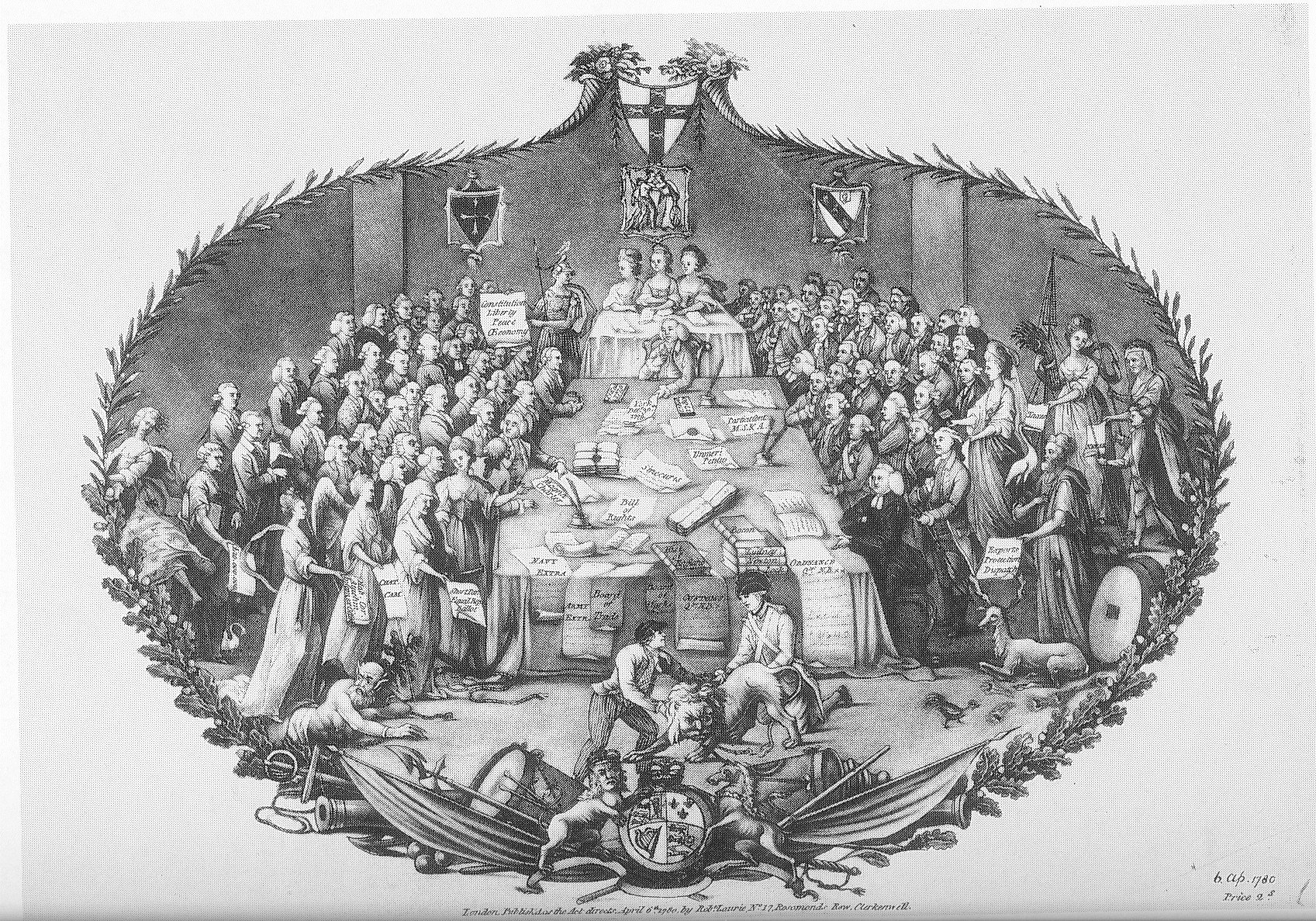
Meeting to petition King George III
page of history” and admired Oliver Cromwell far more than the kings who ruled before and after him.

When she published the first volume of her history, it was widely read and praised. She became a star—no doubt partly because of the novelty of having a woman who could write solid history. And she enjoyed her role and the acclaim that went with it. She used her fame as a pathway into some of the male privileges of the time. As one astonished fellow-guest wrote, “Mrs. Macaulay does not retire after dinner with the ladies, but stays with the men.”

While British activists argued about the lessons of history, American colonists were busy applying their theories. They looked to many British historians, including Catharine Macaulay, for interpretations of the actions of the monarchy. Benjamin Franklin and John Adams were among the American leaders who read Macaulay’s history and admired her work. Thomas Jefferson bought the whole 8-volume set of her history books for the library when he established the University of Virginia. Macaulay was very supportive of the Americans struggle to control their own destiny and in 1775, wrote a passionate “Address to the people of England on the Present Important Crisis of Affairs” in which she urged King George III and Parliament to change their policy.

Well, we all know what happened next. The crisis was not solved, the American colonies rebelled, and a new country was formed. As we celebrate the occasion, we should perhaps look back not only on the heroes who fought for that country, but to the people who inspired them and helped shape their ideas of how a government should treat its citizens.

Catharine Macaulay is almost forgotten today. There is an excellent biography by Bridget Hill called The Republican Virago, but it is not easy to find in a library or bookstore. The lives of the other women who influenced the American Revolutions are celebrated in a widely available book by Cokie Roberts, Founding Mothers: The Women Who Raised Our Nation. that is well-worth reading too.

When Will There Be Justice for Rachel Jeantel?

Is anyone surprised that Rachel Jeantel, a young woman who was called to testify in the George Zimmerman trial, was reluctant to appear? After watching the way she was treated by the defense lawyer, surely even more people believe that a court appearance leaves them vulnerable to harassment. Fewer and fewer will want to open themselves to such treatment.

gavel_large_rs_1What does the ability to read cursive writing have to do with the power of observation? Many schools no longer teach cursive writing and many young people cannot read it. Does the fact that we as a nation refuse to provide the kind of education that is wanted in a court of law mean that the students should suffer? If the ability to read and write cursive is necessary to be a credible witness then surely our schools should make that a requirement rather than abandoning it.

Are we going back to the days a hundred or more years ago when girls were not allowed to study Latin or Greek and then, as they grew up, were told they were unfit to vote or to govern because they could not read the classic texts? Talk about setting up impossible hurdles! It is our fault that we don’t provide the kind of education that students need.

Why is it that only women are judged on the shape of their figure or the style of their hair? Many a male politician is taken very seriously indeed even though his excess weight would cause a personal trainer to blanch.

Why do tweeters around the country feel they have the right to post cruel remarks about a witness in an important trial who is obviously suffering grief at the loss of a friend? Americans pride themselves on being kind and generous people, but at the moment many of us are demonstrating that we can be cruel bullies.

Rachel Jeantel deserves our respect for doing her civic duty in coming forth to testify. Let’s treat her with the dignity she deserves and apologize for the attacks she has received.

People Who Go Too Far–WikiLeaks and Simone Weil

I recently saw the documentary film about WikiLeaks We Steal Secrets and it is a troubling movie. WikiLeaks burst into the news suddenly in 2006 during a banking crisis in Iceland. In 2010 the organization made public large quantities of U.S. government videos and documents, some of them classified as secret and others not classified but also not released to the public. Sections of the documents were published in the New York Times and the Guardian in the UK causing consternation and condemnation in many government offices. Now, almost as quickly as it came, it seems to have disappeared.

Julian Assange, the founder of WikiLeaks, is central to the film as is Bradley Manning, the American soldier who sent many of the documents to the WikiLeaks group. Neither of the two men was interviewed for the film: Assange because he refused, and Manning because, as everyone knows, he has been in prison since his arrest in Iraq 2010. Most of the information we learn from the film comes from earlier interviews with Assange, from interviews with his former colleagues, journalists, and government officials. Information about Manning’s motives for releasing the files comes mainly from text messages he exchanged with the man who eventually reported his activities. Bradley Manning

After seeing the movie, we leave the theater with more questions than answers. Both Assange and Manning seem to believe that there should be no secrets from the public. What are we to make of their actions? Certainly our government keeps too many secrets. Many of the so-called secrets seem to be nothing but cover-ups for mistakes or for unjustifiable actions. Surely it’s better for citizens to know what our armed forces are doing in our names. When we see civilians and journalists killed in Iraq, prisoners tortured, and soldiers acting like bullies, we have a right to demand that the government put a stop to it. But Assange seems to believe there should be no secrets in government. Is that ever possible? Is it right to reveal to other countries what our plans for future engagements are or who is working with us? Even those of us who sympathize with Assange and Manning in their attempt to make the public aware of what is going on must wonder—Are they going too far?

Simone WeilIncongruous as it may seem, the film reminded me of my feelings about one of the most famous intellectuals of an earlier generation—Simone Weil. During the 1950s and 1960s when her books were published posthumously in the United States, she was an influential figure much discussed on college campuses. She was a French philosopher, born in Paris in 1909 to well-to-do, educated parents who were secular Jews. Her childhood was shadowed by her father’s being called to serve in World War I, but on the whole she had a happy childhood. She was a delicate child who suffered from migraines, but her illnesses did not prevent her from becoming a teacher of philosophy.

Weil was interested in many religions, including Hinduism, but she was drawn especially to the Catholic Church. She was introduced to several priests and began studying the writings of Christian mystics. Politically she allied herself with the Left and supported striking workers, became a communist, and worked as a laborer for a while despite her frailty and poor health. In 1936 she went to Spain to fight for the Republican cause, but her attempts to become a soldier failed. She joined an anarchist group, but was so bad at handling a gun and shooting that none of her colleagues would take her out on missions with them. Finally she had to give up and return home to France.

Even the beginning of World War II did not deflect her from her concentration on understanding the lives of the poor and the secrets of spirituality. In 1941, she stayed for a while on a farm belonging to the philosopher Gustave Thibon and his wife, both of whom admired her work. Thibon wrote that Weil found the farm “too comfortable…[and] decided to live in an old, half-ruined farm belonging to my wife’s parents.” She ate the least amount of food that she could and “Every month she sent half her ration coupons to the political prisoners.” Meanwhile she continued to write about spirituality.

There are two ways of renouncing material possessions, she wrote. One way is to give them up with a view to some spiritual advantage. The other way was “To conceive of them and feel them as conducive to spiritual well-being (for example: hunger, fatigue, and humiliation cloud the mind and hinder meditation) and yet to renounce them.” But to what end? For more than half a century admirers of Simone Weil have tried to reconcile the wisdom of her writings with the troubling example of her life choices.

During World War II, when she was in her early thirties, Weil was able to get to London and work for the Free French forces there. She despised war and wrote “We must strive to substitute more and more in this world effective non-violence for violence.” But she emphasized the point that non-violence “is no good unless it is effective”. Many people have recognized the wisdom she displays in her writings. But what of her life?

While working in London in, Weil insisted on eating no more food than what she thought people in occupied France were able to eat. Her health suffered so severely that she finally was sent to a sanatorium where she died in 1943. According to the coroner’s report “the deceased did kill and slay herself by refusing to eat whilst the balance of her mind was disturbed.” She was 34 years old.

In the years since her death, many of us have wondered what work she would have done had she permitted herself to live out a normal lifespan. Would she have clarified her thought and perhaps been able to discover a way to spiritual fulfillment while at the same time living a human life? Would her insights have helped the workers and the poor she cared for so deeply to lead more tolerable lives? Instead her works are locked away, for the most part, on library shelves, not even taught in universities very much. Is she an example of a person who went too far?

People like Julian Assange, Bradley Manning, and Simone Weil—though very different from one another—are all people who make us question our values and the lengths we should go to maintain them. At the very least we owe them attention. I strongly recommend that you see the documentary We Steal Secrets, and a new one which is promised for next year. And if you haven’t read them, there are many books by and about Simone Weil available in libraries for you to read and ponder.

Remembering World War II and after with Christa Wolf

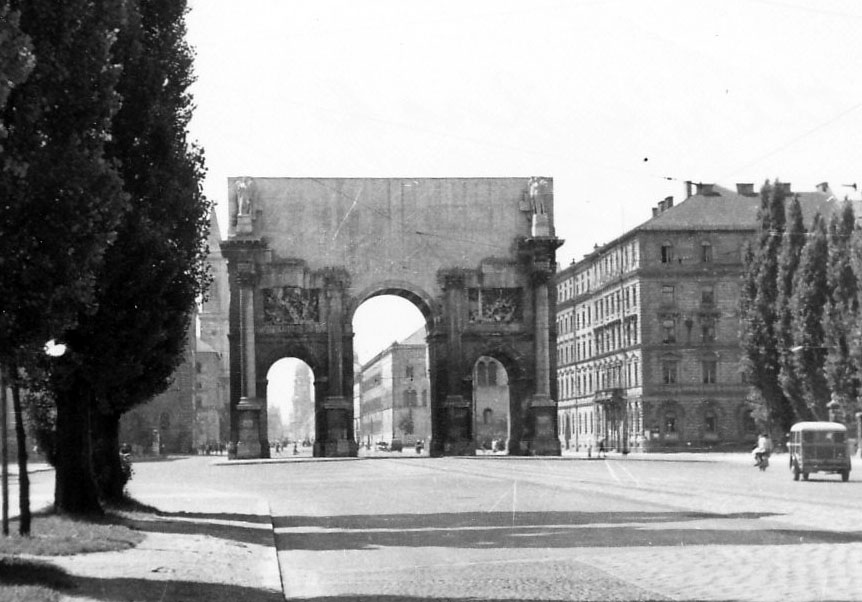
Hitler's Arch, Munich 1951
Hitler’s Arch, Munich 1951
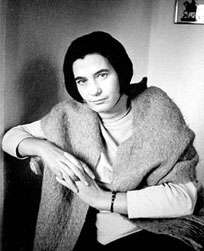
Christa Wolf
Christa Wolf
Memorial Day brings tangled memories of wars and their aftermaths. Wars have defined the last hundred years of America’s history—of the whole world’s history. Every generation has its defining war, and those of us who have lived through them never completely forget.

Christa Wolf, one of the best known novelists of postwar East Germany, died in 2011, but her voice is still alive. I have been reading her last book, City of Angels: Or, The Overcoat of Dr. Freud, a novel, more of a memoir really, of a year spent in Los Angeles in 1993 as a Getty fellow. Wolf was struggling to come to terms with the fall of the Berlin Wall in 1989 and the reunification of Germany. During that year the German authorities released a file documenting some interviews she had with the Stasi thirty years earlier. Her friends, her readers, and she herself were devastated by the revelation that she had been interviewed by the secret police and had apparently cooperated with them and talked to them about other writers.

My attitude toward Wolf was shaped by her earlier books documenting her childhood in Nazi Germany during the 1930s. She and I share a birthday, March 18, although not in the same year. She was born in 1929, close to me in age, and while she and her family lived through WWII in Germany, I was living through it in New York City. Her 1976 book Patterns of Childhood brought a jolt of recognition when I read it because for the first time I felt what a different person I could have become if I had grown up in Germany rather than America.

The first time I went to Europe, on a student trip in 1951, several countries, and especially Germany, still showed many traces of war. To our group of American students, the war seemed long in the past, but we saw some of its reality then in the broken buildings, the armed guards at the border of the Eastern Zone, and the rationing that still lingered in the UK. As I looked at the faces of people in the streets of Germany I wondered what they thought of us and whether they would ever forget the bitter hatred that divided us from them for so many years.

Now, reading City of Angels, I am more conscious than ever of how long wars linger in memories and attitudes. No one ever leaves a war behind even though we do not remember exactly how we felt or even what we did during different times. How did I feel about the internment of Japanese-Americans during the war? I am sure I never questioned it, neither did my parents. We believed our government was always right and Japan and Germany were always wrong. Yet people who lived through that internment will never forget. And most Americans agree now that it was unnecessary and cruel.

On this Memorial Day, the idea that stays in my mind and keeps me from enjoying a holiday is knowing that during the years since World War II, America has fought so many wars and created so many bitter memories for new generations. War has become our permanent state. Children who have grown up with drone attacks killing their families and friends and with sudden outbursts of gunfire on streets they walk down to school, will never forget. Seventy years from now the memories will still be there poisoning their lives and the lives of their children and grandchildren.

Sometimes it is good to go back and look at a war through the eyes of someone on the other side. Were they really so different? Were all the bombings and the imprisonments and the frenzy of anti-Communist rhetoric really necessary? The world goes on just about the same as ever—no better and probably no worse. There are evil deeds that must be punished, and individuals who should be kept out of society, but is mass killing ever the answer? We need to spend more time listening to the people who suffer and are displaced because of our endless, often pointless, quarrels. Those are the voices we need this Memorial Day, not the speeches of glib politicians.

Christa Wolf’s books, City of Angels, Patterns of Childhood, and several others are available in most libraries, a few bookstores, and of course on Amazon. Another book I highly recommend is a collection of poetry by German women called After Every War, translated by the Irish-born poet Eavan Boland, who teaches at Stanford University. You will find some unforgettable voices of people who lived through the turmoil of two world wars and commemorate the losses those brought. I can’t forget the words of Rose Auslander, “My key/has lost its house.” (I can’t quote the whole poem, because of Copyright rules, but it is worth searching out and reading.)

Today we remember the losses that all wars bring. Let’s try to put an end to the continuing losses we are causing year after year after year.

Queen Victoria and Angelina Jolie–two courageous women

Queen Victoria's family
Queen Victoria’s family
Angelina Jolie, the beautiful film star who has been at the center of so many media stories, has reached new fame with her decision to have a double mastectomy as a way to avoid breast cancer. Her decision has sparked some controversy, but also an outpouring of informative stories describing different types of the breast cancer and different options for treatment. Ms. Jolie’s candid explanation of her choice in a N.Y. Times op-ed piece has encouraged more discussion about the risks women face. She joins a long line of prominent women who have had the courage to try new solutions to women’s enduring health issues. One of the most surprising of them was Queen Victoria, the ultra-proper ruler who presided over the stringent rules of the Victorian era, showed courage in taking the initiative in her own healthcare.

More than 150 years ago Victorian women endured an often painful and sometimes dangerous succession of childbirths. Even Queen Victoria, despite her position as monarch of the British empire and the most powerful woman in the world, went through the same pains of childbirth as she bore nine children in fairly quick order. Having many children and enduring the struggle of their births without complaining was a demonstration of her status as a virtuous wife. But eventually even Victoria felt rebellious, it seems, and her loving husband Prince Albert, agreed with her that she deserved some help in easing the pain of childbirth.

Although women had been seeking relief from the pain of childbirth for centuries, when anesthesia finally became available during Victorian times, many people condemned its use. Men of religion proclaimed that if God had wanted childbirth to be painless, He would have designed it that way, so using anesthesia was against God’s wishes. The pain of childbirth was described by at least one English minister as suffering that women owed to God. There were few women ministers at that time to argue against that. Finally women began to demand some easing of their pain. We can imagine the arguments in homes across the Western world as women began to demand relief.

When Queen Victoria led the way by having chloroform administered during the birth of Prince Leopold, she gave courage to many women across England. Just like Angelina Jolie today, her decision was reported in the news and started conversations and discussions. Nowadays some women choose to have childbirth without anesthesia while others prefer the medication. Either decision is accepted as a woman’s right. In just the same way, Angelina Jolie’s decision to choose preemptive mastectomy will broaden the choices that women in her situation feel empowered to make.

Three cheers for the powerful women who have the courage to set an example that gives other, less well-known women, more choice in their lives!

No fairytale life at the palace for Fanny Burney

Many a young girl, I suspect, has dreamed of being a lady-in-waiting to a queen. The words conjure up a life of glamour and excitement, and the possibility of meeting Prince Charming. But when Fanny Burney was asked to serve Queen Charlotte as Second Keeper of the Robes, she had a feeling it would be a disaster. Instead of having time for her writing, she would be required to wait on the queen at least three times a day, to help her get dressed, to choose her ornaments and fan, and to help dress her hair. Charles Burney, Fanny’s father, was proud to have his daughter serve in the Court and strongly encouraged her to take the position. She would receive an apartment of her own and 200 pounds a year, a nice supplement to the family income.

The court of George III was not known for its culture or style. Fanny went there in 1786 and served almost five years, but she found Court life stifling. Fanny admired Queen Charlotte because of her high moral standards, but the queen was not a well-educated woman and was not interested in books or intellectual discussion. After Fanny’s life at home associating with artists, musicians and writers, the endless rules and formality of court life were hard to accept. Everyone was required to back out of the presence of the King and walking backwards in a long skirt was a difficult skill to master. Fanny knew that it was her success as an author that led to her appointment at the Court, but she found the monarchs knew little about her books. In her diary she recorded this conversation with the king:

“How came you—how happened it—what?—what?”
“I-I only wrote, Sir, for my own amusement,–only in some odd, idle hours.”
“But your publishing—your printing,–how was that?
“That was only, sir, –only because—“
I hesitated most abominably, not knowing how to tell him a long story, and growing terribly confused at these questions;….
The What! was then repeated, with so earnest a look, that, forced to say something, I stammeringly answered—
“I thought-sir-it would look very well in print.”

Fanny found her life at Court far from a fairytale. Much of it was a series of difficult conversations with people who shared neither her interests nor her talents. To make matters worse, while she was still in this post, King George became ill and suffered bouts of manic energy and feverish behavior. No one knew the cause of his illness and no doctor could cure it; it wasn’t until the 20th century that his rare illness, porphyria, was determined to be the cause of his attacks of madness. Living through the attacks was difficult for the Queen and for Fanny who had to report to her on the condition of the king each morning.

It is no wonder that Fanny grew increasingly unhappy in her service to the Queen, and yet it was not easy to find a way out. She found it difficult to eat and lost weight, her anxiety made her breathless and dizzy. She tried several times to resign from her post, and her friends urged the Queen to let her go, but it took months before her wish was granted and she could return to live with her family again.

Fanny Burney's tombstone
Fanny Burney’s tombstone
From that time on, Fanny Burney’s efforts to make money were all turned toward writing, and she was successful with her novels. It is nice to think that he life was made happier by a late marriage to a French aristocrat, Alexandre d’Arblay, a refugee from the French revolution. The marriage was a happy one and the couple had one son. Fanny continued to write to support her family; she endured a mastectomy without anesthesia, and lived to be 88 years old. Her books are still available online and in many libraries as well several biographies of her. One of the more recent ones is Fanny Burney by Claire Harman, a fascinating introduction to a woman worth knowing.

Fanny Burney–an Indie author from the past

Title page of EvelinaEngraving of Fanny BurneySometimes when the news seems impossible to bear, as it has these past few weeks with the tragedy in Boston and suffering in Syria, I turn back to the past to escape the dreadful present times. Of course, the past isn’t any better than today, but at least the pain of those days has passed and people survived despite all their troubles. One of my favorite periods of the past is the 18th century, when manners were formal and civility masked much of the cruelty of the times.

One of my favorite people of the 18th century is Fanny Burney, a woman born in 1752, who was considered so dull and backward by her family that she was never educated at all. The Burney children grew up in a busy household because their father was a popular music teacher and had many students from the London’s society world. Her brothers and sisters were given tutors or sent to school, but poor Fanny grew up a silent watcher of what went on in the world around her. When she was eight years old she still could not read and no one noticed how or when she finally caught on to how to do it. But reading led to writing and eventually Fanny was able to use her hours of quiet observation to write a series of novels that expertly caught the social life of the times.

Fanny was eager to publish her book, but unlike today’s authors, she tried to do it secretly. She arranged with a bookseller to print her book and distribute it and watched and waited for it to be discovered. Like most writers even today, she sometimes worried about putting her work before the world. In her diary she wrote:“I have an exceeding odd sensation, when I consider that it is now in the power of any and every body to read what I so carefully hoarded even from my best friends, till this last month or two; and that a work which was so lately lodged, in all privacy in my bureau, may now be seen by every butcher and baker, cobbler and tinker, throughout the three kingdoms, for the small tribute of threepence.”

Despite her fears, she was thrilled when she was told by friends and relatives that they had discovered a remarkable new book. She was pleased to listen to an aunt read the book to her invalid brother and laughed to think they had decided it must be the work of a man. Soon enough however, her family and others learned who the true author was and Fanny Burney was launched on a new and illustrious career as one of England’s most popular authors. Jane Austen loved her books and was influenced by her success. The quiet girl became a favorite in society; she served as a lady-in-waiting for Queen Charlotte. Then, in a development worthy of her own books, she married happily and had a son. She suffered many of the trials that have become familiar in modern life, including breast cancer, but she survived.

Best of all, her novels and diaries are still readable and available in most libraries as well as incredibly inexpensively online. In fact I’m going to search out my Kindle and read my 99-cent version of Evelina. I’ll write more about Fanny next time.

Sarah Losh–pushing the boundaries for women

Sarah Losh
Sarah Losh

When Sarah Losh turned 18 in 1794 in Northern England, one of her uncles described the social scene she faced: “The men gave themselves airs and seemed to consider dancing as too much exertion, while the ladies sat like so many animals waiting for a purchaser.” Sarah decided not to enter the marriage market but to build her own life and do as she wanted. She was lucky not to have to marry for money, because she was a wealthy heiress and she and her sister Katherine inherited their father’s estates in Cumbria.

Sarah and Katherine had been well-educated. Their family were merchants and intellectuals who believed in rationality, science, and manufacturing. They participated in the beginning of the industrial revolution which brought railroads and factories into even the rural village of Wreay where the family had lived for generations. But Sarah and Katherine appreciated the history of their community as well as its future and tried to preserve its buildings and celebrate its past. They traveled to France and Italy and learned about the culture and art of Europe. Sarah decided she wanted to design buildings for her community and became a self-taught architect.

The unusual and lovely church of St. Mary’s in Wreay is her major monument, but it is not the only building she financed and planned. She also built schools and a home for a school teacher. Jenny Uglow has written a fascinating biography of Sarah Losh called The Pinecone, which is now available in libraries and bookstores.

St. Mary's Church (photo by Alexander Kapp)
St. Mary’s Church (photo by Alexander Kapp)

The title comes from one of Sarah’s favorite decorative motifs, the Scots pine, Britain’s only native conifer. Reading the book gives us an appreciation of how a woman, even in those times, could build a satisfying life by pushing beyond the limits society would place on her.

Even today few women become architects, and that seems curious to me because women are so often the people who care most about buildings—houses, schools, churches. They decorate and sustain the buildings, but not too many of them design and build them. One contemporary woman architect has written an account of her life in her chosen profession and how it became intertwined with her family and social activism. That is Wendy Bertrand whose book Enamored with Place is available at her website and well worth reading. So let’s celebrate all the women who have widened the world for girls and women everywhere by pushing the boundaries of women’s work and place in the world.

The queen who looked at a cat–Mary Queen of Scots

Cat embroidered by Mary Queen of Scots
picture of Mary Queen of ScotsWe’ve all heard the expression “A cat may look at a queen” but Mary Queens of Scots was one of the few queens who looked closely at a cat. You must remember Mary, the beautiful queen of Scotland whose implacable enemy Queen Elisabeth I put an end to the dream of her becoming Queen of England. Back in the 1500s, women had very little power, but queens were a special sort of women. Because of their bloodlines, men could not ignore them and if the queens were clever, they could sometimes manipulate the courtiers around them and build a satisfactory life for themselves, their families and their countries.

Elizabeth I was clever enough to maintain her throne for 44 years and to lead her country through a stable and prosperous period. She chose the unconventional path of remaining unmarried, leaving the possibility of a royal marriage open for as long as possible so as to keep her enemies guessing about where she would form alliances. Mary was not nearly so clever—or so lucky. She loved and married unwisely and was bullied by various factions in Scotland, England, and France including especially Elizabeth, who feared that Mary wanted to take over her throne.

For many years Mary was a prisoner of Elizabeth’s and some of those years were spent in an uncomfortable, cold, drafty medieval castle of Tutbury in Staffordshire. The castle had been built many years earlier and repaired infrequently so it had become extremely damp and had a marsh underneath it from which “malevolent fumes arose, unpleasant enough for anyone and especially so for a woman of Mary Stuart’s delicate health” according to Mary’s biographer Antonia Fraser. Nonetheless, Mary was stuck there and had to make the best of which. One of the ways she did that was by designing and executing lavish embroideries.

Embroidery is not considered a major art form, but for many years it was used to produce attractive pieces combining images with words and symbols that made them art works to read and understand as well as view. This picture of a cat is one of the most straightforward of her pieces. Look at how carefully she devised the cat, with its tale curling at the end as though she was about to twitch it at the mouse beside her. Did Mary think of herself as the mouse, quavering before Elizabeth the cat? I think perhaps Mary had a better sense of herself. She was the tall, impressive cat twitching her tail at the mousey attacks of her enemies despite the danger.

Somehow it is comforting to think that this woman, so harassed and troubled during her lifetime, left a legacy of beauty for generations who followed. And not only art, of course, she left a son who became King James I. Quite a legacy for a woman who lived in a time when all females were supposed to be submissive and quiet. By the way, if you want to read more about Mary Queen of Scots, you can follow her fascinating story in the biography of that name by Antonia Fraser available in almost every public library.

Charlotte Brooke–the woman who saved Irish poetry

Irish pattern in Connemara 1842
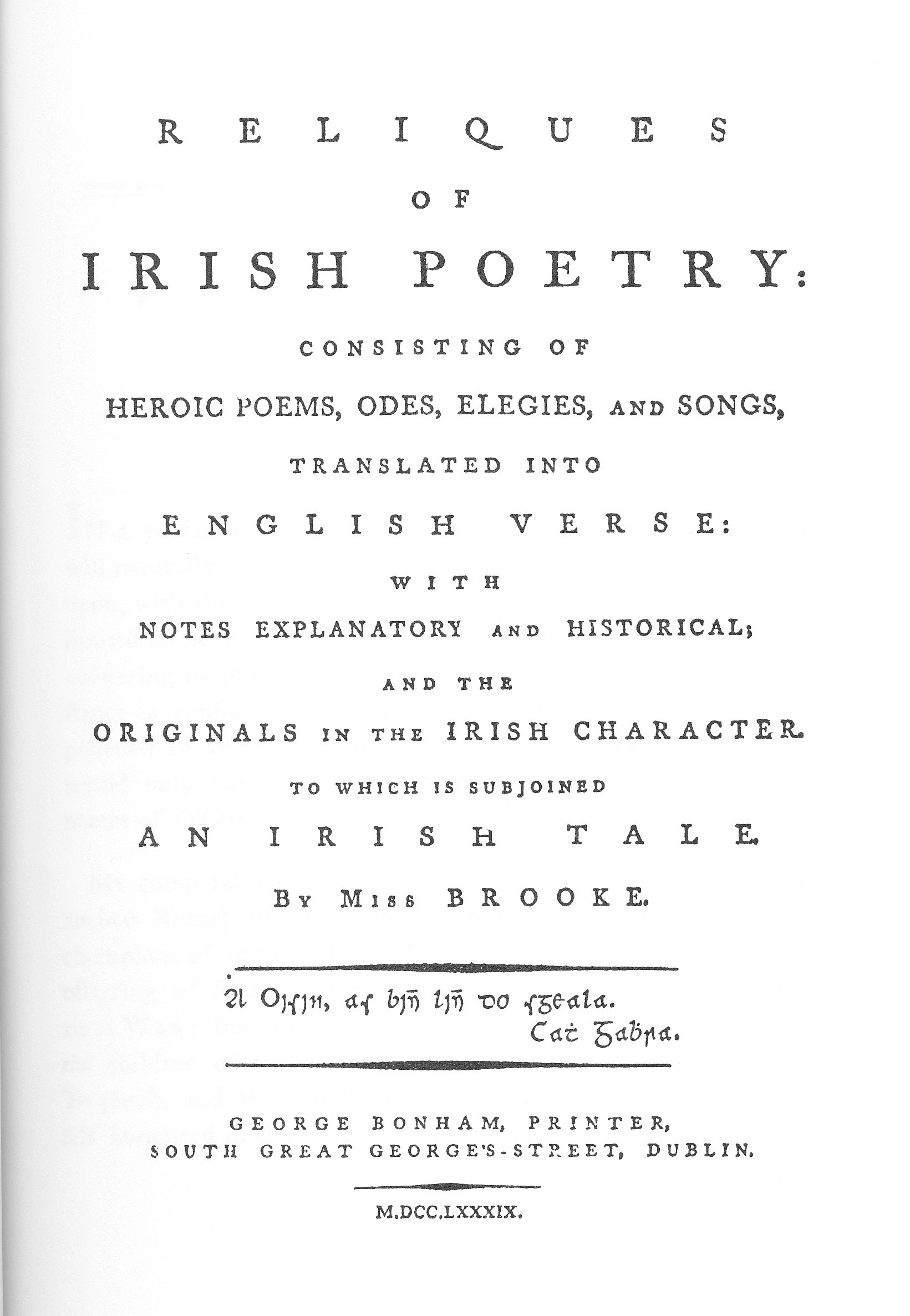
title page of Brooke book

When St. Patrick’s Day comes around, Americans burst out with a flood of t-shirts, shamrocks, and parades. This year we even have a story about snakes in Ireland as the NY Times writes about how prosperity made snakes a favorite pet for a few years. Snakes are not the most cuddly of pets, so many of them have been set free, bringing snakes to Ireland after all the centuries of being free of them, courtesy of the legendary saint himself.

Few of stories and celebrations of St. Patrick’s Day have anything to do with the culture or history of Ireland and many of the heroes of the country, as well as most of the heroines are unknown today. One of the most unlikely lovers of Irish culture was Charlotte Brooke, born in County Cavan in 1740 to an Anglo-Irish family. Her father, Henry Brooke was a well-known playwright of the time, so Charlotte was raised in a cultured, literary family. Many Anglo-Irish people were fond of Ireland and enjoyed living there, but they thought of themselves as quite separate from the Irish peasants who lived around them. Very few learned the Irish language or knew the native Irish people except as servants. In fact the English did their best to stamp out all traces of Irish Roman Catholicism, the Irish language, and all of Irish culture. Charlotte was an exception. She learned the Irish language and appreciated the beauty of Irish poetry and legends and she became determined to preserve the legacy from extinction.

While her father was alive, Charlotte, like a dutiful 18th century daughter, devoted herself to helping him in his writing of now long-forgotten plays. When he died, she took on the task of collecting his plays and poetry and preparing them for publication. It was only after she had accomplished all this that she felt justified in turning to translating some of the Irish poetry she had found. Like most writers of the time, she had to find sponsors to provide money for publication and find them she did. Finally her book Reliques of Irish Poetry was published in 1789. She published not only her translations but the original Irish texts that she had used. The importance of this work is confirmed by a listing on the Cavan County Libraries site which points out that this book “confirms her place in the history of Irish literature and acclaims her as a forerunner of the literary movement for the revival of Irish in the nineteenth century and the formation of the Gaelic League. This was the first time that a wide selection of Irish verse appeared in print.”

Despite the importance of her contribution to the study of Irish literature and the influence that she had on poets of the 19th and 20th centuries, Charlotte Brooke is almost forgotten today. Her translations sound old-fashioned, written as they are in the style of the 18th century, but some of them capture the vitality of the Irish originals and can be enjoyed by modern readers. My favorite is this touching elegy written by a young man for his wife:

Sad the bird that sings alone,
Flies to wilds, unseen to languish,
Pours, unheard, the ceaseless moan,
And wastes on desert air its anguish!

Mine, o hapless bird! Thy fate!
The plunder’d nest, the lonely sorrow!
The lost—lov’d—harmonious mate!
The wailing night, the cheerless morrow!

O thou dear hoard of treasur’d love!
Though these fond arms should ne’er possess thee,
Still—still my heart its faith shall prove,
And its last sighs shall breathe to bless thee!