What’s Happening at the Grand Houses of England?

How can anyone write a blog post today without mentioning Downton Abbey the PBS show that has a vast swath of Americans waiting impatiently for its Fourth Season debut tonight? For weeks, media outlets have offered tantalizing glimpses of what is in store for Lord Grantham, Lady Cora and their family, friends and staff. Mary, the newly widowed eldest daughter, seems to be the focus of the new season, but others in the show have more unusual roles and play more historically resonant characters.

Lady Cora joins the ranks of the real-life American heiresses who married British aristocrats during the tail end of the 19th century and the beginning of the 20th. Like Winston Churchill’s mother, Jennie Jerome Churchill, Lady Cora represents the marriage of American wealth with British titles. The privileged lives of the upstairs contingent of the Downton Abbey cast are puritanical compared with the scandalous behavior of the real life counterparts of Edwardian aristocrats. Jennie
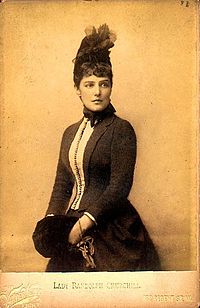
Photo of Jennie Jerome
Jennie Jerome before her marriage
Churchill was reported to have had many lovers, but that didn’t prevent her from playing a central role in aristocratic society. And unlike Lady Cora, Lady Churchill did not appear to be very involved in the upbringing or lives of her children. As a child Winston Churchill seldom saw his mother who relied on nannies and servants to care for her children. Compared with the Churchills, the Grantham family seems middle-class; they are almost modern helicopter parents, concerned in the day-to-day struggles of their daughters, their servants and their relatives. And who among us can imagine Lady Cora having an affair with another man?

Perhaps this season’s series will concentrate on Lady Mary and her adjustment to widowhood. There will be suitors no doubt, but it seems like an old, old story that we’ve seen many times before. Much more interesting would be following the adventures of Lady Edith, who is tempted to move to London and take up with a man married to an insane woman. Barred from divorce by English law, Edith’s admirer will have no choice but to persuade her to accept a status as mistress. Will she be willing? I can’t help hoping that she can build herself a fine career as a journalist, move in with her lover, and have a far more exciting life than could ever be found at Downton Abbey.

And then there is Daisy. Will she take on the farm that her father-in-law is trying to give her? Instead of being a kitchen maid, or even the family cook, she could become a successful farmer and build herself a new kind of life. Her story would be far more fun to follow than poor Mary’s. After all Mary is stuck with living in the Abbey until her son can take the reins of managing the house. No matter which suitor she accepts her life is pretty well laid out.

In fact, the downstairs contingent of Downton Abbey have more to look forward to than their counterparts upstairs. The 1920s brought in sweeping changing which meant upward movement for the hordes of women and men working in domestic service. Leaving the grand mansions to become factory workers, shopkeepers, teaches, nurses and other possible new jobs gave them far more independence than they ever had before, while their “betters” struggled to keep their outdated lifestyles going. Let’s hope the producers give us a glimpse of the new world opening up for so many former servants after World War I.

In between episodes, if you want to find out more about the American heiresses who traveled to England to marry, read To Marry an English Lord by Gail MacColl and Carol McD. Wallace. It paints a lively picture of transatlantic entanglements that helped draw our two countries together.


We Have Enough Veterans

Last night on the TV news, the signoff story was about Veterans Day. “Tell us about how a veteran affected your life” said the anchor. How to begin? When I was growing up, all the men I knew were veterans. On long Thanksgiving afternoons my father and uncles would sit in the living room smoking cigars and telling stories of their army days. My brother was allowed to sit and listen to them while my sister and cousins and I helped our mothers and aunts in the kitchen. War was a closed male circle that we knew little about.

Service men and women

I’ll never forget one story my father told about his war—World War I. When he was in the Army on the Western Front, he and his company marched across a desolate battlefield. Wearing gas masks in case of attack, they stumbled across the fields and into a wooded area. When it became so dark that moving forward was dangerous, they were ordered to lie down and get a few hours sleep. My father was lucky to find a spot on the ground that was not too rocky and he slept soundly. When morning came the men woke up and saw that the soft spots they had found and where they had rested their heads were the bodies of dead German decomposing in the mud. The horror of that morning discovery never left him. Even though he returned home safely, married and raised a family, and led a successful life, the scene was still in his head. Even when he was close to death at the age of 93 he could recall those grim hours on the battlefield seventy years earlier.

All veterans have been marked by their experiences. Some of them are scarred so badly they can never be the same; others seem to return to everyday life without deep trauma, but all of them remember. All of America’s wars—all of the world’s wars—have left indelible scars on those who fought in them. William Dean Howells, the American novelist, describes the impact of the Civil War on President James Garfield. At the sight of these dead men whom other men had killed, something went out of him, the habit of a lifetime, that never came back again: The sense of the sacredness of life and the impossibility of destroying it,”

The Civil War, the two World Wars, and the Korean War were almost universally felt by Americans. Every family had people serving, every community lost friends and neighbors. The wars since then have directly affected far fewer people, but those who served come back with the same kind of memories and scars. We see Vietnam veterans among the homeless on our city streets, and Iraq and Afghanistan veterans in our colleges and workplaces. Some of them carry physical wounds that will affect their lives and the lives of their families for decades to come. Others carry only memories that are not visible to the rest of us, but which will live with them all of their lives.

And yet we continue to have more wars and more veterans. Why can’t we remember how terrible it is? Why do we forget so much of the pain and suffering? I recently read Julie Otsuka’s book When the Emperor Was Divine which gives a vivid account of the unnecessary pain we Americans inflicted on people of Japanese ancestry who lived among us. Many veterans of the Japanese internment camps are still alive and still carrying memories of the pain of their exclusion from the country they had chosen.

The drones we are sending now to bomb people in the Middle East are creating more memories and more suffering. Children in Pakistan today who lose family members to American drones will carry that pain through most of the 21st century. More wars—more veterans. When will it ever stop? When will the world learn that we already have enough veterans to honor? Let’s honor the veterans we have and work to prevent more wars that will continue the cycle of suffering and remembrance forever.

Celebrate Women’s Equality Day

August 26, 1920 was the day that American women finally got the right to vote. It took a long, hard fight to win this right. Let’s celebrate!

Everybody counts in applying democracy. And there will never be a true democracy until every responsible and law-abiding adult in it, without regard to race, sex, color or creed, has his or her own inalienable and unpurchasable voice in government. -Carrie Chapman Catt

Prof. Lee Lorch, a long-lasting light in a dark world

Almost twenty years ago, in 1994, I made my first trip to Cuba as an adult. I had visited as a child with my family during Lee Lorchthe days of close U.S.-Cuban ties, but after Fidel Castro’s successful revolution, it was difficult for Americans to travel there. The 1994 trip was to a conference of the International Federation of Library Associations so participants came from all over the world. The trip was an eye-opener for all of us as it gave us a chance to see for ourselves what Cuba was really like. For me a special bonus was getting to know Lee Lorch, a most unusual academic and activist who has had an impact on people and events in several different societies.

Lee contacted me through mutual friends to see whether I would join an effort to send secondhand computers to Cuba. Having seen the shortage of technology in the schools and libraries in Cuba, I was glad to participate. As time went on I discovered that helping Cuba was only a small part of Lee Lorch’s efforts to improve the world. As a mathematician at York University he taught students and wrote scholarly papers, but being a scholar wasn’t enough for him. He had spent many years fighting racism in the United States and every time I met him there were new revelations about events he had participated in. He fought to open an apartment complex in New York City to African-Americans; he and his wife escorted students into the newly-desegregated Little Rock High School during the turmoil of school desegregation. He lost teaching jobs and had to move from one university to another as his notoriety grew.

In 1959, Lee and his family moved to Canada when he took a position at the University of Alberta. Later he moved to York University in Toronto. After all the turmoil of his life in the U.S. he found friends and a new life in Canada, and he never gave up fighting for justice. One of his interests was to encourage women mathematicians who were routinely discouraged from entering the field and often treated unfairly if they persisted.

People today find it almost inconceivable that even in the 20th century academics openly discriminated against non-white people and women. Until you read the story of someone like Vivienne Malone Mayes, it is hard to imagine the determination needed for women, and especially African American women, to be accepted in science and mathematics. Lee Lorch was among the pioneers in encouraging women to enter the field and in supporting their efforts for advancement.

I know I am late in finding out about this, but it made me very happy to learn that last year Professor Lee Lorch received a distinguished scholar award from CAUT—Canada’s organized voice of academic scholars. At the age of 97, he has participated in many struggles for justice and fair treatment for all people. He is a credit to the universe, and I hope the honors continue to flow during these crowning years of his long life.

Sisters on the Go

When we think of the great travelers and explorers of the past, we usually think of men—Marco Polo, Christopher Columbus, Stanley and Livingstone—but there are many women who feel the lure of travel too. Even in fairy tales when it was usually the prince who went wandering through the world seeking his fortune and/or a beautiful princess, there were also girls who went on journeys.

Do you remember the story of Snow White and Rose Red, who lived deep in the forest with their mother and

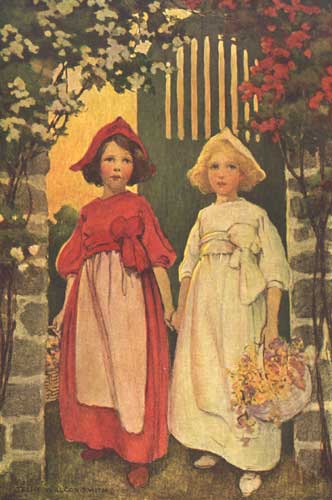
Snow White and Rose Red by Jessie Willcox Smith, 1911
were kind to a bear that came asking for shelter one snowy night? These two sisters roamed through the woods and kept meeting an unpleasant little dwarf who got into terrible scrapes by having his beard seized by a fish in the river, or caught in a log the dwarf was trying to split. Each time they met, the girls saved the dwarf from harm, but he only screamed and harassed them for their trouble. Finally one day they came upon the dwarf looking over his collection of precious jewels in a quiet glade in the forest. The dwarf was angry that they had found him and started screaming at them but just then the bear came out of the woods and killed the wicked dwarf. Sure enough, as usually happens in fairy tales, the bear turned into a handsome prince ready to marry Snow White and his equally handsome brother married Rose Red. The moral being, I suppose, that sisters who travel together may come upon great treasure and happiness to share.

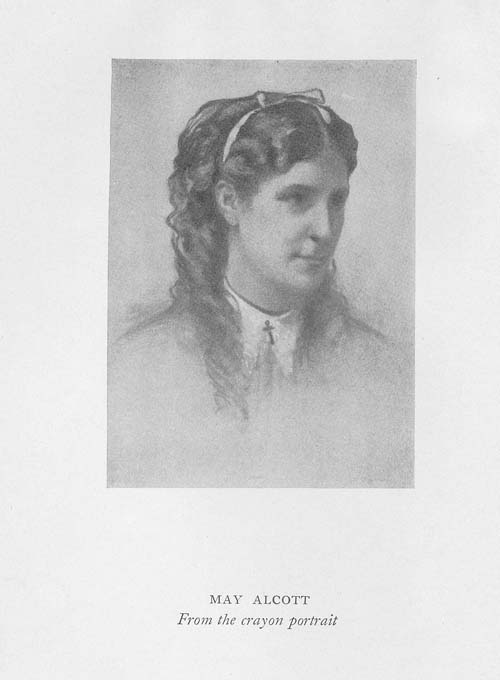
Real life sisters, of course, were rarely so lucky. Still, travel sometimes brought new adventure, professional growth, and even a loving husband. Louisa May Alcott and her sister May, traveled to Europe together after Louisa had found success with the publication of Little Women. Her sister May wanted to be an artist, but facilities for studying art were limited in the Boston of the 1860s, so the two set off for Europe. They traveled through England, France and Italy and for the first time had a chance to study the great European art they had only read about. When Louisa went back to America to help their ailing mother, May lingered in Europe to continue painting.

May Alcott
May Alcott
There she met a young Swiss businessman named Ernest Nieriker who encouraged her art. The two fell in love and married, although their happiness was brief. May died in childbirth and never had time to become the great artist she dreamed of being. Perhaps she never would have reached that goal, but at least she had a chance at it, and she found love and happiness through the generosity and companionship of her sister Louisa who made her travel possible.

Traveling to Europe became much easier for American women as the years went by. When I graduated from college, my sister and I went on a summer-long student tour of Europe. Today I posted on my website the journal I kept during that trip in 1951. If you go to the top of this page and click on the link to “Europe Summer 1951” you will find that journal, including the black-and-white photos of a postwar Europe much less crowded and much less prosperous than it is today.

Does history have to be true?

Millions of viewers saw the Academy Awards on Sunday evening as Argo won the award for best film. People who have seen the movie mostly agree that it’s a fine adventure film based on the story of the American hostages who escaped from captivity in Iran in 1979. Everyone seemed happy with the award except for the Canadians who were chiefly responsible for the escape. Somehow the adventure had turned into a CIA caper instead of an appreciation of the help of Canadians, and especially ambassador Ken Taylor, who had planned and carried out most of the successful escape.

Does it matter that a movie gives credit to the wrong people in a film based on real history? It certainly matters to Canadians, especially to those who know and respect Ken Taylor, the former ambassador who was central to the story. Former president Jimmy Carter, who was president at the time of the escape, was one of the few Americans who tried to set things straight. He credited Canadians with being responsible for 90% of the planning and execution of the escape.

In an unusual happy ending, producer and director Ben Affleck worked to set the matter straight by changing a final line in the film to credit the Canadian contribution as an “example of international cooperation” according to newspaper reports. Ambassador Taylor was flown to LA for the Academy Awards ceremony and the story ended with smiles all around.

But did it matter that history was distorted in the first version? It seems to me it does. As most of us are aware, we often get of information about history from movies, television, and fiction. If entertaining stories are based on history, the least their authors can try to do is get the facts straight. The Argo story was corrected because there are many people still around who remember the events. Many other historical events are distorted in films for the sake of building tension or glorifying a hero or some other motive, but those of us who care about understanding the world ought to protest. While we will never know all the facts of history, at least we can try to present honestly the ones that are verified.

Seeing Vermeer

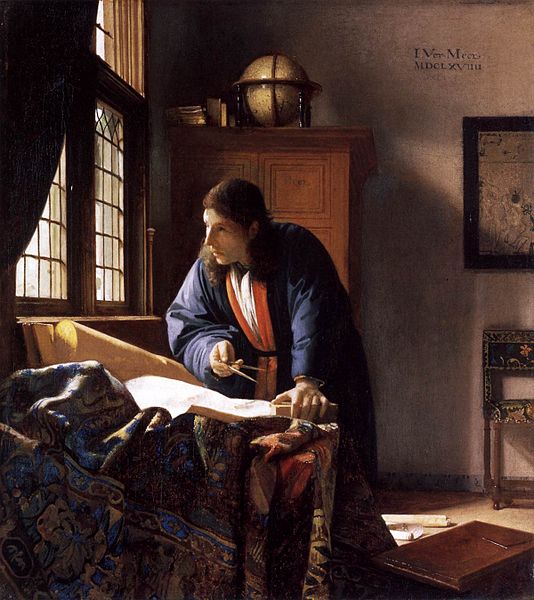
Vermeer's The Geographer
Vermeer’s The Geographer
San Francisco is full of talk about Vermeer these days because a new exhibit at the DeYoung Museum is attracting crowds of people to see the famous Girl with a Pearl Earring and other paintings of the Dutch Golden Age. The Vermeer show seems to be attracting almost as many people as the Impressionists did recently.

Why does Vermeer attract so many viewers? The sheer beauty of his work, the light and color that infuse his paintings are surely part of the attraction, but it seems to be more than that. Vermeer shows real people in an intimate world that we can recognize even though the details are far removed from the 21st century. Many of his paintings feature women, which surely is an attraction for the female majority among the museum-goers. Vermeer shows women in everyday scenes, playing a musical instrument, reading a book, chatting with an attentive gentleman,

Vermeer's Lacemaker
Vermeer’s Lacemaker
making lace. Well, all right, very few of us make lace these days, but most of us have handled a needle and thread if only to sew on a button.

There is a fascinating book called Vermeer’s Hat by Timothy Brook published a couple of years ago, which is not a study of Vermeer’s paintings, but an introduction to his world. Starting with the hat Vermeer features in several of his pictures, Brook expands on the number of items that Vermeer shows us which give us clues to his world. At first glance the pictures show us what seems a mundane world of domestic comforts, but knowing the background of some of the items lets us see them as keys to a new world. The hat brings up the subject of beaver fur and how important the fur trade was in opening North America to trade with Europe. Who knew?

The map on the wall in Vermeer’s rooms as well as his painting of The Geographer poring over a sheet on which he is presumably drawing a new map, shows us a world that was growing beyond the boundaries of Europe. During the 1650s and 1660s when Vermeer was painting, scientists and explorers as well as merchants were finding that the world was much bigger and laden with greater treasures than they had dreamed of. The history behind Vermeer’s paintings expands our understanding of why they appeal to us so much. The people seem alive because their world was opening up to them and the more we know about and enjoy their world, the more we can understand the possibilities in ours. It’s a perfect example of how looking at the past informs our feelings about today.

Who was Helen Jewett and what was her profession?

Prostitution is one of the oldest professions in the world but aside from stories about the horrors of human trafficking we seldom hear much about it. Prostitution has flourished throughout history, but the individuals who work in the sex trade mostly keep a low profile. Even today

Sex worker statue in Amsterdam.

there are very few places except Amsterdam where sex workers are acknowledged and even honored by a public statue. In past centuries, prostitution was a topic often whispered about but seldom mentioned in public.

English majors may have read the Victorian novels that portray “fallen women” as outcasts aware of their pariah status. Remember Nancy in Dickens’ Oliver Twist who described herself as an “infamous creature” and is brought to tears of joy when a “respectable” woman says a kind word to her? Dickens was sympathetic to the problems of prostitutes, but he still portrayed them as beyond the reach of normal life and in need of rescue. Was 19th century prostitution really like that? Was it populated only by outcasts who had been seduced and betrayed by a man and by wantons who had an abnormal desire for sex? Or is it possible that it was a reasonable career choice for some women?

Recently I came across a book about Helen Jewett, a young prostitute who apparently lived a comfortable life in New York City during the 1830s. She was suddenly swept into prominence by a violent crime that made her famous throughout the East, but she has long since vanished from history. Her death, of course, was tragic, but it is only because she died violently that we have learned about how the sex trade in New York operated during the decades before the Civil War.

The first surprise for many of us is to learn that prostitution was not illegal in New York, as it was in most states, at the time. The police did not care much about people’s private sex lives, although they might arrest women for disorderly conduct or vagrancy. Keeping a brothel was illegal, but the crime was not often prosecuted. New York was growing very quickly during these years and many young men poured into the city seeking jobs. Most people accepted the idea that young men would seek out sex and that the women who provided it were a normal part of it city’s population. Prostitution was not defended by respectable men, and middle-class women were assumed not to even know about it, but it wasn’t until the early 20th century that it actually became illegal.

All of this was the background for the story of Helen Jewett, who moved from Maine to New York and joined the ranks of those women earning their living in the sex trade. I will write more about her in my next post, but if you want the full story, you might want to read Patricia Cline Cohen’s well-researched book The Murder of Helen Jewett.

History as Entertainment

As 2012 ends, many people are looking back toward history rather than ahead. After all, what is ahead for us except the dreaded “fiscal cliff” a phrase designed to frighten us all. One of the major entertainment successes of the fall, aside from the inevitable fantasies of hobbits and talking animals, has been the story of Abraham Lincoln and his successful handling of a government crisis. RunningtheMachine-LincAdminThe popularity of this movie has pushed the history book on which it was based Doris Kearns Goodwin’s Team of Rivals to the top of the bestseller list here in San Francisco. It isn’t often that the general public agrees that history can be fascinating and can perhaps even give us insight into what is going on in the world today. We’ll never know how Lincoln would have handled the current fiscal crisis, but seeing how the men in that rambunctious Congress is certainly a reminder of what is going on in Washington today.

This sudden surge of interest in historical figures has cheered me as I look over the year’s progress in this blog. History is filled with figures who can both entertain and enlighten us. It’s a pleasure to read more about them and get to know them. Understanding how they thought and acted sheds a new light on what’s going on in our own world. One of the people who has been introducing women’s history to audiences for years is Bonnie Hurd Smith whose website and blog describe her busy life helping businesses and nonprofits craft their histories into stories for the public. Her book “We Believe in You” tells the stories of twelve women who made their mark on American history. If you don’t know her work, 2013 is a good time to learn about it.


Recognizing the Worth of a Woman

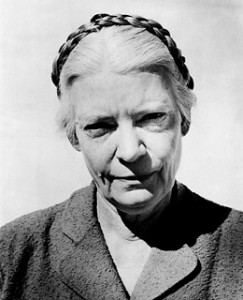
One small item in the New York Times this week that probably escaped many people’s notice concerned Dorothy Day, a woman I’ve written about in this blog before. She has been a hero to older liberal Catholics for many years, but her mission among the poor in America has faded from memory during the more than thirty years since her death in 1980. The article this week was about a move to canonize Dorothy Day and recognize her as a saint and it is being led by Cardinal Timothy Dolan, the rather conservative leader of the New York diocese.dorothy_day-243x300

For those of us who remember the 1950s and 1960s when Dorothy Day was leading a campaign for social justice and peace, her relations with Cardinal Spellman, a predecessor of Dolan’s, were frosty to say the least. Many of her followers, if not Day herself, considered Spellman a representative of everything that was wrong with American Catholicism at the time. I remember they delighted in calling him “strikebreaker Spellman” when the Cardinal appeared in a news photo digging a grave (or at least holding a shovel) in a cemetery to show his disapproval of a strike by the gravediggers. The Cardinal and Day disagreed on labor policy and on the measures needed to defend America, although they agreed on doctrinal issues. Dorothy Day led civil disobedience efforts to protest air raid drills in the city by refusing to take shelter when the sirens went off, a position that also put her at odds with Church leaders.

Now when so many people in this country have shifted to the right on issues of social justice, death sentences, and the value of voluntary poverty, many Catholic bishops appear to be closer to Dorothy Day than they have been in the past. Certainly she would approve their efforts to remind politicians that the drive for social justice for everyone, including the homeless, undocumented immigrants, and the working poor, is as much an American value as capitalism and entrepreneurial spirit. It is good to know that Cardinal Dolan is supporting a move to recognize the importance of the work Dorothy Day did to remind the world that the Catholic Church, like America itself, is a large institution that has room for many differing viewpoints and can support a variety of visions.