Flawed but not Forgotten–Maud Gonne

Why, what could she have done, being what she is?

Was there another Troy for her to burn?

William Butler Yeats

Maud Gonne was born in England into a wealthy family. Her mother died while she was a child. Maud and her sister were sent to a boarding school in France and grew up speaking both French and English fluently.  Her father, Thomas Gonne, who served as an officer in the British Army, spent time in many countries around the world. In 1882, when Maud was in her early teens, he was sent to serve in Dublin. At that time, he brought his two daughters to live with him. It was during those years that Maud got to know Dublin and observed the poverty of many of its people. These were difficult times in Ireland and Maud became a strong opponent of the British landlords who evicted tenants from their homes when crops failed and the farmers were unable to pay their rent. 

After the death of their father in 1886, Maud and her sister were sent to live with an uncle in London but were not happy there. Maud, who had grown into a beautiful young woman, decided to train to be an actress. Unfortunately, her career was cut short when she developed TB and was advised to move to a spa in France. In 1887, she came of age and inherited her share of her mother’s fortune. For the rest of her life, she was wealthy and had no need to earn money. She divided her time between France, England and Ireland and maintained a lively social life in each of those countries.
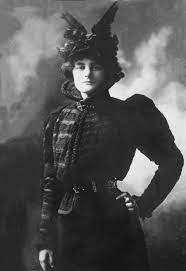
Maud Gonne

In Paris, Maud met Lucien Miklevoye and began her first serious love affair. Miklevoye was married, and a divorce was almost impossible to obtain in France, but the two of them remained devoted to each other for several years and eventually had two children, although the eldest died very young. As was usual in wealthy families, the children were raised mainly by a devoted governess. When Maud spent time in Ireland, she never acknowledged the children but referred to her daughter as her niece. Yeats, who was a close friend for many years, knew almost nothing of Maud’s Parisian life or about her children. He fell in love with Maud and repeatedly asked her to marry him, but she turned him down without apparently telling him about her relationship with Miklevoye or about her children. It was several years before he learned about Maud’s private life.

The 1890s were difficult years in Ireland, and Maud spent much of her time in Dublin working with other activists to oppose British rules. She supported the Boers during their war to drive the British out of South Africa and started a women’s association. She is credited with starting the Sinn Fein (“ourselves alone”) organization, which became a powerful anti-British association.

Gonne’s private life remained turbulent. She met John McBride, a hero of the Boer War, and married him. They had one son, but the marriage was not a happy one. In 1905, she sued for divorce in France (divorce was illegal in Ireland), but she lost her case and the divorce was denied. McBride later became a hero of the Irish republican movement and was executed by the British in 1916.

As the years went by, Maud became more and more anti-British and was accused of supporting the Germans. In 1918 she was jailed for six months after being accused of supporting a pro-German plot. During the years between the two World Wars, Gonne’s strongly anti-British feelings led her to support the anti-Semitic actions of German fascists. She never spoke out against the prison camps or the deaths of many Jews during Hitler’s rule. She did much good during her lifetime, but also sometimes supported cruelty and caused pain.   

A recent biography The Fascination of What’s Difficult: A Life of Maud Gonne by Kim Bendheim (OR 2021) tells the story of Maud Gonne’s life and achievements. The author gives a clear and detailed account of Gonne’s life, but mysteries remain. Maud’s own writings, including her letters and memoirs, are not always accurate and sometimes raise more questions than they answer. Perhaps we will never be able to understand all the complexities of Maude Gonne, but we can be grateful that her life inspired some of the best poetry written by one of the greatest poets of her time, William Butler Yeats. Perhaps he was thinking of her when he wrote these lines:

How many loved your moments of glad grace,

And loved your beauty with love false or true,

But one man loved the pilgrim soul in you,

And loved the sorrows of your changing face.
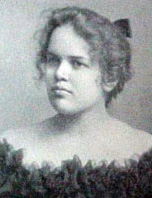
Adelaide Crapsey—Scholar and Poet

Some poems seem to be spontaneous outbursts of feeling—“My heart is like a singing bird…” (Christina Rossetti) or “Fear no more the heat o’ the sun/Nor the furious winter’s rages:” (Shakespeare). But poetry is not easy. Most of the poetry that we continue to read and to love is the result of many long hours of careful work.

One of the scholars who spent years studying metrics—the way words can be put together to achieve art—was a young American poet named Adelaide Crapsey. Although she died young and her work is often forgotten, she was an important writer of the early twentieth century. Her work continues to influence many poets today.

Adelaide Crapsey

Born in Brooklyn in 1878, Adelaide Crapsey and her family soon moved to Rochester, N.Y. where her father was pastor of an Episcopal Church. She was raised in a family that valued women’s education and Adelaide was encouraged to attend Vassar College. There she had a happy and successful educational life. She was president of the Poetry Club and graduated as valedictorian in 1897.

Two of Adelaide’s sisters died while she was in college, and Adelaide herself became sick with a severe illness that was later diagnosed as tuberculosis. After recovering and spending some time teaching, she went to Europe in 1904 to study at the American Academy in Rome. Although she was very happy in Rome, family problems prompted her return to the United States in 1905. Her father was accused of heresy by the leaders of the Episcopal Diocese, and he was brought to trial in 1906. He was found guilty of refusing to support the doctrine of virgin birth and lost his position with the Church after an unsuccessful appeal. He and his family had to leave the rectory.

Despite her desire to return to Europe, Adelaide chose to stay close to her family to offer support and encouragement. She taught at a private school and also continued to work on her scholarship and writing. Eventually she was able to return to Europe for a few months and while she was there she completed her book,  A Study in English Metrics, although it was not published until after her death. She returned to America when her tuberculosis became more severe and died in 1914 at the age of 36.

Adelaide’s study of metrics led her to investigate various poetic forms such as the Japanese haiku and tanka. She invented a new form of poetry called the cinquain and much of the poetry for which she is remembered uses this form. One example is this well-known piece:

November Night

Listen…
With faint dry sound,
Like steps of passing ghosts,
The leaves, frost-crisp’d, break from the trees
And fall.

Although Adelaide Crapsey’s poems are no longer included in many anthologies, you can find a good sample of her work at the website of the Poetry Foundation. https://www.poetryfoundation.org/poets/adelaide-crapsey

Another legacy of Adelaide Crapsey’s life is the effect her poetry has had on the teaching of poetry to school children. A simplified version of the cinquain has been introduced in many classrooms, for example:

Cinquain: (This is the format used in many schools—didactic cinquain)

  1. One word (subject)
  2. Two words
  3. Three words
  4. Four words
  5. One word (synonym for line 1 or five words to sum up the poem)

Many students, both children and adults, enjoy following this pattern and producing verses that can be satisfying both to write and to read.

Summer Beach

Ocean

Creeping waves

Tickling children’s toes,

Hurling broken shells against bare legs,

Triumph.

Adelaide Crapsey’s early death deprived the world of a notable poet, but it is some comfort to know that her work is still inspiring other writers.

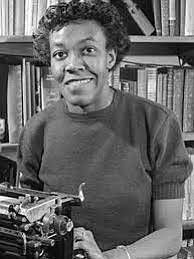
Gwendolyn Brooks—A Poet for Our Times

African American women have been writing and publishing poetry since colonial times but have not always been known and acknowledged. One of our earliest poets published in the United States was Phillis Wheatley. One of the best known, and most often studied African American women poets of the 20th century has been Gwendolyn Brooks whose birthday is celebrated this month.

Gwendolyn Brooks

Born in Topeka, Kansas, in 1917, Gwendolyn moved with her family to Chicago before she was a year old, and her work and success are closely identified with that Midwestern city. From early childhood, Brooks had few doubts about her career. Her first poem was published in a children’s magazine, American Childhood,  when she was thirteen years old. She continued to write and publish poems until she died at the age of 83 in 2000.

After graduating from a community college in Chicago, she worked for the NAACP (National
Association for the Advancement of Colored People) and continued to publish poems eventually appearing in the prestigious Poetry magazine. She was invited to join a poetry workshop where she met several other important African American poets including Langston Hughes who became a lifelong friend. She married Henry Lowington Blakely, Jr. in 1931 and the couple had two children. And year after year she continued to write poetry, which met with continuing success.

Her first book of poetry, A Street in Bronzeville was published in 1945. Her poems were admired by critics, and they were also read and cherished by a large popular audience. Brooks was able to write about the people of Bronzeville with warmth and an acknowledgement of the struggles of their lives.  In her poem “Kitchenette Building”, for example, she wrote of the difficulty of dreaming big dreams in a stunted environment:

But could a dream send up through onion fumes

Its white and violet, fight with fried potatoes

And yesterday’s garbage ripening in the hall,

Flutter, or sing an aria down these rooms.

The list of Gwendolyn Brookes achievements is a long one: She won the Pulitzer Prize in 1950, the first African American to be so honored. She added many other prizes too. In 1986 she became the Poet Laureate of Illinois. She also served as a consultant to poetry in the Library of Congress and was the first African American woman inducted into the American Academy of Arts and Letters.

Now, almost 25 years after her death, she is still honored and, more important, still read. You can read many of her poems on the Poetry Foundation website. https://www.poetryfoundation.org/poets/gwendolyn-brooks, and her books are available in almost all public libraries.

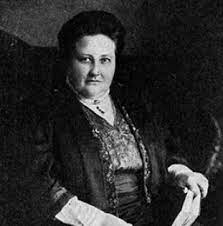
Playing Poetry with the Big Boys—Amy Lowell

What does a woman poet look like? They are frequently pictured as frail and waiflike.  Think of Emily Dickinson floating about her family home, a recluse dressed always in white; or Elizabeth Barrett Browning retreating to her sickbed to write her poems. Often these maneuvers have helped women to find time to do their writing and achieve the art they wanted. But not all female poets fit these stereotypes.

Today, to celebrate Poetry Month, we will talk about a poet who turned all these stereotypes around. Amy Lowell was never frail, seldom shy, and looked nothing like a waif. She was a strong, heavy woman who used her strength and power to influence the course of poetry in America and all of the English-speaking world.

Amy Lowell

Born in 1874 into an old New England family that had provided leaders for generations, Amy never suffered from a lack of money or influential friends and relatives. She attended private schools but was not popular with other girls. She grew up believing that she was ugly and of less value than her four brothers. She was not sent to college because her family believed that college was inappropriate for girls.

Instead of a conventional education, Amy turned to books and later to travel. When she was in her twenties, she started writing poetry. Her first work was published in the Atlantic Monthly in 1910 when she was in her mid-thirties. She may not have been an early bloomer, but once she started writing and publishing poetry, she had a major impact on the literary world. Her most famous poem, “Patterns” is still widely taught in schools today. The opening stanza introduced many American readers to a new type of poetry—free-flowing and often unrhymed.

I walk down the garden paths,

And all the daffodils

Are blowing, and the bright blue squills.

I walk down the patterned garden paths

In my stiff, brocaded gown.

With my powdered hair and jewelled fan,

I too am a rare

Pattern. As I wander down

The garden paths.

Source: Selected Poems of Amy Lowell (Houghton Mifflin Harcourt, 2002)

Amy Lowell was soon recognized as one of the most prominent modern poets of the early 20th century. She travelled to Europe and met Ezra Pound, Richard Aldington, H.D. (Hilda Doolittle) and others who were part of the imagist movement. She conceived the idea of publishing an anthology of imagist poetry, which she did in 1915. Unfortunately, she ruffled the feathers of some of the early leaders of the postwar literary scene, especially Ezra Pound, who suspected she was trying to take over the imagist movement. The ruling men of the poetry world did not welcome a woman intruding on their ranks.

Lowell not only wrote poetry and published anthologies she also went on speaking tours throughout America and England. She was a vivid presence on the stage and introduced many audiences to modern poetry. Her poems continued to be popular with the public throughout her life, although reviews by literary critics were mixed. Many of the men who dominated literary criticism found it difficult to accept a spinster who wrote about love and sexuality as easily as about more ladylike subjects. Lowell never married, but she had a long and loving relationship with her partner, Ada Dwyer Russell. The strength of their bond and what it meant in Lowell’s life was seldom mentioned, however, because of the prudery of readers and critics during that time.

During the early 1920s, Lowell took several years off from poetry to write a biography of John Keats, one of her favorite poets. During these years, unfortunately, her health deteriorated, and she died of a stroke in 1925 at the age of 51. The Keats biography was published after her death and in 1926, she was posthumously awarded the Pulitzer Prize for Poetry. You can read a detailed account of Lowell’s life and death in Carl Rollyson’s biography Amy Lowell Anew: A Biography (2013).

It is almost a century now since Amy Lowell died and she is often ignored or treated as a minor figure in the history of American literature. During the 1930s and 1940s her achievements faded from public notice as tastes in poetry changed. But critics are not always right in their assessments and, as many readers have found, Amy Lowell’s poems are well worth rereading. They speak to modern concerns just vividly as they spoke to the people of her time—like these final unforgettable lines of “Patterns”.

And the softness of my body will be guarded from embrace

By each button, hook, and lace.

For the man who should loose me is dead,

Fighting with the Duke in Flanders,

In a pattern called a war.

Christ! What are patterns for?