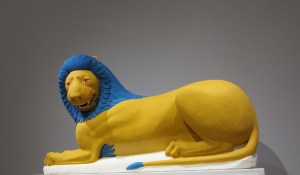
 Visiting the exhibit of colored Greek statues at the Legion of Honor museum here in San Francisco this week brought me a new perspective on classical statues.
Art scholars have known for years that the ancient Greeks painted their statues and that the pure white statues found in so many European and American museums today are not at all like the ones the ancient Greeks knew. Like every other human activity, sculpture changed over the years. The introduction of Christianity changed the direction of art in Europe and throughout the Western world. The image of snow white marble sculptures influenced the way people  thought about ancient Greece. Is it possible to see the statue of Socrates as it is shown in this picture and not associate it with austere, intellectual philosophy? Would we think of Socrates in the same way if he were portrayed in an orange or red toga with a busy, bright pattern?
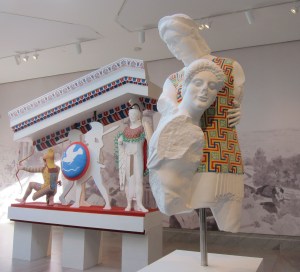
Do we ever truly know what an historical period was like? Can we ever really imagine how people thought and felt in times gone by?
It wasn’t until the 19th century that the sculptures of ancient Greece were sought out by people from Western Europe. Many of them had been neglected for years. The Parthenon in Athens Elgin Marbles had been used to store arms and the pediment sculptures that make up the Elgin marbles were neglected by the Turks who ruled Greece for many years. Eventually, many of the sculptures that decorated the Parthenon were brought to Western Europe—most famously to England, but also to Denmark, Germany and France.
The 19th century is much closer to us in time than the ancient Greeks were. But much of
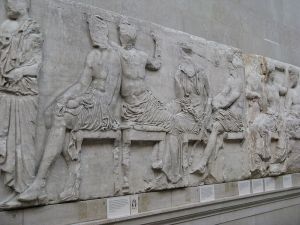
the story of the removal of the Elgin Marbles to England were still done in a period of history that seems foreign to us. Susan Nagel in her fascinating book Mistress of the Elgin Marbles: A Biography of Mary Nisbet, Countess of Elgin (2010) tells how Lord Elgin and his wife managed to persuade the Turks and some Greeks to help them move the sculptures to London. But their story also raises questions about how well we understand historical characters.
Lord Elgin was a noted spendthrift who had gambled away his own fortune and relief on his wife’s money to make his purchase and transportation of the Elgin marbles possible. The Nisbets were a devoted couple for several years, but bearing three children in three years made Mary very reluctant to continue having children. It is hard for us to realize how helpless wives of those times were in controlling their bodies and their frequent
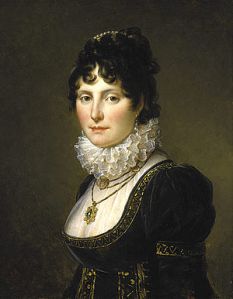
pregnancies. Without access to contraceptives, Mary Nisbet was entirely at the mercy of her husband. She was the wealthiest woman in Scotland, but that was no protection. Lord Elgin wanted a large family and Mary had no power. Eventually he managed to get a divorce—which took an act of Parliament—and take their three children away from his wife. He married a second wife and had seven more children.
Whether it is ancient Greek color schemes or 19th century marriages, the past is a constant surprise. We are always discovering new truths about it. Historians are kept busy discovering new records and old remains that offer different glimpses of our ancestors. Someday, no doubt, historians will be search back through our Facebook posts and Twitter feeds to discover what in the world 21st century people were thinking and feeling. Will they ever really know us?
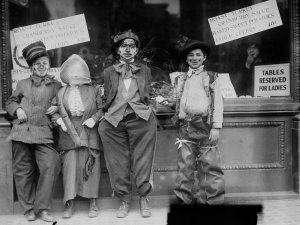 popular ways for children to have holiday treats was to dress up as ragamuffins and go from door to door begging for money. The ritual was mentioned in Betty Smith’s book A Tree Grows in Brooklyn. This tradition flourished in New York City for 50 years or more into the 1940s. There are still ragamuffin parades on Thanksgiving in some parts of Brooklyn and the suburbs. It wasn’t until after World War II that Halloween took over in most of the country as the holiday for dressing up and begging for treats.
 switched to a five-day workweek, the Thursday date left an inconvenient Friday hanging. Many schools and offices began giving people the Friday off, and that was the beginning of Black Friday—the biggest shopping day of the year. Merchants began offering special sales and encouraged everyone to start their holiday shopping as soon as Thanksgiving was over. We all know what that led to—stores started opening earlier and earlier on Friday morning and some have now spilled over into Thanksgiving itself.
 readers as well as many TV viewers choose to go back to earlier times. Somehow it seems as though life must have been simpler then, although the truth is that it wasn’t. Finding enough food for the family and keeping young babies alive was a lot harder than coping with an overcrowded bus on the daily commute.
 difficulty of judging guilt or innocence in a crime is a perennial problem. It will be interesting to see whether the TV version of Alias Grace treats the subject with as much depth as the book did.
 really want a glimpse of what it was like to be a servant in early 19th century England, you might want to read Jo Baker’s Longbourn, which gives a fascinating glimpse of the life of a servant in the service of Jane Austen’s fictional Bennet family from Pride and Prejudice. Admittedly Jane Austen wrote about an earlier historical period than Downton Abbey, but it is hard not to believe that Baker’s view of the world is far more realistic than the one offered by the familiar TV series.
 Utopia? Recently I discovered that they all have enough in common to share a space on the Internet in Utopian studies.

 behind. For several long days now the storm has been punishing the small island that dot the Atlantic between Florida and South America, islands that most Americans know almost nothing about. Still suffering the effects of centuries of colonial rule by European governments, most of those islands will find it much harder to rebuild homes and lives after the hurricane has passed than Florida and other Southern states will.
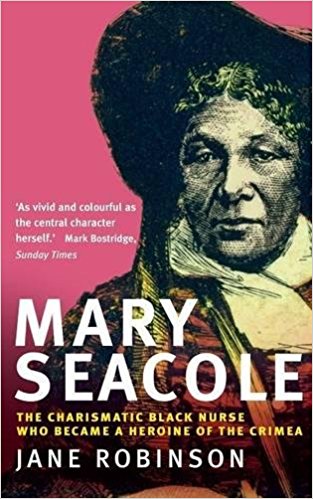 Mary Seacole was born in Jamaica in 1805 in the prosperous and attractive city of Kingston, the base of British operations in the West Indies. White British upper-class people controlled the island, while most Jamaicans of African descent were slaves. Mary’s mother was apparently of mixed-blood and was free, as were many children whose fathers were white. Mary herself writes in her autobiography “I am a Creole, and have good Scotch blood coursing in my veins. My father was a soldier, of an old Scotch family;”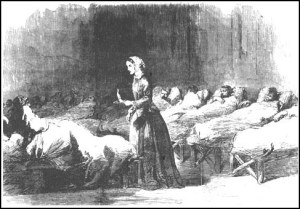

 Break, break, break,

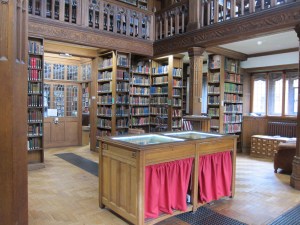

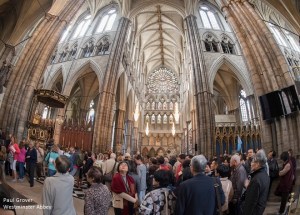 though one square and find a dozen ideas for stories or photos or music—whatever form your creativity takes. But I wonder how many of the great ideas that are born in vibrant cities like London ever come to fruition.
 Teacups and Tyrants-Adele Fasick looks at people, books, and history